
The Icarus Mission
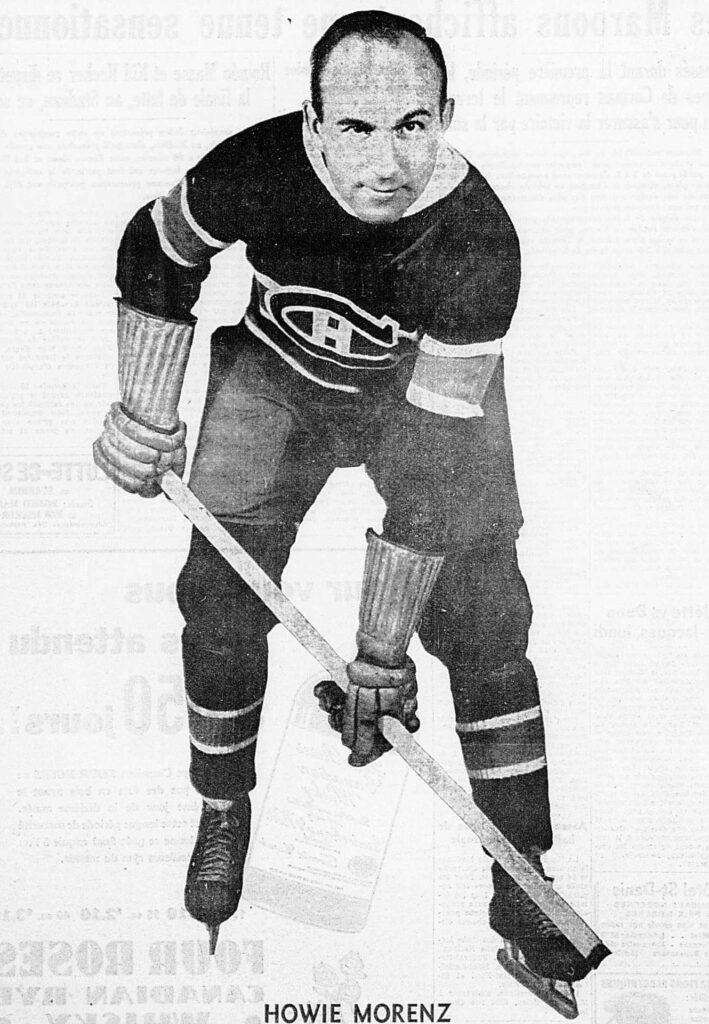
This is the game when Howie Morenz suffered what might have been a season-ending tendon injury to his right ankle in the latter half of the first period. It was an injury that would keep him out of the next three games, and impair his skating agility for the balance of the season and 10 playoff games.
The significance of the injury to his season and his career deserves a long discussion – as accidental as it was, just like the career-ending injury that shattered his left leg on January 28, 1937.
Rather than entering on that discussion here, I have decided that the better choice is to give space (not available in the book) to how marvelously he had been playing that evening of March 5, 1931. He would score important and elaborate goals again, but perhaps none that showcased all of his accumulated skills so well. And I will also offer a few thoughts about why he tried to continue to play that same night.
He had burst out of the blocks early in the first period with an extravagant and almost defiant demonstration of his athletic prowess as a hockey player. With barely 5 minutes gone in the first period, the teams were playing 5 on 5. Each team had a player on the penalty bench for unrelated infractions – Ivan Johnson for the Rangers, and Nick Wasnie for the Canadiens: The Montreal Daily Star, March 6, 1931, p.34, c.8; The Montreal Daily Star, March 6, 1931, p.34, c.7.
Morenz secured the puck near the Canadiens goal. He evaded Frank Boucher, Bill Cook, Joe Jerwa, and goaler John Ross Roach of the Rangers in turn. Each set of eyes that watched the play develop saw him move diligently and confidently through a series of different challenges and obstructions:
All alone he manoeuvred [sic] the puck from one net to the other, escaping all snares and pitfalls, evading all attempts to trip him or make the meat of a human sandwich out of him, and then topped his magnificent run by putting the puck in with a backward twist.
The Montreal Daily Star, March 6, 1931, p.34, c.7.
Morenz broke away from the Canadien end and blazed up the left wing. Jerwa moved over to meet him, but Morenz leaped nimbly, flipped the puck ahead, cleared Jerwa’s feet in his stride but stumbled as if he might fall. But with a great effort he regained his balance, swerved sharply to avoid the thrusting stick of Bill Cook, and swinging like a flash around this obstacle, whipped a back-hand shot that travelled like a bullet and tore across Roach’s ankles
The Montreal Herald, March 6, 1931, p.9, c.5.
The play had been so remarkable that The Gazette devoted a large proportion of its game story to that one goal:
Howie weaved his way into Rangers’ defensive area. But Morenz got himself entangled in the snares of the New York rearguard. And it was in extricating himself therefrom and straightaway tallying that he earned a tremendous ovation from the crowd. Apparently caught by the Ranger defence, he began to worm his way out. Two attempts were made to trip him. He evaded the first, but the second was almost fatal.
Maintaining his balance by some miraculous exercise of equilibrium, Morenz staggered out of the scramble, toward right wing. He had a clear road for his shot, fairly close in, but he was falling. He, however, got away his shot, a blistering backhander, remarkable for its speed as he was off balance when he let drive, and then he dropped. The puck bit deep into the twine at the precise moment Howie hit the ice. Roach slid out to save, but too late.
The Gazette, March 6, 1931, p.18, c.3
His play had unanimously and immediately been recognized as a “gorgeous,”: The Montreal Daily Star, March 6, 1931, p.34, c.7, and “un exploit de toute beaute.”: La presse, 6 mars 1931, p.20, c.3.
It was not simply a hockey triumph, but a personal triumph as well. Those who had watched him over the course of his 36 previous games appreciated that this had been “one of the finest”: The Montreal Herald, March 6, 1931, and “one of his most brilliant individual goal-scoring efforts this year.”: The Gazette, March 6, 1931, p.18, c.3.
La presse had noticed something else – how his rush caused the crowd to jerk to its feet even in the midst of his initial charge, and once every fan was finally standing, how he caused them to burst into an exclamation of louder, exultant hollering at the moment when the puck snapped into the back of the net:
Morenz s’empara de la rondelle a la ligne bleue de son equipe et s’elanca vers la forteresse de l’adversaire. Comme si elle avait prevu ce qui allait se produire, l’assistance commenca a applauder fortement Howie lorsqu’il s’empara du disque. Le centre de Bleu Blanc Rouge se dirigea a toute vitesse vers les buts ennemis. Frank Boucher tenta de l’arreter mais Morenz lui echappa en faisant un ecart puis s’elancant tout a coup comme un cyclone il laisse le cote est de la patinoire pour aller passer du cote ouest. Avant que la defense des Rangers fut revenue de sa surprise, Howie l’avait contournee et etait rendu pres de Roach a qui il ne donna aucune chance d’arreter son coup en tirant rapidement dans le coin du filet. Une immense acclamation retentit dans tout le Forum, toute l’assistance applaudissant frenetiquement Howie pour son magnifique exploit.
La presse, 6 mars 1931, p.20, c.3
Ivan Johnson, known as “a dirty player who never made a fair check in his life,”: Hiam, C. Michael; Eddie Shore and That Old Time Hockey, McClelland and Stewart (Toronto:2011), at p.122, had watched helplessly from the penalty bench. He understood the challenge, and six years later identified Howie Morenz as “the hardest forward to stop I ever encountered in the league.”: “Gotham Sends Admirers to Morenz Benefit Game”, Canadian Press story: New York, November 1, 1937.
The zeal of Morenz in launching that challenge against the five Rangers, and persisting with it, showed Johnson and his other Ranger teammates what they already knew: this wasn’t just a game for Howie Morenz. It was a vocation. His method of play represented a commitment that infused his whole being. He brought an enthusiasm to the use of his body and his skills that dared his adversaries to make more of an effort when they played against him. That was where he continued to find the life in the game.
Mike Rodden, the sometime NHL referee and Globe and Mail columnist once opined:
. . . Morenz was a man of destiny, as the Canadiens discovered. He might never have arisen to the acme of reckless perfection had he thrown in his lot and his future with any other team except the Flying Frenchmen: The Globe and Mail, March 10, 1937, p.21, c.3
Buddy Maracle, playing the only professional game that he would ever play in the NHL at the Forum, could have seen the unique glimmer in Morenz’s play that he recognized from home:
. . . the Sandy Lake players I sat with would remark that a player must be living ‘in town’ because of his superior skills and knowledge of the game. In other words, one could tell who had access to organized hockey, which contrasted with the pond-hockey style most participants played. . . . System-based styles of play are boring compared to the creative risk-taking versions of the game where players face off one on one . . . .
The Globe and Mail, March 10, 1937, p.21, c.3
It was the same thing that Ken Dryden saw it in the river play of Guy Lafleur: Macgregor, Roy; Wayne Gretzky’s Ghost and other Tales from a Lifetime in Hockey, Vintage Canada (Toronto:2012), at p.56.
+++++++++++++++++++++++++++++++++++++++++++++++++++++++++++++++++++++++++++++++
Morenz then chased down a Ranger counter-attack near the end of the opening period, this time devoting all of his energy to that pursuit. His was the enthusiasm of a rookie rather than that of an eight year veteran. Suddenly, as he stretched his body forward, Morenz:
. . . fell and wrenched an ankle badly: The Montreal Herald, March 6, 1931.
The Toronto Daily Star, March 6, 1931, p.12, c.7 – 8, described it merely as a “turned” ankle. In fact, it had happened so quickly and innocuously that it wasn’t really clear what the consequence was:
As a matter of fact, the injury to Morenz was entirely accidental. He was pursuing a Ranger play up the ice when “Bun” Cook fell. Morenz fell with him, and in trying to free himself of the entanglement, Howie fell over sideways and wrenched the leg.
The Montreal Herald, March 6, 1931.
Either way, the inevitable had struck Morenz. Douglas Hunter has made the commonplace, but unavoidably true observation that:
It scarcely bears mentioning that hockey is a dangerous game. The world’s fastest team sport, played on ice, with full contact permitted and encouraged, presents near-infinite opportunities for injury.
Hunter, Douglas; Yzerman: The Making of a Champion, Doubleday Canada (2004), at p.145
Every hockey player in the rink understands the risk:
A hockey player knows that no matter how talented he is, no matter how brightly the future beckons, it can all come to nothing because of an injury. . . . If someone else happens to comment on the length of time since a player has been injured, the athlete will knock on wood or cross himself or say a silent prayer . . . . It is no affectation; it is an almost visceral fear that the dreams of a young lifetime are quite capable of disappearing – and very often do disappear – in an instant.
Olver, Robert; The Making of Champions: Life in Canada’s Junior Leagues, Penguin Books (Toronto:1991), at p.97
The game had been tied at ones when Howie had been injured, and now early in the second period word came that the Rangers had taken the lead. There was no compelling reason for Morenz to return. The Canadiens’ first place, playoff position was secure. But it was said that Morenz wanted to play, and that he was willing to play:
He was under treatment by club physicians throughout the second period, and insisted, in typical Morenz fashion, on coming back for the final frame: The Montreal Herald, March 6, 1931
. . . when he felt he was needed he got the doctor to strap up his leg and came out again, . . . The Montreal Daily Star, March 6, 1931, p.34, c.7
The media understood the Morenz attitude to injury. A whimsical sketch in La presse showed him by the boards, waving a crutch in each arm and shouting:
“Je jouerai avec des bequilles, mais je jouerai”: La presse, 6 mars 1931, p.20, c.1
Returning to play required, at minimum, stabilizing the ankle. Any flex in the joint would cause him pain, but without flex he would not be able to skate. If he was given sufficient wrapping to stabilize the ankle, he might not be able to get his skate back on. So a decision was made to attempt a return, and it was Dr Gray, rather than Doc Corrigan or Jim McKenna, who took responsibility for stabilizing the ankle:
Howie’s right ankle was tender, though skillfully strapped by Sir Henry Gray.
The Gazette, March 6, 1931, p.18, c.3
As Morenz hobbled back to the player’s bench, and then onto the ice for the start of the third period, the crowd rose spontaneously to its feet in admiration:
Lorsqu’il reparut sur la glace au commencement de la troisieme periode, la foule lui fit une ovation comme rarement nous en avions vue cette annee au Forum.
La presse, 6 mars 1931, p.20, c.3
For Howie Morenz, the welcoming roar at the start of the third period may have been the medicine he thought he needed. It restored his faith in himself:
The thing they always said about him in his earlier years under the Big Top was that he couldn’t last; Nobody could hit the Morenz clip and fail to burn himself out in a couple of seasons. They used to watch him come down to the defence at mile-a-minute pace, vault the sticks and bear in on goal, whisking away a cannonball shot and, likely as not, crashing into the boards, breakneck fashion because there wasn’t room to stop. Then the wiseacres would shake their heads, “Too bad!” they would remark, “This can’t go on for long. Nobady [sic] can keep up that pace. He’ll either crack his skull or burn out his bearings!” But he didn’t. He kept on going. He went faster, not slower. Every year he hit new heights.
Roberts, Leslie, “The Magnificent Morenz”; unidentified newspaper clipping, likely The Stratford Beacon-Herald, undated.
While his own junior history had hinted that he was willing to, and could play through pain, and while scientists would eventually learn that athletes were less sensitive to pain than non-athletes (and particularly on game days): e.g., Epstein, David; The Sports Gene: Inside the Science of Extraordinary Athletic Performance, Portfolio/Penguin (New York:2014), at pp.263 – 265, pain was often a signal of some physical damage seeking rest, and likely treatment. One could only train the mind to overcome pain so much, and regardless of that training, an injured muscle would still be an injured muscle.
The result of Dr Gray’s efforts at wrapping the ankle was not as encouraging for either Morenz or the Canadiens as the exhortation of the crowd had promised:
Howie, true enough, returned to action in the third period, but his re-entrance to the game was of more moral value than practical: The Gazette, March 6, 1931, p.18, c.3
. . . doing a little but not much good in the obstruction line: The Montreal Daily Star, March 6, 1931, p.34, c.7
Every stride, and every stance or pose on his skates required Morenz to confront the pain of a physically incapable joint:
- The Gazette, March 6, 1931, p.18, c.3: Morenz . . . had to be careful of the affected joint. The injury, quite naturally, slowed him up tremendously.
- The Montreal Herald, March 6, 1931: He lacked speed, . . . and was plainly distressed, . . . .
- La presse, 6 mars 1931, p.20, c.1 – 2: Morenz . . . ne revient sur la glace que dans la reprise finale pour une courte apparition.
- La presse, 6 mars 1931, p.20, c.1: . . . son pied le faisait encore tres souffrir pour lui permettre de se signaler.
Lanny McDonald has explained why elite NHL players continue to do this kind of thing to themselves:
With age comes pain. Some of it’s mental. Some of it’s physical. . . . In the early days, I’d get hit, and feel it, but the pain would go away. In the last couple of years, I’ll get hit and it doesn’t go away; it becomes second nature to play with pain. It becomes mind over matter; a question of just how badly you want to play.
McDonald, Lanny, with Simmons, Steve; Lanny, McGraw-Hill Ryerson Limited (Toronto:1987), at p.200
When it happened to Morenz’s ankle again, in January 1934, he missed nearly a whole month of the season – and his troubled season would lead to his sale the next autumn. Even when the leg finally shattered against the south end boards on January 28, 1937, the fact was that he had outlasted every one of the NHL players who had played during his rookie season – except Joliat The Stratford Beacon-Herald, March 9, 1937, p.7, c.7 – 8 (and perhaps Sylvio Mantha who was attempting a comeback with the Boston Bruins at the time).
The cheers heard at the start of the third period had obscured other voices of apprehension and disapproval that became louder as the third period continued. Some of the fans began to boo his brave, or foolhardy, but clearly inadequate efforts. He could not play up to the fans’ expectations. Even worse, it appeared that he could not even play at a competitive NHL level. It was a short, sharp, and immediate hint of how the fans would complain in three years when injury would once again degrade his effectiveness, and supposedly justify his sale to Chicago. They were not complaining about any lack of effort. They were complaining about his failure to be superior:
I always regarded Montreal fans cruel for the treatment they gave the great Howie Morenz – an idol on a par with Rocket Richard in later days. I never saw Morenz play but I heard and read so much about him I saw him play his heart out in my mind’s eye. Yet the fans booed him out of the Forum when he stopped scoring the big goals. I resented the booing too, but during the first season with Rangers my attitude changed from resentment. The fans in Montreal really didn’t mean it; they were so much a part of the winning complex it was something that just came naturally. When I went back to the Forum as a Ranger they cheered me – and I finally understood them. ‘No hard feelings, Jacques,’ they were saying, ‘but we have to win.’
O’Brien, Andy, with Plante, Jacques; The Jacques Plante Story, McGraw-Hill Ryerson (Toronto:1972), at p.108.
See also: Howe, Colleen and Gordie, with Wilkins, Charles; After the Applause, McClelland & Stewart (Toronto:1990), p.40; Howe, Gordie; Mr. Hockey: My Story, Viking (Toronto:2014), p.186
It was in Morenz’s character to have tried to play. Returning to the ice wasn’t entirely about trying to win a meaningless game, nor defiance or disregard of medical advice. Even if he was injured, Morenz remained engaged with his teammates, and the game. He preferred to delay the proper treatment of his own hurt in order to stay with them, if it was at all possible. He needed to fight back against the idea of being sidelined, tossed involuntarily to the periphery by a mere physical inconvenience. See, for example, Ryan Walter’s description of the impact of his own broken ankle as the the Canadiens were approaching a run for the Stanely Cup in 1986: Walter, Ryan; Off the Bench and Into the Game; Cygnet Publishing (Red Deer, Alberta:2001), at pp.107 – 108, relating his own experience with a broken ankle just as his Canadiens were about to begin a successful playoff run in the spring of 1986. See also: Bernstein, Ross; The Code: The Unwritten Rules of Fighting and Retaliation in the NHL, Triumph Books (Chicago:2006), at pp.100 – 101; Malcolm, Andrew H.; Fury: Inside the Life of Theron Fleury, McClelland & Stewart Inc. (Toronto:1997), at p.107.
Similarly it was as much Morenz’s mission in support of his teammates to keep playing, as it had been his responsibility to back-check on that Ranger rush where the mishap had happened.
Even though the initial injury report after the game seemed benign:
The injury is not though to be serious and Morenz likely will be ready for action again after a brief rest: The Montreal Herald, March 6, 1931.
Howie Morenz did not make the team’s trip to Detroit, was still in Dr Gray’s hospital on Monday, March 9, and was considered a doubtful starter for the game against the Hawks on March 10: The Montreal Daily Star, March 9, 1931, p.24, c.2. By then it was clear that the injury had not been trivial.
By March 10 the diagnosis was torn ligaments in the knee: The Montreal Herald, March 10, 1931, p.6, c.1, but by March 11 it was thought that there were torn ligaments in the ankle: The Montreal Herald, March 11, 1931, p.6, c. 6. That was the day when it was whispered that Morenz might not even be back for the playoffs, which were still 3 weeks away.