
Even instincts require practice
Howie Morenz’s private Friday morning ice at the Forum was not just for testing his speed and turns on his recovering sprained ankle. He spent time lining pucks up and shooting them at the new, inch-thick unbreakable glass enclosure protecting Goal Umpire Charlie Porteous’ position in the north end.
Howie had known this glass was coming since February, and the writers had been waiting to see what he’d do with it:
Better get Howie Morenz to do a little shooting. If the glass can weather that storm its good.
The Montreal Herald, February 25, 1931, p.9, c.4
He had seen the Black Hawk players attempting shots at the glass before the third period of their game against the Canadiens earlier in the week, and now he had the opportunity to try the same. The tell-tale tink, tink, tink sounds echoed through the empty Forum as he tried different angles, speeds, distances, and power:
He practiced yesterday trying to break the glass over the umpires cage and afterwards remarked it would take a hammer to put a crack in it.
The Montreal Daily Star, March 14, 1931, p.15, c.1 – 2
With talk about this kind of glass going up to replace the kind of netting that was common in league rinks, Howie needed to learn how the puck might react after contact – how it would carom, or turn, or ride, or bounce back to the ice, based on different kinds of arrivals or deliveries:
The players like it because the puck bounds back from it in great style instead of dropping down dead when it struck the wire netting.
The Montreal Daily Star, March 13, 1931, p.34, c.2
He needed to understand how to make the glass part of his game.
It was understood that the glass would eventually replace all of the protective netting then in use at the Forum: The Montreal Daily Star, March 13, 1931, p.34, c.2. Bill Tobin of the Hawks had already arranged to take a sample back to Chicago for testing there: The Montreal Herald, March 11, 1931, p.8, c.3. Compare Sinden, Harry; Hockey Showdown, Doubleday Canada Ltd. (Toronto:1972), at p.82 in relation to Peter Mahovlich appreciating the potential impact of mesh fencing rather than glass when playing at the Luzhnicki Arena in Moscow – an observation which foresaw a Russian scoring play: Dryden, Ken, with Mulvoy, Mark; Face-Off at the Summit, Little, Brown & Company (Canada) Limited (Toronto:1973), at pp.171 – 172
The New York Times appreciated the bigger issue for Morenz:
Morenz is a keen student of the game he plays so well and is ever seeking to improve his effectiveness. He pays particular attention to the styles of the various defense men in the league and knows how to play against each individual opponent in the manner calculated to bring the best results. Nichols, Joseph C., “Players of the Game: Howie Morenz – Speedy Centre of the Canadiens”
The New York Times, April 6, 1931, p.28
Howie Morenz had also always been able to imagine the game differently, to conceive of newer ways to play more successfully, or at least to stay a step ahead of his opponents: e.g., Gzowski, Peter; The Game of Our Lives, McClelland & Stewart (Toronto: 1981), at p.124.
Russian coach Anatoly Tarasov was an advocate of that same attitudinal approach:
Tarasov was a follower of the great Russian actor/director Stanislavsky. He studied with Moiseyev. Tarasov saw sport as a kind of art, himself as choreographer and director, his players as performers. He believed in endless practice, repeating movements again and again to perfect technique from which true artistry could grow. . . . his players competed against themselves and each other in practice and, like artists in other fields, against an artistic standard in their teacher’s head. As time passed, as the players improved, the standard would rise.
Dryden, Ken, with MacGregor, Roy; Home Game: Hockey and Life in Canada, McLelland & Stewart, Inc. (Toronto:1989), at p.201
It was an attitude that Russians instilled in prospects from childhood: Ludwig, Jack; Hockey Night in Moscow, McClelland and Stewart Limited (Toronto:1972), at pp.138 – 142. It was how Bob Gainey, even as his body began to fail him, could make himself better through the discipline and diligence of practice: Dryden, Ken, with MacGregor, Roy; Home Game: Hockey and Life in Canada, McLelland & Stewart, Inc. (Toronto:1989), at pp.98 -100. Johnny Bower was described the same way in Imlach, Punch, with Young, Scott; Hockey is a Battle, Goodread Biographies, Formac Publishing Inc. (Halifax, NS: 1969), at p.123.
This is, of course, not unique to hockey. Al Davis would exhort his own players to engage in extra practice because “Right now Raymond Berry and John Unitas are still workin’, still practicin’.”: Ribowsky, Mark; Slick: The Silver and Black Life of Al Davis, Mcmillan Publishing Company (New York:1991), at pp.96 – 97
Howie Morenz had developed that attitude all on his own. The difference between just having a superior aptitude for the game, and continuing to be its “most valuable player,” was his corresponding willingness to put actual practice time in on the ice eight years into his professional career. See generally: Olney, Ross L.; This Game Called Hockey, Dodd, Mead & Company (New York:1978), at p.50, 52 – 53. See also: Augimeri, Enzo; The Last Shot, Enzo Augimeri (Mississauga, Ontario:2005), at p.71; Williams, Tiger, with Lawton, James; Tiger: A Hockey Story, Seal Books (Toronto:1985)
Harold Klawans described Ben Hogan’s approach to golf the same way:
He still had an all-consuming desire to make it as a pro and he translated that desire into a will to improve his caliber of play in order to win. That will manifested itself in an intensity of concentration and work ethic that few have matched and none have exceeded. . . . The American poet Donald Hall has written that absorbedness is the paradise of work; such absorbedness is a form of unsurpassed contentment.
Klawans, Harold L.; Why Michael Couldn’t Hit And Other Tales of the Neurology of Sports, W.H. Freeman (1996), at p.86
It was how Eric Cantona played professional football:
Cantona was not a dilletante, he was a worker. . . . First on, last off the training ground was his modus operandi. His problems came because he cared too much, hated losing, was wound up by injustice. He was in love with the game and the opportunities it gave him for self-expression. For Ferguson, that was the perfect pro.
White, Jim; Manchester United: The Biography, Sphere (London:2009), at p.301
Scotty Bowman noted the same kind of devotion forty years later in a young Guy Lafleur:
“There’s nothing complicated about it, . . . I have never seen an athlete who loved his work so much. Lafleur reminds me of the incredible stories I read about Howie Morenz who was an incurable hockey nut. This Morenz was addicted to hockey. I never thought we would ever see such a phenomenon recur, but all of a sudden I find exactly the same thing right on my own team.”
Quoted in Larochelle, Claude; Guy Lafleur: Hockey’s #1, Lotographie Inc. (Quebec:1978), at p.203.
See also: Strachan, Al; Go To the Net: Eight Goals that Changed the Game, Doubleday Canada (2005), at pp.50, 52. The same was also said of the 34 year old Bob Gainey: Dryden, Ken, with MacGregor, Roy; Home Game: Hockey and Life in Canada, McLelland & Stewart, Inc. (Toronto:1989), at pp.100 – 101
Part of the reason that Morenz continued to do that eight years and thousands of dollars and thousands of fans into his career, was because whatever the fans and newspapers said, he was modest enough to remember that he wasn’t actually the greatest player: Fischler, Stan; Those were the Days, Dodd, Mead & Company (New York:1976), at p.73; Fischler, Stan and Fischler, Shirley, Heroes and History: Voices from the NHL’s Past, McGraw-Hill Ryerson Ltd. (Toronto:1993), at pp.41 – 42
Even his former Mitchell teammates had not pegged him as the most likely to succeed. His Mitchell coach, W. C. Thorne, quoted in The Toronto Sun, September 15, 1975, p.29, compared Howie’s ability on the 1917 team with the perspective of a half century:
Matter of fact, he was pretty ordinary. Johnny Cook was faster’n him but he didn’t develop. Gamey Leaderman, too. Howie’s dad left here the fall of ’17, moved to Stratford, and Howie developed some then.
Morenz never forgot the effort that had got him to the big league, nor that as he aged he probably needed to practice more – not only to stave off deterioration of his existing skills, but to be able to stay ahead of the kids looking to establish their own places in the league. Even as The Globe described him as “Hockey’s Greatest Exponent,” it also appreciated that:
Morenz, despite his great success, does not rate himself as highly as his admirers do.: The Globe, April 17, 1931, p.10, c.3 – 4
Part of staying ahead meant continuing to apply the learning techniques adopted in the player’s youth:
Only when the fear of failure is absent can young players enjoy trying things they have never tried before. And only in trying out new moves, trying several things that don’t work in order to find the one that does, and trying things they could never risk pulling off in a “real” game are skills developed. Becoming comfortable and confident with new skills requires practice and experimentation . . . .
Gruneau, Richard, and Whitson, David; Hockey Night in Canada, Garamond Press (Toronto:1993), at p.157
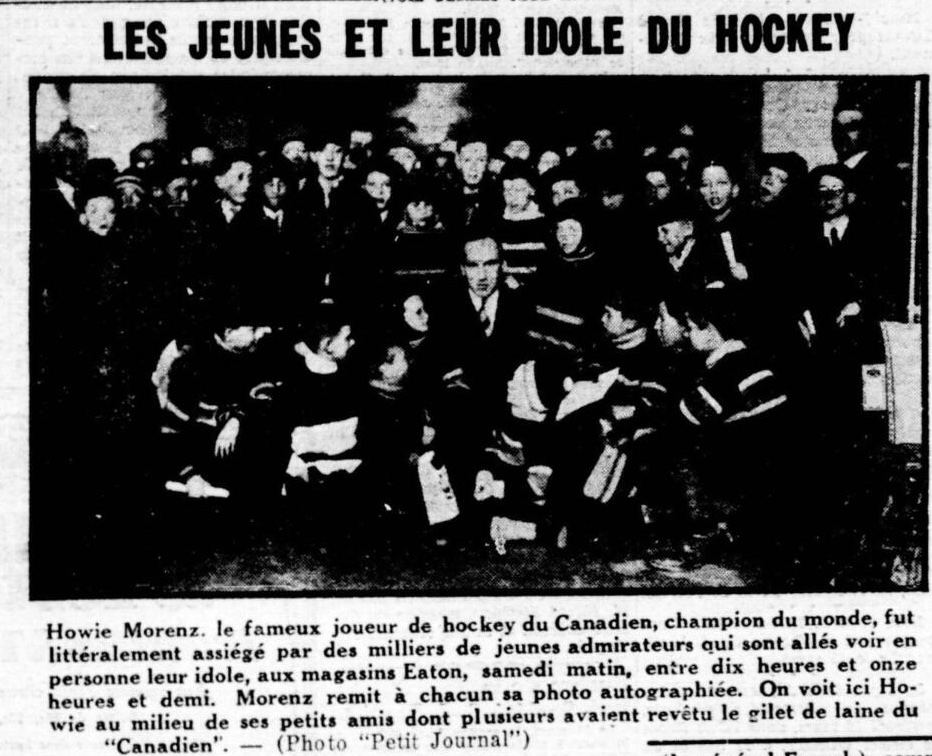
The other thing that really lofted Howie Morenz into fabled status was how he had deliberately cultivated his own expanding multitude of fans by putting in the time with them, just as he put in the time on the ice to maintain his game skills.
What we liked about Howie most we think was the modesty with which he took the smiles of fortune and the adulation that was conferred upon him by hockey fans everywhere. If ever any athlete had reason to get a big head from reading the newspapers it was Howie Morenz, but even in his greatest years he was as modest as a school-girl about his achievements. Fame that came to an unknown junior out of Stratford never spoiled the boyish enthusiasm of Morenz.
Per Dink Macdonald in The Gazette, March 10, 1937, p.14, c.2 – 3
Paul Gallico remarked on this habit, or phenomenon, when speaking about the public magnetism of Babe Ruth:
. . . the Babe lived with us daily and we with him until he became a better-known and better publicized figure even than the President of the United States. He could not have achieved this had he not been worthy of it, had he not been the extraordinary figure he was with the capacity to make men, small boys, and even women love and care about him.
. . .
It was the characters that made people care deeply. The newspapers discovered that caring meant circulation, . . .
Gallico, Paul; The Golden People, Doubleday & Company, Inc. (Garden City, NY:1965), at p.35
Leslie Roberts was already saying the same thing about Howie Morenz:
So far as the youth of the country is concerned he is a far more important citizen than any mere cabinet minister or premier. There is a young man in my house, for example, who is a veritable portfolio of Morenziana but who cannot be bothered to remember who guides the ship of state this year.
Leslie Roberts, “The Magnificent Morenz” undated, originally published in Current Events, and reprinted in The Stratford Beacon-Herald. Some spelling errors corrected.
Largely by his own humility, and his obvious devotion to wringing as much perfection as he could from the game, he created imitators among the kids – and the kids wanted to be him. Hugh MacLennan made this an idea of importance in his novel, Two Solitudes, Collins (Toronto:1945), at p.285:
“You love hockey, don’t you, Paul?”
“I used to. . . . Some winters I felt as if I lived in the Forum.”
. . .
“How did you happen to do it – play hockey like that, I mean?”
“Because I needed the money.”
“No – I mean, why hockey and not something else?”
He thought a moment. “I guess it was the first professional game I ever saw. I was sixteen. Joliat, Morenz and Boucher were playing. After that I was willing to slave eight hours a day training just on the chance of being half as good as they were.” He reached up and stroked her hair. “But now I’m an old man, and at the best I was never even a quarter as good.”
Hugh MacLennan, Two Solitudes