The Most Valuable Apparition
In the hardcopy version of Howie Morenz: The Greatest Season in the Life of Hockey’s First Legend, I quote from Roch Carrier’s Our Life with the Rocket: The Maurice Richard Story, Penguin Canada (Toronto: 2001), at p.58, where Howie Morenz is sensed as a presence at the Forum when Rocket Richard scored his first goal for the Canadiens on November 8, 1942. By then Morenz had been dead for 5 and a half years, but he was still known and remembered. He was still the measure of comparison.
In an academic discussion about sport and hero status in society published in 2001, Howie Morenz received but two nearly passing mentions in four pages of analysis: Howell, Colin D., Blood, Sweat, and Cheers: Sport and the Making of Modern Canada, University of Toronto Press (Toronto), at p.91 – 94. That could be taken by some, perhaps, as an unspoken acknowledgment of Hannaford Woods’ comment that:
Hockey is only a game, a stylized activity, a grossly distorted, incomplete miniature of life with all sorts of illusory goals and rewards attached to it.
Howell, Colin D., Blood, Sweat, and Cheers: Sport and the Making of Modern Canada, University of Toronto Press (Toronto), at p.93.
Perhaps one might be tempted to add the idea that adults playing a child’s game for the purpose of commercial entertainment is socially unproductive, and unworthy of memorial, veneration, and the attribution of heroic status to its athletes. Awards and memorials might also be seen as subtle inducements to impute a chimerical value to a commercial, athletic endeavour.
In this chapter of the book about Morenz I had been motivated to have the reader consider how we remember great players, and why we do memorialize their accomplishments. That leads to the further question of why what these athletes do is important to us?
Today there is no one left who ever saw him play – and too few who ever saw the Rocket play, although there is quite a bit of film of Maurice.
There is little illusory or unimportant about the emotional and physical commitment required from a person to rise above one’s competitors, or in conjunction with a team, in any chosen field of endeavour – once, and then again, and for a third time again. This applies to any field of human endeavour – business, the healing of the sick, the communication of knowledge, and yes, measurable athletic excellence.
The trophy approach which has been institutionalized by the National Hockey League has done an increasingly good job of heralding performance accomplishments by individual players in competition against their peers. This is the case for both individual and team awards: the Vezina, the Norris, the Art Ross, the Hart, the O’Brien, the Kennedy, the Prince of Wales, and of course the Stanley Cup. Where the League has sometimes struggled is in the process of identifying who should win those trophies where judgment is involved.
The NHL’s awarding of trophies, and the memorialization of competitive accomplishment, is cleaner where the winner succeeds because of what counts on the ice, because of what can be verified by the fans’ own eyes: fewest goals against, most goals scored, most scoring points; the teams that win the most games, and the only team each season which wins the last game played.
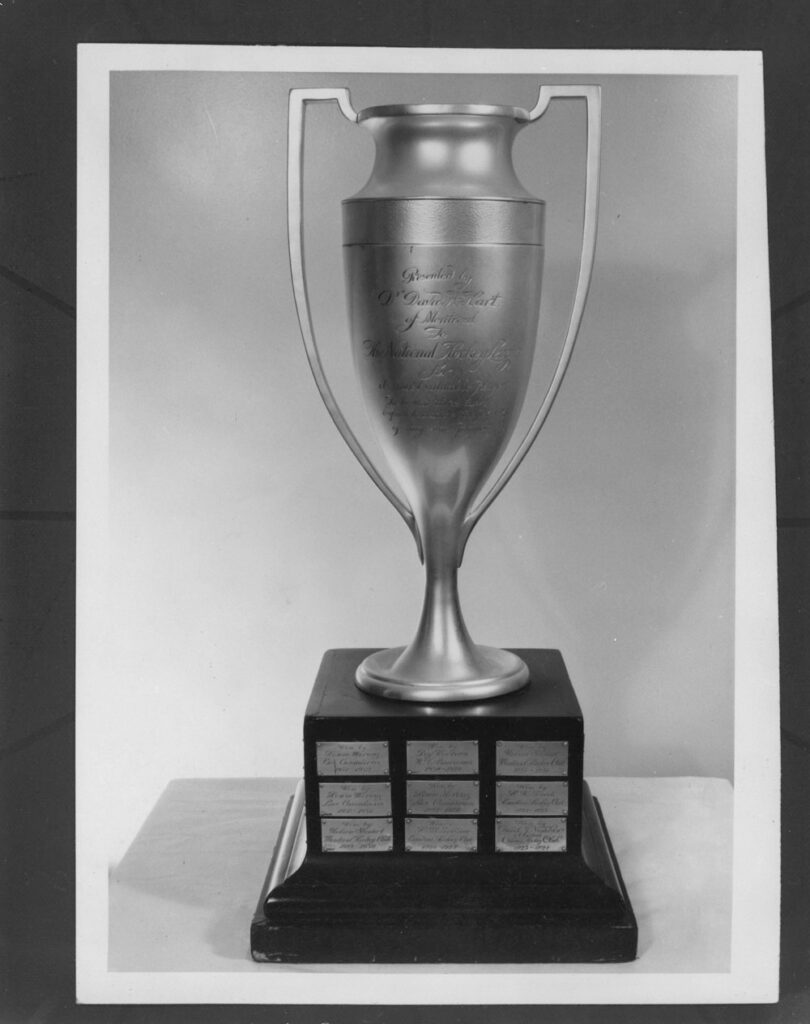
In Morenz’s time the only real individual award was the Hart Trophy – a trophy he won three times: a feat which neither the Rocket, nor Beliveau, nor Lafleur, nor any other Montreal Canadien has managed to do in the nearly 100 years since he won his third (in the spring of 1932).
He did win some trophies that are no longer available, and on which player names were not included. One of those was the Kennedy/Kendall Cup. The Cup had been donated by Frank Kendall, and put into competition, in 1926 as a trophy to be awarded to the best professional hockey club of Montreal based on the results of the season series between the Canadiens and Maroons: La presse, 23 mars 1931, p.22, c.1 – 4.
Although named the “Kendall” Cup, it was often referred to as the Kennedy Cup because Frank Kendall had donated it to honour his brother George, who had been the Canadiens’ first Montreal owner: The Gazette, February 25, 1942, p.18, c.2 – 3.
George had grown up as a Kendall, until he saw a future for himself as a professional wrestler. He changed his last name to Kennedy to protect his birth family from the embarrassment of having a professional wrestler as a blood relation. George also created the Club Athletique Canadien. In addition Kennedy and the CAC promoted “a professional lacrosse team, several billiard halls and bowling alleys, and a very popular Montreal bar.”: Whitehead, Eric; The Patricks: Hockey’s Royal Family, Doubleday Canada Ltd. (Toronto:1980), p.116.
Shortly after the creation of the Montreal Canadiens in 1909, Kennedy assumed responsibility for operating the Club de Hockey Canadien in the old National Hockey Association for the price of $7500. He apparently arrived as an owner with a truculent attitude: O’Brien, Andy; Les Canadiens: The Story of the Montreal Canadiens, McGraw-Hill Ryerson Ltd. (Toronto:1970), at p.13; Gregoire, E. Waxy; Bert Corbeau, Ningwakwe Learning Press (2010), at p.74.
Kennedy also managed the Canadiens to their first Stanley Cup championship in March 1916. He caught the Spanish Flu During the team’s next Cup final series against Seattle in 1919 and never really recovered. He died, still as George Kennedy, in October, 1921: e.g., Jenish, D’Arcy, The Montreal Canadiens: 100 Years of Glory, Doubleday Canada (2008), at pp.29 – 50. See also: Whitehead, Eric; The Patricks: Hockey’s Royal Family, Doubleday Canada Ltd. (Toronto:1980), p.135, and Gilles Janson, “KENDALL, GEORGE WASHINGTON, named George Kennedy,” in Dictionary of Canadian Biography, vol. 15, University of Toronto/Université Laval, 2003–, accessed July 18,2019, http://www.biographi.ca/en/bio/kendall_george_washington_15E.html.
In the Kendall Cup’s first 5 years (it would only remain in competition for 11 years), the Canadiens had won the bragging rights twice. The Canadiens dominated the Maroons this 30 – 31 season by winning three of the first five games, and drawing the other two. It remained very much a local trophy with strong local interest. Local retired players continued to brag about their Kennedy Cup superiority into the 1940s, long after the demise of the Maroons: e.g., The Gazette, February 25, 1942, p.18, c.2 – 3.
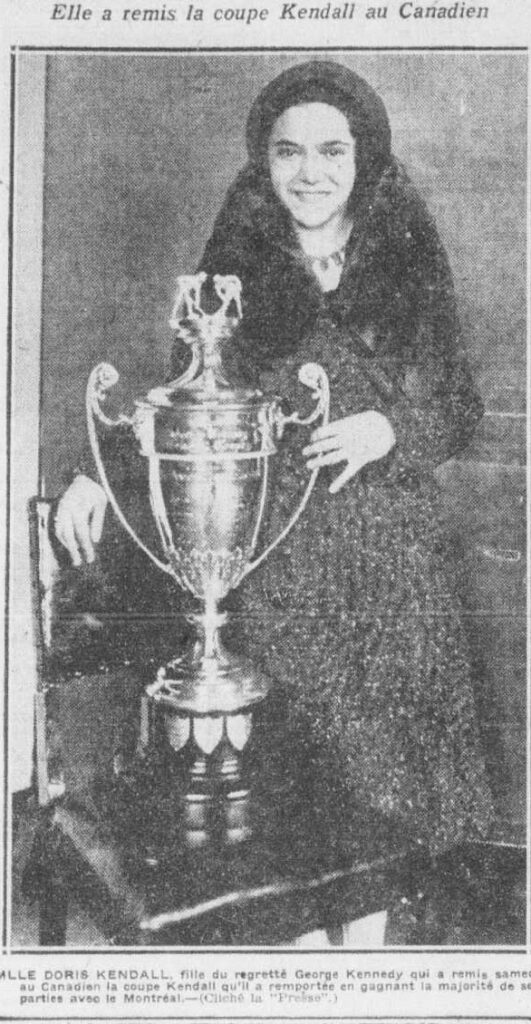
The picture at the head of this post features George Kennedy/Kendall’s daughter Doris (by 1931 publicly known as Doris Kendall) presenting the Kennedy Cup to the Canadiens in 1931. La presse, 23 mars 1931, p.22, c.1, 3 – 4. Doris was George’s only surviving child. A younger female sibling had died as an infant on October 19, 1921.
Morenz would win this award with the Canadiens 5 times. But the trophy medallions only identified the team, not the players. The only individual “honoured” by the Kendall remained George Kennedy.
The other trophy that Morenz won during his career that is no longer available was the O’Brien Trophy. Originally this team trophy was awarded to the winner of the National Hockey Association and then National Hockey League schedule. Since the split of the League into American and International Divisions, the O’Brien became associated as recognition of the season first place winners for the NHL’s International Division. Morenz would eventually participate in winning the O’Brien 6 times in his first 9 seasons, but none thereafter.
Who did that trophy memorialize? It was never clear whether the “O’Brien Cup” memorialized the National Hockey Association’s founder, Michael John O’Brien (a man who never took the time to see a hockey game in his life), his son J. Ambrose O’Brien, or was intended to refer to the family as a whole: Young, Scott and Astrid; O’Brien, The Ryerson Press (Toronto:1967), at pp.71, 74; Finnigan, Joan; Old Sores, New Goals: The Story of the Ottawa Senators, Quarry Press (Kingston, Ontario:1992), at pp.48 – 49. What was clear was that winners of the O’Brien were identified on the trophy medallions by team and year – not by the names of the men who had actually played.
As I point out in the book, the only competitive trophies which Morenz won, and which were designated as a personal accomplishment by physically attaching his name to the trophy, were the Hart Trophy for being recognized as the League’s most valuable player (3 times), and the Stanley Cup for being recognized as a professional hockey champion (also 3 times).
The true memorial of his career was the hold that he continued to have after death, and for more than a generation, in the minds and imaginations of those who had seen him – and been enchanted or inspired by him.
In the days before film and video, once a player was off the ice he was consigned to memory, to comparison. Without the tangible acknowledgments, he would remain in the mind only so long as fans chose to remember:
Many men who walk slower and see their contemporaries taken resent Hull. They hold to Richard as they cling to Howie Morenz, as they remember Joe Malone, as they revered Cyclone Taylor. . . .There is a human tendency to pine for the men you knew, when the men you knew were young. “Compare Morenz and Hull?” Selke says. “Sure. You know how exciting Hull is on his big nights? That’s how Morenz was every night.”
Dick Beddoes in The Globe and Mail Weekly, March 5, 1966, Third Section, p.1, c.8 – 9; and repeated in The Globe and Mail, March 25, 1971, p.42, c.1 – 2.
The same sentiment had been expressed by Milt Dunnell in the Toronto Daily Star, December 8, 1960, p.12, c.1 – 2
The great advantage of memory is that once it is established in imagination, memory becomes evocative, providing the player with a pedestal of presumptive greatness. But that is still time-limited. It lasts only so long as those who are doing the remembering. Howard Liss expressed it this way:
There are great hockey players in the NHL today. Nobody doubts the incredible abilities of the likes of Gordie Howe, Bobby Hull, Stan Mikita and others. And, going back only a few years, the names Maurice “Rocket” Richard and Bernie “Boom Boom” Geoffrion were synonymous with the very word “hockey.” But old-timers still compare every promising newcomer with “The Stratford Streak,” Mr. Howarth Morenz. Eyeing a rookie with great speed, a grizzled veteran of the ice wars will nod and say, “Yep, the kid looks pretty good – but he’s still not as fast as Morenz.” Possibly, in their eyes, nobody else will ever compare.
Liss, Howard; Goal! Hockey’s Stanley Cup Playoffs, Delacorte Press (New York:1970), p.36
Frank Selke highlighted the same essential point about why people tended to remember Morenz:
In many respects, you have to say that Howie Morenz was the most dynamic figure the game of hockey has ever known. He skated as fast and as tirelessly as Cyclone Taylor; had a tremendously powerful left-hand shot; backchecked like a demon; and played with such reckless abandon that he captured the hearts of sport fans in the United States when hockey was new. All of them will tell you to this day that he was hockey’s greatest salesman.
Selke, Frank J., with Green, Gordon; Behind the Cheering, McClelland and Stewart Limited (Toronto:1962), pp.175 – 176.
Even after Rocket Richard’s 50 goal season, there were doubts about how he compared to Morenz, because people still turned to the imaginations of their youth, and found them populated by the excitement of Morenz:
“Rocket” Richard exhibits an exciting ice-talent and a blinding speed that is reminiscent of the great Morenz. Like Morenz, he is dynamic and colourful. . . . It is open to question whether the Richard legend will, in the course of time, attain to such proportions as that of the fabulous Morenz.
McAllister, Ron; Hockey Stars Today and Yesterday, McClelland and Stewart Limited (Toronto:1950), at p.97.
Even Bill Hewitt was reluctant to remove Morenz from any pedestal in favour of Richard:
Some years ago, around 1940, I was invited to name the outstanding hockey players during the previous half-century. At that time, I chose the following players as my All-Time All-Stars.
. . .
Forwards
Howie Morenz Montreal Canadiens
Cyclone Tayler Vancouver Lions
Scotty Davidson Toronto
Bill Cook New York Rangers
. . .
As I review those names nearly twenty years later, I wouldn’t drop one of them. However, I would add four more of all-time stature who arrived on the hockey scene during the years since 1939. . . . Doug Harvey . . . Milt Schmidt . . . Rocket Richard . . . Gordie Howe.
Hewitt, W.A., Down the Stretch: Recollections of a Pioneer Sportsman and Journalist, The Ryerson Press (Toronto:1958), pp.207 – 208
Jim Coleman proposed this assessment of Howie Morenz in 1971:
He could skate faster than Davey Keon, he could shoot as hard as Bobby Hull and he was as strong as Gordie Howe. . . . Was Richard as good as Howie Morenz? “It’s difficult to compare them. Let’s just say that they were two of the greatest players I ever saw. They made ordinary men look like pygmies. They were Sir Galahad and Sir Lancelot jousting with village yokels.”
Calgary Herald, February 19, 1971, p.47, c.1 – 2
In Montreal, and Quebec, Richard eventually did satisfy many that he was in fact the greater of the two – but rarely without a debate. Eventually the old-timers would acknowledge that it was their imperfect, and perhaps burnished memories urging the bias for Morenz, and say, with Andy O’Brien:
Recognized beyond question as to the greatest center player of his day . . . .
O’Brien, Andy; Superstars: Hockey’s Greatest Players, McGraw-Hill Ryerson Limited (Toronto:1973), at p.115
The Rocket himself was aware of this same kind of impermanence. In retirement he would acknowledge:
My name still means something. . . . I have a good life now, I go fishing. I play tennis. I still play some hockey. I do what I want and go where I want to go, and even though a lot of people have forgotten me, I’m still asked for my autograph in a lot of places.
Fischler, Stan; Slapshot!, Grosset & Dunlap (New York:1973), at pp.91 – 92
The potential for anonymity, the potential to be forgotten, was certain. But even a generation beyond the grave, and without the benefit of film, video, and records, “Chick” Appel could say, with confidence:
. . . the irrefutable fact remains that Morenz, pride of the Canadiens, belonged in the ultra class of hockey, and it is just as certaion that his name, and recognition, will last as long as hockey is played. If Morenz was not the greatest hockey player, he was undoubtedly one of the most idolized and certainly one of the most exciting, for good reasons.
Appel, “Chick”; “A New Approach to the Much-Told Morenz Saga,” The Stratford Beacon-Herald, December 27, 1960, p.14
The appropriate measure may simply be this – as it is for any athlete in any sport in any era – expressed by Frank Deford in relation to tennis great Bill Tilden:
Every time it counted, he beat the person he was playing.
An athlete, no less than a general or a statesman, must be judged by what he accomplished in his time. That is the only appropriate standard. Since some athletic proficiency can, however, be precisely measured, since we know that people run faster and jump higher all the time, as they also live longer and grow bigger, it is as easy as it is fashionable to conclude that no athlete of the 1920s could beat any reasonable representative of the 1970s. But to what end?
. . . “The beauty of that time was that each individual was a certain game . . . .”
Deford, Frank; Big Bill Tilden: The Triumphs and the Tragedy, Simon and Schuster (New York: 1976), at pp.29 – 30
Andy O’Brien attempted an answer from Montreal:
“Was Howie Morenz actually as great as the stars we have seen or are seeing today?” . . . The answer can, I know, sound strained because storybook goals often sound alike in the telling – in the telling, most greats are a blending of fast skater, tricky stick-handler and hard shooter. Just how can one explain to a thirty-year old fan the “different” magic of a star thirty years dead?
O’Brien, Andy; Les Canadiens: The Story of the Montreal Canadiens, McGraw-Hill Ryerson Ltd. (Toronto:1970), at p.38
Perhaps the best memorial to Morenz was expressed by King Clancy to Dick Beddoes, at a time when Clancy owed absolutely nothing to Morenz:
I seen ‘em all score goals. Howe, wicked and deft, knocking everybody on their ass with his windshield-wiper elbows; Rocket Richard coming in mad, guys climbing all over him; Hull, booming a slapshot like a WWII cannon; Wayne Gretzky mesmerizing the defence as he waltzes across the blueline, then wafting a feathery pass to a fast-coming winger. . . . But I never saw anybody – nobody – score a goal like Morenz on a furious charge down centre.
Quoted in Cole, Stephen; The Canadian Hockey Atlas, Doubleday Canada (2006), at p.181
Of course Clancy’s admiration might be discounted both as kindness, and for the fact that men who had been champions, and then been bested by others, clung to:
. . . the inner belief that nobody could’ve played the game any better than the guys you couldn’t beat.
Sharnick, John, Remembrance of Games Past: On Tour with the Tennis Grand Masters, Macmillan Publishing Company (New York:1986), at p.233
The Stanley Cup has a magic that is different than team trophies like the Kendall, O’Brien, and Prince of Wales. Howie Morenz knew in 1931 what every player in the NHL today knows: when a player wins the Stanley Cup, the player’s name would actually become part of the trophy. This practice was begun, unofficially, in 1907 by the Montreal Wanderers, and had become established as an NHL practice with the Canadiens’ 1924 Cup victory: Shea, Kevin, and Wilson, John Jason; Lord Stanley: The Man Behind the Cup, Fenn Publishing Company, Limited (Bolton, Ontario:2006), at p.428.
Players like Morenz knew that anybody who would pick up the Stanley years later would find a name, could find his name, and trace it with a fingertip. Everyone would know that Howie Morenz had been there in 1924, and then again in 1930, and 1931. That was the best way to become permanently woven into the history of the game.
Even hockey men who did not see him game after game knew his value. Eddie Livingstone, the pariah from the National Hockey Association who had been left behind by the National Hockey League, and who was locked in civil litigation with Major McLaughlin in Chicago, remained current with the goings on in professional hockey. He had picked an all-star team with Morenz at centre, and then named Morenz the “Best forward,” as well as “Best player any position” in 1931. The Globe, March 24, 1931, p.10, c.3 – 4. So there was a rare unanimity of appreciation that season among those in, and on the outside, of the League about Morenz’s greatness. Mike Rodden of The Globe stated with an attitude of self-evident authority:
Canadiens have the best forward of them all in the dashing “Howie” Morenz.
The Globe, March 30, 1931, p.10, c.3 – 4
In time there would be the banner in the rafters at the Forum, with his number 7 prominent and always present as the younger, future Canadiens played below. His banner would one day get lowered, and be joined by the banner for his son-in-law Boom Boom Geoffrion, so that the two could rise side by side, and take their place in the air above. Together, and the older still remembered, 75 years later: March 11, 2006, described in Dowbiggin, Bruce; The Meaning of Puck: How Hockey Explains Modern Canada, Key Porter Books (Toronto:2008), at pp.166 – 167
Immediately after his sudden death in March of 1937, Stratford’s pee-wee league inaugurated a “Howie Morenz Junior Trophy,” awarded the first time by Howie, Jr. himself: Robinson, Dean; “Howie Morenz was a Very Special Person,” London Free Press, March 4, 1977, pp.10, 13.
The recognitions have come occasionally since. There was the Canadian Press poll that named him the best hockey player of the half century in December 1950. Mitchell Arena began to house a Mitchell “Hall of Fame” showcase about Howie since its opening on November 3, 1967, unveiled by Howie, Jr and Marlene, and including a replica of their dad’s sweater. There was plaque unveiled at the Montreal Forum on February 25, 1978, and then the naming of the “Howie Morenz Arena” in the Villeray-Saint-Michel-Parc-Extension in 1979. Keith Roulston’s play Fire on Ice about Howie Morenz was staged by the Blyth Summer Festival in the summer of 1981. Dean Robinson’s book, Howie Morenz: Hockey’s First Superstar, was published in 1982.
Beginning near the end of the millennium, approaching 60 years after his death, there was a flurry of delayed recognition:
- a rush to put up signs identifying Mitchell, Ontario, as “The Home of Howie Morenz” in 1997;
- a “Howie Morenz Memorial Gardens” park, the very site of the town’s original arena, which had been erected in 1908, and beside the Thames River, near where it is fed by Whirl Creek – the tributary where he had learned to skate all those years ago.
- a Howie Morenz Memorial Award, sponsored by the Canadiens, but with contributions from the Hawks and Rangers.
- a Canada Post stamp with his image as part of its “Hot shots” series, with that of Guy Lafleur, in 2002;
- Stratford’s naming of the street in front of its William Allman Memorial Arena as “Morenz Drive.”
The fact that Morenz was, ultimately, memorialized as more of an idea or conception of a “hero” than a lasting statistical success was a consequence of his time. He played in the time between the wars, and was, like his baseball comparator Babe Ruth, often known for playing a children’s game and pursuing the hedonistic pleasures available in urban society. That urban society in turn created the heroes who bobbed up to the surface: the contrasting and competitive characters of Howie Morenz, and Eddie Shore. These athletes were both the “golden people.”
I will close with a comparison of how different writers remember, or memorialize, Howie Morenz’s own generation. In 2001 we have this from Colin Howell:
The hockey heroes of the interwar period personified the grace, the speed, and the rugged masculinity of the game; they also reflected the violent undercurrents that have plagued hockey throughout its history.
Howell, Colin D., Blood, Sweat, and Cheers: Sport and the Making of Modern Canada, University of Toronto Press (Toronto), at p.93.
Closer to Morenz’s own time, Paul Gallico observed athletes of the 1920s as “The Golden People,” and his comment about the enduring memory of Johnny Weissmuller as the outstanding swimmer “of the half century” is legitimately transferrable to Howie Morenz:
. . . one needs only to examine what it was that the Golden People had in common with one another. It was their ability not only to excel in, but to dramatize their sport as well, through the extraordinary power of their personalities. . . . Such an award is not based upon records alone but is the result as well of an exciting personality, coupled with consistent performance. Along with those others of his era he impressed himself indelibly upon the national consciousness.
Gallico, Paul; The Golden People, Doubleday & Company, Inc. (Garden City, NY:1965), at p.222
The memories endure a century on – but only in written form.