Chapter 1: A Challenge to Faith
Canadiens at. Bruins, March 24, 1931
The Canadiens had left Montreal on Monday evening to give themselves a full day in Boston to prepare for the opening game of the playoffs. Team Secretary Jules Dugal had managed to keep the Canadiens’ hotel destination a secret from the newsmen until they were either on the train, or until they had arrived in Boston. The team wanted no distractions for its players.
When the Canadiens arrived in Boston on Tuesday morning, the news also arrived that Howie Morenz had once again been selected as the winner of the NHL’s Hart Trophy. The Hart Trophy, originally donated by Coach Cecil Hart’s father David, was given to recognize the NHL player who had been most valuable to his team during the regular season.
Knowing that someone had won “the Hart” meant that the player had been recognized as most valuable in making his teammates better, and so making his team’s achievements, better. A person didn’t need to know all of the exact goal scoring statistics, nor his steals or his hit count in back checking, how many times he might have broken up dangerous plays by his team’s opponents, the exact measure of excitement that the player inspired on the ice for his teammates, nor any of the other myriad ways in which the player might have influenced the course of his team’s season. The Hart was one of the NHL’s ‘consensus of opinion’ awards, based on sportswriter voting from around the League. To get the Hart required the player to be known as an influential player both at home and on the road.
The trophy itself had already begun to consolidate those ideas and concepts. It represented in one tangible, visible piece of hardware, a whole body of work over the course of one season. As soon as it was awarded, the details, the subjective opinions that led to its award, became less important – even unimportant. Simply knowing that the player had been awarded “the Hart” allowed everyone to acknowledge the importance of that player during that season.
The award also had the effect of elevating a player. A winner became part of the select company of those who had been recognized with the award before: Frank Nighbor (1924), Billy Burch (1925), Nels Stewart (1926 and 1930), Herb Gardiner (1927), and Roy Worters (1929). Morenz himself had already been recognized with the award in 1928. Since its inception in 1924, only 5 other players had been deemed worthy to be part of the Hart’s elite circle by 1931. At the time, only Howie and the Maroons’ Nels Stewart were multiple winners – Stewart having won in 1926 and 1930.
This year, the voting for the Hart had mostly been a contest between Howie Morenz and Eddie Shore. Morenz proved to be “le grand favori”: La presse, 24 mars 1931, p.25, c.1 – 2. The playoff game between the Canadiens and Bruins this very night would provide an opportunity for a direct comparison between the two – an opportunity for the public to pass judgment on the wisdom of Morenz’s selection. Which man would be most valuable to their team in this game? Which of them would make their team better? Which of them would be able to create the difference in what was expected to be a close game?
This was the third straight year that the Canadiens and Bruins would meet in the playoffs, and they had already begun to develop a pattern in their playoff encounters. A season was not spiritually complete for either until each had had the opportunity to measure themselves against the other. Whatever each team might have managed to do against the rest of the League, and whatever season-long achievements each might have accomplished, or not, the question in the spring inevitably seemed to be whether the Canadiens or Bruins would overcome the aspirations of the other?
In the spring of 1929, the Canadiens had finished first overall, and the Bruins two points behind in second. In a best of 5 final, the Bruins surprised the Canadiens by winning the first two games in Boston by 1 – 0 scores, and then completed a disdainful sweep of the Canadiens with a 3 – 2 victory at the Forum in Montreal. The Bruins went on to win the Stanley Cup that year.
In the spring of 1930, the Bruins had finished first overall, and the Canadiens third overall: 17 wins and 26 points behind the Bruins in the League standings. But in a best of three series for the Stanley Cup, the Canadiens stunned the Bruins 3 – 0 in Boston, and then 4 – 3 in Montreal, to win the Cup.
This year, as in 1929, the Bruins and Canadiens met as the champions of their respective divisions. The Bruins had won the Prince of Wales Cup. First awarded retroactively to the Canadiens for their strike-assisted NHL championship in the spring of 1925 after their opening night game win at Madison Square Garden in New York, the Prince of Wales Cup/Trophy was subsequently awarded to the League Champion in 1925, 1926, and 1927. In 1928, and continuing until 1938, the trophy was awared to the team finishing first in the League’s American Division.
The Canadiens had been awarded the O’Brien Cup. First awarded in the spring of 1910 in connection with the National Hockey Association, this trophy had been donated by railway builder and mining magnate M.J. O’Brien: Young, Scott and Astrid; O’Brien, The Ryerson Press (Toronto:1967), at pp.71, 74. The O’Brien Cup represented the NHA championship until that league ceased operations, and then served as the trophy emblematic of the NHL championship from 1917 until 1923. The O’Brien Cup was replaced in 1924 by the Prince of Wales Cup/Trophy. The O’Brien Cup was re-invested as the championship trophy for the NHL’s Canadian Division starting in the spring of 1928 until 1938.
Both trophies represented season-long accomplishments, achievements measured by the accumulation of points for the most wins and draws among their divisional peers. The successes represented by those trophies were what got them here. Those successes would get them no further. Despite the months and games of effort that it took to win those trophies, that success was shrugged away as soon as the playoffs for the real Cup – the Stanley Cup, and the bragging rights between the Bruins and Canadiens, began.
The engagement of the Bruins and Canadiens with each other, already a rite of passage for the players and a rite of spring for their fans, developed differently from their respective rivalries with teams like the Leafs. The relationship between the Leafs and Bruins, for example, was characterized more by episodes of taunting and fisticuffs between its coaches, and the descent from fierceness to brutality in the on-ice encounters of its players.
Even in the past month the open, long-running feud between Art Ross of the Bruins, and Conn Smythe of the Leafs, had broken out again with Smythe swinging at Ross, as well as complaints by Bruins’ owner Charles Adams about gamesmanship by the Leafs on and off the ice. See: The Montreal Daily Star, March 11, 1931, p.26, c.8; The Montreal Daily Star, March 12, 1931, p.35, c.1 – 2; The Montreal Daily Star, March 13, 1931, p.35, c.4 – 5; and The Montreal Daily Star, March 19, 1931, p.31, c.2, and p.33, c.2
By contrast, the aggression, anxiety, grief, and exultation that infused the Bruins/Canadiens’ contests were entirely about what happened fiercely on the ice. This evening in late March 1931, with 17,000 fans jamming themselves into the Boston Garden, who “filled every point of vantage and dripped from the steel work of the upper balconies”: Boston Post, March 24, 1931, p.1, would be no exception to their pattern.
The first period was cautious, with players testing their opponents as individuals, as strategic groups, as co-ordinated teams. The Bruins were particularly wary of Morenz. The Boston Globe alerted its readers:
Boston lays more stress on team play than do the Frenchmen, a team which has always been noted for its opportunistic tendencies, its daring, its gallantry, against which the Bostons will offer their better balance, their close-knit passing game and their rugged defence.
Though hockey is a team game, both outfits will put on the ice a galaxy of individual stars. Topping the visiting array looms the might figure of Howie Morenz, the Swiss speed merchant, generally considered as the greatest of all hockey players, mighty on the offense, indefatigable on defense.: Boston Globe, March 24, 1931, p.21, c.2 – 4
The Boston Post was similarly respectful, and even more effusive:
Howie Morenz the sensational . . . Les Canadiens are most dangerous when Howie Morenz goes streaking like a comet, with his hair shooting straight back and his body being carried along on steel runners with not only the speed of something mechanical rather than human, but with the grace and balance and sureness of foot of a sensational ballet dancer. Howie is the fast thinker, the Ty Cobb of the ice in this respect. None other has a shot more dangerous for marksmanship and effectiveness. The great Morenz can well be compared with a snarling tiger of the jungle who is [sic] his cat-like way, is hard to compete against – who does the unexpected – takes advantage of the slightest error, cannot be trusted by a foe a split second and has all the tricks of his trade to be master of his surroundings.
Morenz is very much a team in himself. Sorry it is for a rival caught napping. With the meagerest set-up for a goal, Morenz will come through successfully where most would fail. In fact, he is such a magnet for the thoughts of the opposition that his teammates at times go almost unnoticed about their work until they seep in for the killing that Morenz has so cleverly laid the stage for.
Boston Post, March 24, 1931, p.18, c.1
But the Post still definitely had its local favourite:
Shore is the Babe Ruth of hockey today. When his big bulk gets away on his famous locomotive tears . . . the gallery rises in unison to be ready to applaud the completion of the play. For color even Morenz wouldn’t be an even swap for Shore.
Boston Post, March 24, 1931, p.18, c.2
So the game began:
The first period was dull, efficient, conservative and dull hockey, without a score.: Montreal Herald, March 25, 1931, p.6, c.1 – 2
The game started out in desultory fashion, and the first period was torpid and uneventful, and gave little promise of the action that flamed in to a goal-getting orgy later on.: The Montreal Daily Star, March 25, 1931, p.36, c.3
Weiland managed to find himself in alone on Hainsworth three times, and missed the net each time. Morenz had the best chance of the opening period:
Joliat had carried down the left while Shore and S. Mantha were having words behind the Canuck net. Joliat got well through and fed Morenz a perfect pass three feet in front of Thompson. Howie shot for the corner, but Tiny slid his stick out just in time to send the puck up and outside of the near upright.: Boston Globe, March 25, 1931, p.15, c.3
The first period ended, with no score but with penalties that showed a disposition to physical challenge and sparring: Galbraith with a high stick, Sylvio Mantha holding, Marty Burke with a trip, and then Clapper for charging. Two penalties to each team.
The second period began at a higher pace, with a very early chance by Joliat on a give and go with Gagnon, using Morenz as a decoy; but Joliat’s shot missed. Then back the other way, Clapper had a shot that took Hainsworth completely off his feet to make the save, but had the Canadiens’ goalkeeper looking in the net for the puck.: Boston Post, March 25, 1931, p.18
On the next rush up the Garden ice by the Canadiens, carried eagerly by Albert Leduc, Eddie Shore was forced to take a penalty for hooking, or tripping. It was then that Howie Morenz threw down the gauntlet to the Bruins, and Shore.
As Shore sat in the penalty box, the Canadiens’ freewheeling speed game came alive with a goal set up from the stick of Morenz:
With Galbraith and Beattie roving front of Hitchman and Owen, Leduc carried down the left. He was spilled by Owen, but Morenz pounced on the puck and passed it from the left rink boards to Gagnon out in right center uncovered. Gagnon, playing his first big series, set himself and then rifled the puck past Thompson into the upper righthand corner.
Boston Globe, March 25, 1931, p.15
Morenz forced a scrimmage at the back boards and passed out in front of the cage. . . . Galbraith should have slugged it clear, but hardly nudged it and Gagnon was on the job to collect, turn and scale the disc past the defence and past Tiny’s outstretched leg at the open corner for the first goal.
Boston Post, March 25, 1931, p.18
With Shore off the ice, Canadiens bristled into a slashing attack. Joliat went swerving through, carried the puck in, but was crowded and fell. Morenz swept in, took a short shot, pounced on his own rebound, carried it behind the cage and passed out across the face of the net. Little Johnny Gagnon swung suavely around the grouped Bruin players, hooked up the puck and [?] a sizzling shot that beat Thompson completely.:
Montreal Herald, March 25, 1931, p.6, c.1 – 2
Leduc boomed down mid-ice and passed to Joliat, who shot to the boards, and Morenz went tearing in behind and hurled a hard pass to Gagnon, who caught it cleverly and whipped his angle shot into the right hand corner of the net.: The Montreal Daily Star, March 25, 1931, p.36, c.3
Howie blasted a furious shot at the Boston goaler. The puck bounced off Thompson’s pads and landed near Gagnon, who whaled it into the Boston net for the opening goal.
The Globe, March 25, 1931, p.11, c.1
Regardless for how the first goal had been scored, the Canadiens remained on the offensive:
. . . at 6:26, with Shore still off, the Canadiens scored again. Leduc again started the play. This time he carried down the right half, evaded Owen, but was finally flattened by George. Wasnie trailing alone behind, put on an extra burst of speed, picked up the loose rubber and carried right into Thompson before letting fly a back-hander.: Boston Globe, March 25, 1931, p.15, c.3 – 4
Soon:
. . . Boston defence being plainly shaken by the continued absence of Shore. The big Blonde was still an absence when Leduc went plunging in. He was heavily checked by Owen but the puck slid along and Nick Wasnie swept in from right wing, grabbed the disc and whistled it home.: Montreal Herald, March 25, 1931, p.6, c.3 – 4
One minute later, it was again Leduc who tore down centre ice, was checked by the defence, and flipped the puck over to the left. Nick Wasnie tore in, and then leaned on one of the shots that have made him a feared sniper among N.H.L. goalies. Thompson was as powerless to stop the shot as to check a shaft of lightning.: The Gazette, March 25, 1931, p.20, c.2.
It was time for the Bruins to respond, but for more than 10 minutes, they could not manage to get the puck past Hainsworth. They had their best chance of the period when Clapper fed Weiland, who had a great chance on Hainsworth: Hainsworth blocked and Morenz dashed in to claim and clear the rebound before Barry could reach it.
Barry had another opportunity of his own, but Hainsworth dove to stop him:
Hainsworth lost his aplomb, and at the same time his balance and cap, when he went into temporary convulsions to stop a shot of Barry early in the second period.: Boston Globe, March 25, 1931, p.15, c.7
There were also notable stops to Weiland, and then to Oliver on a feed from Beattie. Finally, with about 2 and a half minutes remaining in the second period:
Owen carried down the middle, with Weiland out at his left. Owens [sic] passed at the defense, and Leduc’s outstretched stick shoved the puck into the corner. Weiland went after it and passed dangerously across the goal mouth. Hainsworth half cleared but the puck landed on Clapper’s stick, and from 15 feet out, Did [sic] put it home as pandemonium broke loose.: Boston Globe, March 25, 1931, p.15, c.4.
A different version of the goal, leaving out Weiland entirely, appeared elsewhere in the Boston Globe, March 25, 1931, p.15, c.8.
Again, other newspapermen differed on what had occurred:
George Owen battered his way to close quarters, passed to Weiland, and the latter shot. Hainsworth cleared, but Clapper circling on the outer edge of the group of struggling players, picked up the rubber and whistled it back like a bullet for Bruins’ first goal.: Montreal Herald, March 25, 1931, p.6, c.3 – 4
Owen fed to Weiland on the left lane at the line. Cooney was overskated but he fed back to Owen at the goalmouth. Owen couldn’t nail the pass and it went to Clapper who, left alone, had a cinch in lifting back a scorcher for a goal. The place went mad.: Boston Post, March 25, 1931, p.18
The Canadiens remained defiant, and with the initiative of Howie Morenz, continued on the attack with less than a minute left:
Morenz blazed away from the Canadien end, his speed leaving the Bruin line in the rear and with Burke in attendance surged in on the defence. The Bruin defence messed up the play. Thompson was flat on his face and the defencemen were floundering about when Burke tapped the rolling puck and it rolled slowly and serenely into the Bruin cage.
Montreal Herald, March 25, 1931, p.6, c.3 – 4
Just when things were shaping up for some more fun Morenz broke from a scrimmage at his end and lugged Burke and S. Mantha with him. They all got tangled up at the defence and Tiny was down flat to protect his net. From the scramble, Burke was able to get in a smash and the light glowed for a goal.
Boston Post, March 25, 1931, p.18
Just before the period ended, the Canucks resumed their two-goal margin. Morenz, Burke and S. Mantha rode down on the Bruins goal, and all seemed to get through on Thompson. Tiny stopped thrusts by Mantha and then Morenz’ stab failed to clear Tiny’s prone body. Burke dove headlong into the tangled mass of players and the red light went on.
Boston Globe, March 25, 1931, p.15, c.4
Hitchman and Shore allowed Burke too much leeway. He got too close to them, passed to Morenz and then swept in to play the rebound back into the Boston net.
The Globe, March 25, 1931, p.11, c.1
Marty Burke and Morenz got back that [first Boston] tally on a passing affair. Burke passed Morenz, who flipped the puck back to the defence man. Burke took a shot, and swept in to trickle the rebound into the nets as Thompson sat on the ice outside the cage, helpless.
The Gazette, March 25, 1931, p.20, c.2
After two full periods, the Canadiens led the Bruins by a startling score of 3 – 1. They had not scored 3 goals in a game at the Garden since the first game against the Bruins in last year’s Stanley Cup final series. In fact, they had only scored 3 goals at the Garden all season. The Canadiens seemed in control with just 20 minutes to go.
Howie Morenz had already broken 4 sticks with the vigour of his shooting:
Howie Morenz leads the series in the High Cost of Upkeep. . . . Morenz let go a low, screeching liner that hit Harry Oliver’s stick on the shaft and snapped the stick in two. Oliver was intensely surprised as he glanced down at the shattered blade. In addition, Morenz broke three of his own sticks in quick succession in the same game.
The Montreal Herald, April 1, 1931, p.9, c.4
The Bruins returned for the third period determined to wrestle the Canadiens back to closer terms, but an early stick swinging encounter between Shore and Joliat put both men off. Playing with 4 skaters aside, there was room even on the Boston ice for sudden speed, and Red Beattie hazarded a solo attack – hitting the crossbar of the Canadiens’ goal with his shot. As the players scrambled behind the net after the rebound:
. . . Gainor charged Morenz heavily into the fence and drew a minor.: Boston Post, March 25, 1931, p.18
Morenz had tried to protect himself from the collision with the boards by leading with his left arm, but the contact had bent his wrist, and the flash of pain across his face had contributed to the decision to penalize Gainor. The Gainor penalty gave the Canadiens a 4 on 3 advantage:
Within the first minute of the period Shore and Joliat had been exiled for high sticking, and then Gainor joined Shore in the pen. While these two were off Morenz stole the puck from Chapman at the Bruins’ blue line and passed to S. Mantha, who was waiting next to Thompson.: Boston Globe, March 25, 1931, p.15, c.4
It was four against three and Les Canadiens were being successfully held off by Chapman’s effectiveness until Shore was ready to step out of the box. Then Lepine passed back to the blue line to Morenz, while Sylvia [sic] Mantha hung in uncovered near Tiny. Morenz sped forward, Mantha collected, ragged to fool Tiny, and put the Canadiens three goals to the good.
Boston Post, March 25, 1931, p.18
Canadiens made it 4 – 1 when Morenz passed down to S. Mantha over two minutes after the start [of the third period]. Sylvio waited calmly for Thompson to fall and then flipped the rubber into the nets.
The Gazette, March 25, 1931, p.20, c.2
Shore and Joliat were penalized for high-sticking . . . Gainor and Morenz collided on the play and the Boston forward went off for two minutes. . . . Lepine was on with Morenz and before Shore returned, Howie led Sylvio Mantha a pass that netted the fourth Canadien goal.
The Globe, March 25, 1931, p.11, c.1
With the odd man advantage Canadiens pressed, and play was surging around the Bruin net when Joliat and Shore stepped back on the ice. Neither had a chance to get into the play as Canadiens worked one of the smoothest combinations of the night, a triple pass from Lepine to Morenz to Sylvio Mantha. The latter was inside the defence . . . [?] Thompson and tossed the puck into the cage.
Montreal Herald, March 25, 1931, p.6, c.3 – 4
Coach Hart had chosen to use a forward trio of Morenz, Lepine, and former forward Sylvio Mantha, as his powerplay for the 4 – 3 man advantage. Whether Lepine or Morenz stole the puck from Chapman inside the Bruins’ zone – and the assist to Lepine suggests that it was Lepine – Morenz attracted enough attention as the puck carrier to draw cover away from Mantha, and then to thread him a pass which allowed the captain to score. The Canadiens led 4 – 1 with just over 17 minutes to play.
Eddie Shore was finally back on the ice. Howie Morenz had skated into the Garden and had assisted on three of the Canadiens’ four goals. Shore’s team was being utterly embarrassed in terms of being able to put the puck in the net. And three of the goals had happened when he was either serving a penalty or out of the play.
Then play began in the third. Shore found the puck as soon as he could, and the Bruins moved towards the Canadiens’ end, leaving only one defenceman behind. Joliat, Shore’s pesky shadow, came towards him. Shore moved away, but Joliat grabbed him enough to stumble him. Joliat was whistled off for holding Shore – his second penalty of the period – “and then the deluge broke”:
Au commencement de la troisieme periode, alors le score etait de 4 a 1 en faveur du Canadien, le Boston reprit son esprit combatif et se lance a l’attaque avec une energie superbe. Il s’ensuivit alors une serie de furieuses attaques a quatre hommes.
La presse, 25 mars 1931, p.24, c.1 – 2
The whole Bruin outfit except Tiny Thompson, C. F. Adams and Art Ross went down the ice to score the second Bruin goal, which was officially recorded to Eddie Shore.Boston Globe, March 25, 1931, p.15, c.8
Clapper circled the Canadien nets on a whirlwind dash and passed out to Shore who whipped home a perfect shot.
Montreal Herald, March 25, 1931, p.6, c.3 – 4
Clapper started it, was forced to swing the net. He passed out, and Shore was the handy man to collect and belt it back in, bing-bang fashion, straight into the strings.
Boston Post, March 25, 1931, p.18
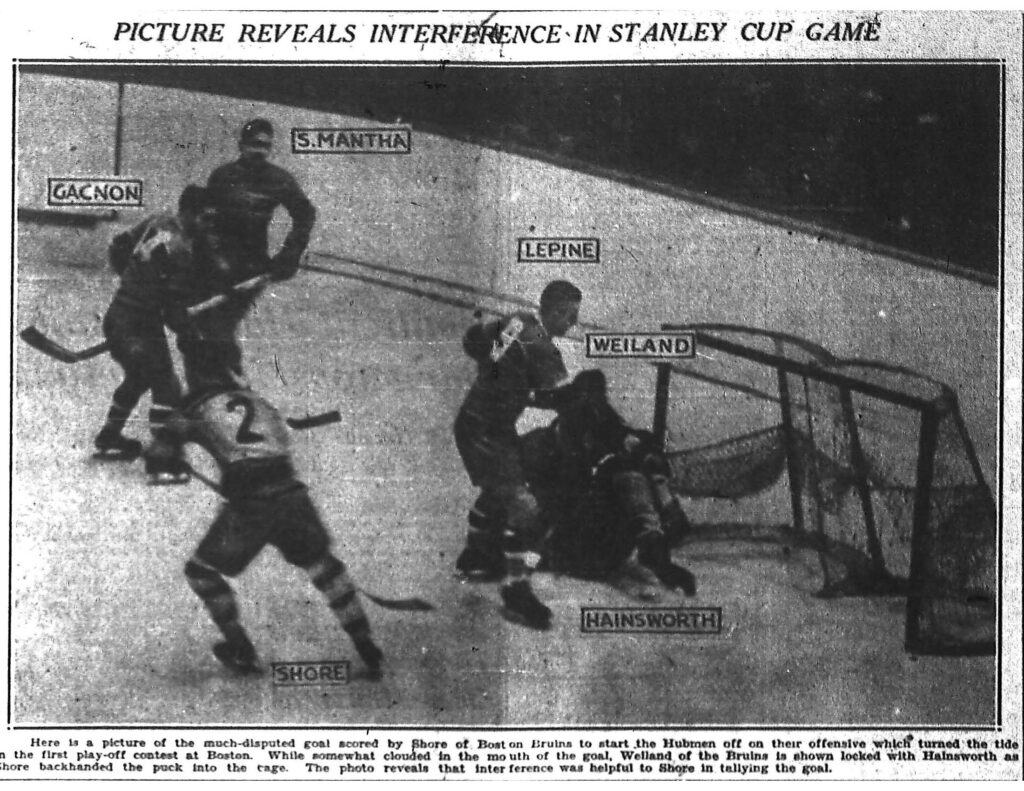
The moment was caught in a photograph, and some Canadiens’ partisans saw menace in the picture. Joliat is identified as chasing Clapper behind the net, but too far behind. It likely isn’t Joliat, whose penalty set up the opportunity. Gagnon is identified as coming back too late to intercept the pass from Clapper to Shore. Lepine is identified as tied up with Weiland on top of Hainsworth at the right side of the goal – leaving the whole left side open for Shore – which became the patriote’s complaint:
Une photographie prise par lors de deuxieme pointe du Boston montre Weiland etendu sur Hainsworth dans les buts du Canadien, ce qui a permis a Shore de lancer le disque dans le filet et de compter un point. C’est la une autre infraction aux reglements que les arbitres ont toleree. La presse, 26 mars 1931, p.33, c.1 – 2; The Montreal Daily Star, March 25, 1931, p.35, c.3.
The photograph was eventually published in The Montreal Daily Star, March 28, 1931, p.34, c.3 – 6. Weiland was actually lying on top of Hainsworth, as appeared in a photograph published in The Boston American: The Gazette, March 26, 1931, p.18, c.3. As a result, the net was empty. Shore’s shot into the empty cage made it 4 – 2 with 16 minutes left.
The Bruins continued to get chances, particularly by Weiland on feeds from Shore, “as the Bruins laid virtual siege to the Canuck goal”: Boston Globe, March 25, 1931, p.15, c.4
The game descended into panic. Hainsworth came 12 feet out to challenge Shore, and stopped him, while “Morenz cleared desperately as Clapper tried to convert the rebound.”: Boston Globe, March 25, 1931, p.15, c.5
The Bruins’ third goal resulted from a dash into the Canadiens’ zone which seemed to tear the Canadiens defence apart:
Weiland and Clapper came back with a dazzling criss-cross combination that baffled the French defence, and Weiland flashed through the opening to score. . . .
Montreal Herald, March 25, 1931, p.6, c.3 – 4
Clapper fed a neat forward to Weiland, who cut in like lightning, collected in the centre and lifted a beautiful shot that rattled the draperies.
Boston Post, March 25, 1931, p.18.
4 – 3, with 13 and a half minutes to go. The Bruins’ swagger at the face-offs had returned. They had started to become more careful about bulling their way into penalties just as the Canadiens’ efforts to calm the game down were forcing them to exercise more physical restraint on the Bruins. When Sylvio Mantha was called for tripping Beattie, Art Ross re-assembled his forward attack to involve Weiland, Clapper, and Barry. Gainor had been slowing up, not keeping pace. During the power play that followed, Owen got the tying goal:
Owen took the puck from Lepine who was trying to rag the disk behind the Canadiens’ net, and fought it out into the open by strong-arm methods. Several Bruins and several Canucks had whacks at the rubber, but there it was bouncing around 10 feet from the cage. Owen finally got it again and shot it home through a tangled skein of players.
Boston Globe, March 25, 1931, p.15, c.5
With the dependable Sylvio Mantha writhing in the penalty box, the Bruins swung down led by the dynamite line and followed by one and sometimes tow defence players. The puck swung crazily around the Canadien goal and after practically every Canadien player had a chance of clearing it, Owen took the loose puck and flung it through the maze of sticks, legs and flying bodies into the centre of the nets for the tying goal, just less than nine minutes from the end of the third period.
The Gazette, March 25, 1931, p.20, c.1
George Owen started a terrific battle at the back boards, which developed into a mad tossing scrimmage in front of the net. Weiland and Barry had their shots as the bewildered Frenchmen worked strenuously to clear and cover. With the rubber ready to be shot down the rink by a French stick, Owen, the aggressive, smashed it, and with a masterful wrist shot snapped it home for the tying goal.
Boston Post, March 25, 1931, p.18. A similar account appeared in the Montreal Herald, March 25, 1931, p.6, c.1 – 2
Hainsworth was flat on the ice when the tying goal went in. Georges Mantha had overskated the loose puck which Owen then hammered home.
Hats, papers and other loose articles rained from the galleries.
Montreal Herald, March 25, 1931, p.6, c.1 – 2; “delirium”: The Montreal Daily Star, March 25, 1931, p.34, c.1. The score had given the crowd its first glimmer of victory since the start of the second period.The score was even. The Bruins were jubilant. The Canadiens had been under siege. The Canadiens managed to stop the bleeding then, at the mid-mark of the third period, and created a last chance to win in regulation time, while killing yet another penalty:
With Larochelle [perhaps Nick Wasnie considering game summaries] off soon after, Ross again rushed his dynamiters into action, but the desperate Canadien defence foiled them and indeed Canadiens came within an ace of winning the game. With the whole Boston team up on the attack Joliat broke away grabbed a rolling puck and flashed off at top speed. There was no one but Thompson in front of him. Though Owen and Clapper pursued him desperately. In his effort to shake off this pursuit Aurel lost control of the puck as he neared the net and fell heavily . . . .
Montreal Herald, March 25, 1931, p.6, c.3 – 4
Other eyes drew other conclusions:
Shore joined the furious milling about the Canadien net and during a scrimmage Joliat broke loose alone and sped toward the Boston goal. There was no one in front of him but Thompson and “Tiny” hurled himself out when Joliat fired and made a sensational stop. Morenz came up fast but Shore was covering the net when he fired.
The Globe, March 25, 1931, p.11, c.1
The rest of the last 9 and a half minutes were scoreless, and tense:
C’etait une lutte furieuse et acharnee. La presse, 25 mars 1931, p.24, c.1 – 2
With the score tied and time running out, the referees put away their whistles, much to distress of Albert Laberge of La presse:
Les punitions ont fort nul au Canadien. Plusieurs infligees par Hewitson n’etaient nullement meritees. Sylvio Mantha recut de Shore un coup de baton sure la tete et le jouer du Canadien fut puni. Georges Mantha a eu le menton fendu par Hitchman et a du se faire faire [sic] deux points de suture. Hitchman n’a pas ete puni. Leduc a aussi eu la figure fendue.: La presse, 25 mars 1931, p.24, c.1 – 2
As the overtime began, the referees began to call penalties again, and again it was Morenz and Shore coming to the fore:
Canadiens were put at a disadvantage early when Wasnie accidentally cross-checked Barry on the nose and drew a penalty. Then Shore and Wasnie were chased together after scrambling on the ice. Leduc and Clapper crashed in a head-on collision.
Montreal Herald, March 25, 1931, p.6, c.3 – 4
The Bruins caught an early break, Wasnie going off for high-sticking Barry. The Bruins promptly put on a four man attack, which failed, the puck going to Morenz. Shore and Owen clipped him as crossed the line. Weiland poke-checked Morenz on the return rush.
The Globe, March 25, 1931, p.11, c.1 – 2
When Wasnie cross-checked Barry the Bruins had the advantage. . . . but Dit missed his shot by yards. Morenz broke back, catching Shore alone but Ed hit him just as Owen came with help and Howie was cornered.
Boston Post, March 25, 1931, p.18
Joliat messed another chance:
Joliat broke free on one of the sieges and had absolutely no one to beat for the winning goal, but just as he got ready to shoot, he lost control of the puck momentarily and Thompson made a brilliant game-saving dive: Boston Globe, March 25, 1931, p.15, c.5. See also: The Montreal Daily Star, March 25, 1931, p.35, c.3.
And then Wasnie had a chance:
Burke fed Wasnie a nice pass when both teams were back at full strength, but Shore flattened Nick before he could shoot. This led to a high-sticking embroglio, in which Wasnie, Shore, Morenz and Owen were involved, with Shore and Wasnie drawing penalties.: Boston Globe, March 25, 1931, p.15, c.6
Wasnie cracked Shore on the dome with a stick, Owen dumped Wasnie; Wasnie and Shore were banished; but Owen remained, to mete out punishment as he saw fit.: Boston Globe, March 25, 1931, p.15, c.8
Morenz and Shore traded their own chances:
As Shore stepped out of the box he got a pass and followed with a bullet drive that rocked Hainsworth. This was matched by one of Morenz’ drives: Boston Post, March 25, 1931, p.18
Just past the 15 minute mark of overtime, Leduc and Clapper collided head on while racing for a loose puck:
Leduc was badly cut when he tried to stop Clapper, who was hitting up a swift pace. He did stop him, but was crashed down and his head bounced off the ice. Boston Post, March 25, 1931, p.18
Leduc collided with Clapper and the former retired with a gashed head.: The Globe, March 25, 1931, p.11, c.2
Leduc had to leave the game with a cut over his left eye, and was still groggy an hour later. The Montreal Daily Star, March 25, 1931, p.36, c.3
Still Morenz led the Canadiens’ offence as the game reached its 78th minute:
For 18 minutes and 56 seconds of the sudden death period, there was no scoring, though Morenz had twice threatened to win the game single-handed and was foiled only by magnificent saves on the part of Tiny Thompson.
Boston Globe, March 25, 1931, p.15
There was the first chance:
Morenz put on two great individual rushes which almost won the game outright. On the first one he raged through the Boston defense with a brilliant display of stick handling which carried him into the open, 10 feet in front of Thompson. Then he let drive with all his might. The shot was waist high and on the post. Thompson kicked like a ballet dancer, the puck going off his thigh to safety.
Boston Globe, March 25, 1931, p.20,
In desperation Morenz broke across centre, bore in on Shore and Owen and sent a comet shot away that was deserving of a goal, but Tiny kicked timely and caromed it clear.
Boston Post, March 25, 1931, p.18
And then, the second, this time against Shore himself:
A second later Morenz was in again. This time he carried square down the middle and again was all alone. Shore drove desperately, stick extended from behind, and cut Howie down before he could shoot.: Boston Globe, March 25, 1931, p.20.
Again Morenz roared in with advanced spark. Shore did a noble job in blocking him, and a hot scrimmage resulted. Larochelle picked out of the scramble and let drive as Tiny, on his knees, threw out his stick arm and connected with the rubber very luckily.: Boston Post, March 25, 1931, p.18.
Thompson, already down, stopped Larochelle’s “low whistling drive” from the right side by throwing out the back of his right hand to make a “marvelous” save: Boston Globe, March 25, 1931, p.15, c.6.
It was then that the referees assessed the third penalty of the game to Canadiens’ captain, Sylvio Mantha – this time for interference on Shore. The Bruins led with their “Dynamite” line of Clapper, Weiland, and Barry, with Shore and Owen on the defence. The Canadiens played with Lepine and Morenz up front, Burke and Leduc on defence:
Two Boston assaults were turned back by dint of shooting the puck the length of the rink. Shore retrieved the disk on the last of these, and set sail down the ice with Owen back at defense, but the rest of the team sweeping along his wake and on his flanks.
Shore bore to the left as he hit the Canucks’ defense and was half tossed by Marty Burke. Shore and the puck slid into the corner. Shore regained control and attempted to pass out. George Hainsworth, the stolid Englishman who guards the Canadiens’ net, intercepted and since there was no one to clear for him, had to attend to that task himself.
The Globe, March 25, 1931, p.11, c.2
The Gazette, March 25, 1931, p.20, c.1:
The goalie dropped the puck to the ice and lifted it high straight ahead in an effort to get it out of the danger zone. But Cooney Weiland, playing with the eclat of a big league infielder, reached high over his head, caught the puck and dropped it to the ice in front of him. A quick movement into position and he buried the rubber behind the helpless Hainsworth for the winning goal.
The Boston Globe, March 25, 1931, p.15, c.3 had a more complete report:
Instead of clearing to the wings, which were thickly populated with Bruins, George decided to hoist one down the middle over the heads of the gang out in front of him. Hainsworth thus got his stick under the disk, and, mashie shot fashion, cleared.
Cooney Weiland was directly in the path of the high-flying puck, 20 feet out, directly in front of the goal. Cooney reached up with his right hand and speared the puck, shortstop or centerfield fashion, dropped it on the ice in front of him, took two or three steps and let it drive. The puck went off the ice, rebounded off Hainsworth’s chest and into the net, and, although the Canadiens protested strenuously, that was the end of the game.
Had it been a mistake, a moment of hubris or panic on the part of Hainsworth, or an uncontrollable rebound? La presse suggested that the puck rebounded from the Eddie Shore shot, hit Weiland in the face, whereupon Weiland knocked the puck down and shot it into the Canadiens’ net for the winning goal:
Eddie Shore, arreta une attaque du Canadien, et s’empara du puck. Il fit le tour des buts du Boston pour prendre son elan, fit une course de toute la longeur de la glace, passa entre Sylvio Mantha et Burke, et tira un coup terrible vers les buts du Canadien. Hainsworth arreta la rondelle avec son baton. Le disque rebondit en avant par desous les tetes de joueurs. Il a frappait Weiland a la figure lorsqu celui-ci le rabattit avec la main et le frappe avec son baton, l’envoyant dans le filet du Canadien.: La presse, 25 mars 1931, p.24, c.1 – 2.
The La presse report contains documented errors. Among all the papers, only La presse believed that Shore was involved in the play, and only La presse asserted that the goal happened with Sylvio Mantha on the ice. The La presse report is unreliable because Mantha’s penalty late in the overtime period had been the pivotal moment for the change of players.
In a separate part of their coverage, La pressewent on with a different interpretation of events:
Weiland a recu le credit pour le point decisif, mais ce point n’aurait pas du etre accorde. Hainsworth repoussa le puck tire par Shore en le frappant avec son baton. Weiland le saisit au vol avec la main, le jeta la terre et le frappe ensuite avec son baton, l’envoyant dans le filet de Hainsworth, avant que ce dernier fut en position.: La presse, 25 mars 1931, p.24, c.4 – 5
Had Cooney Weiland fouled by closing his hand on the puck by making a “catch”? The play preceding the goal had been described as a catch by the Boston Post and the Boston Globe:
Shore . . . lifted high, and the rubber cracked off Hainsworth, who cleared high to little Weiland’s head. Cooney reached, made a catch, tossed it to the ice and socked it to the strings for the victory goal.
Boston Post, March 25, 1931, p.18
Cooney Weiland played the hero’s role in a tightly drawn, overtime finish last night, blasting the winning score past Hainsworth after making a left hand catch of which Freddy Lindstrom might have been proud.
Boston Globe, March 25, 1931, p.20.
Lindstrom was a major league third baseman/outfielder who played between 1924 and 1936, and was voted into the Baseball Hall of Fame in 1976.
The Toronto Globe reported the “catch” version of the play, as did The Montreal Daily Star:
Bruins cyclonic finish . . . brought in its wake a raging controversy. This hinged round the scoring of the final goal by the nimble witted Cooney Weiland who seemeingly seized Hainsworth’s pass out in his hand, dropped it to his feet, and swished the puck into the nets before Canadiens could stop his daring manoeuvre. . . . Weiland reached up in baseball fashion, almost leaving his skates and seemingly caught the puck in his hand which closed for the fraction of a second. He knocked the disc down in front of him, caught it cleverly in his stick, and whipped home a scorching drive while Canadiens looked on in amazement.
The Montreal Daily Star, March 25, 1931, p.34, c.1 – 2; p.36, c.3
Elmer Ferguson took an authoritative tone in in the Montreal Herald:
This is the way the play happened. . . . The story was tied at four-all when with Sylvio Mantha off the ice, Bruins made a smashing drive onto the Canadien cage. From a short range out Dit Clapper tossed a hot drive. Hainsworth blocked it neatly, but the Bruin mob was swirling about the premises. There was no time . . . . Hainsworth had to clear in a hurry and he threw the puck straight out to relieve the situation. It just so happened that right in the run of the clearance, which was shot well up in the air, little Cooney Weiland was stationed. The fast-thinking midget threw up his hand, and like a shortstop spearing a hot line drive, he either grabbed or knocked down the puck. Whatever he did, the rubber flopped to the ice in front of him. Weiland took a stride forward, picked up the rubber on his blade and drove it like a bullet. Flashing through the maze of legs it sped straight as a bullet and though Hainsworth frantically hurled himself towards it he was a fraction of a second late and the rubber bit deep into the twine in the centre of the cage. . . . The Canadien claim is that Weiland actually grabbed the puck in his hand and held it momentarily before flinging it to the ice, a proceeding that calls for a penalty. . . . .
Montreal Herald, March 25, 1931, p.6, c.1 – 2
Years later, Ferguson’s recollection of the goal was just as fresh, but different. He had it happening off a face-off:
There had been a face-off, and Cooney Weiland, a great little centre-ice player who at one time held the scoring championship of the National League, faced Morenz. The puck shot into the air as the sticks clashed. Weiland jumped swiftly, batted it down with his hand, pounced on it like lightning and blasted off the shot that won the game, all done more quickly than you can write, or even read, the words describing the play.
Morenz was heart-broken. He felt that he alone was responsible for the defeat of the team, because that’s the kind of player, that’s the kind of man he happened to be.
Ferguson, Elmer, “The Calvert Sports Column”
Thirty years later, George Sullivan repeated the same “face-off” version of the goal for the purpose of describing Morenz’s character as a player:
Morenz could never bring himself to accept defeat. A loss turned him grim and sullen. Once, in a game against the Bruins, Morenz was matched against Cooney Weiland in a face-off. Both men slashed at the puck at the same instant. It exploded into the air and landed in back of Howie. Weiland took a desperate swing, and his shot landed in the Canadiens’ net for the game’s only goal.
Sullivan, George, Face-off: A Guide to Modern Ice Hockey, D. Van Nostrand Company, Inc. (New York:1968), p.116
Those later versions were simply legend – not true. On March 25, 1931, Weiland certainly had shown the presence of mind and physical dexterity to transform the moment into one of exultation for himself, his team, and the thousands of fans waiting for the completion of their team’s resurrection from death. The Canadiens immediately clustered around Mickey Ion:
LE CANADIEN EST VICTIME D’UNE INJUSTE DECISION
Battu d’une facon tres regrettable au bout de pres de vingt minutes de jeu supplementaire, le Canadien a ete la victim d’une etrange decision hier soir dans la premiere partie de sa serie avec le Boston. . . . Le Canadien protesta vigoureusement aupres des arbitres Ion et Hewitson, mais sans success.
La presse, 25 mars 1931, p.24, c.4 – 5
Those Canadiens were not slow to show their feelings after the game and beefed and crabbed over “Coonie” Weiland’s final goal, but it was the same old story with the Flying Frenchmen. They are okay when they are winning but they certainly hate to take a licking and that trimming last night was the toughest that Howie Morenz, Aurel Joliat & Co. ever suffered.
Boston Post, March 25, 1931, p.18
Morenz had been standing beside the Canadiens’ goal even as Mickey Ion, and Bobby Hewitson started moving away:
. . . the Canadiens crowded around Referee Ion, and argued violently that Weiland had broken the rule in catching the puck, but Ion stoutly held that he had batted the puck with an open hand. Albert Leduc was almost frantic as he led the appeal to Ion, but after a few moments, Howie Morenz sadly tapped him on the shoulder and led him to the dressing room.: The Gazette, March 25, 1931, p.20, c.1
As the celebrating Bruins left the ice, and as the howls of Bruin fans were hurled down from the upper galleries, Morenz discovered how exhausted he was:
Ce fut la un rude choc pour le Bleu Blanc Rouge. Les joueurs du Canadien resterent comme paralyses et immobilizes, lorsque la lumiere s’allume soudain, signe de desastre pour eux.: La presse, 25 mars 1931, p.24, c.1 – 2
The 5 – 4 score represented a record number of goals for a playoff game at the time. But the Canadiens had failed to protect their hard-earned lead. Howie Morenz had led the powerplays and killed penalties. He had created chances and goals:
In the crowding of events that culminated in Weiland’s goal, several personalities stood out. One was that of Weiland who figured in four of the five Bruin goals, scoring two. Then there was Howie Morenz, the tireless centre star, who was the inspiration of his team in piling up their huge lead, and the man who fought hardest as he saw the lead and the game slipping from his fingers.
The Gazette, March 25, 1931, p.20, c.1
Morenz . . . led a tremendous attack and he was held, wrestled and hustled out of the defensive zone nearly every time he raced it, but he spun Thompson round with terrific drives in the third period and overtime that were worth a better fate.
The Montreal Daily Star, March 25, 1931, p.35, c.3
He had backchecked:
Howie Morenz is noted, especially as a razmatz offensive hockey player, but if you do not think that he can check a body, ask Cooney Weiland. Boston Globe, March 25, 1931, p.15, c.7
Even in defeat he had impressed the home team’s followers:
Somebody said that Howie Morenz was a team in himself. It’s a falsehood. He’s a whole league.: Boston Globe, March 25, 1931, p.15, c.7
Despite all of that effort, tonight had been Eddie Shore’s night at the Boston Garden. A goal, two penalties, and he had been able to haul down that late rush by Morenz – without getting penalized:
As goes Ruth, so go the Yankees. As goes Shore, so go the Bruins.: Boston Globe, March 25, 1931, p.15, c.8
The Bruins crowded into their own small dressing room at the Boston Garden, already beginning to believe that they were invincible. They had played steadily and fallen well behind – three goals behind with less than a period to play. And then they had won. The Canadiens could never, ever have them so near defeat again.
If those three Bruin goals by Shore, Weiland and Owen did not break the hearts of Cecil Hart’s Red Shirts they will deserve unstinted praise for their morale. Whatever happens in the next two games, that sudden overwhelming surge of the Boston team is likely to haunt the men of Montreal. Here was a golden opportunity gone to waste, for when will the day come again when Les Canucks hold a three-goal lead against the Bruins with only 17 minutes to play?
Boston Globe, March 25, 1931, p.20, c.3
Canadiens Starters: Hainsworth, S. Mantha, Burke, Morenz, Gagnon, Joliat
Canadiens Subs: Mondou, Wasnie, Leduc, Lepine, Larochelle, Lesieur, G. Mantha, Rivers
Boston Starters: Thompson, Shore, Hitchman, Weiland, Barry, Clapper
Boston Subs: Owen, Galbraith, Oliver, Darragh, Gainor, Beattie, Lyons, Chapman
Referees: Ion, Hewitson
First Period
No scoring
Penalties: Galbraith (high stick), S. Mantha (holding), Burke (trip), Clapper (charging)
Second Period
1. Canadiens Gagnon (Morenz) 5:28
2. Canadiens Wasnie (Leduc) 6:26
3. Bruins Clapper (Owen, Weiland) 17:34
4. Canadiens Burke (Morenz) 19:08
Penalties: Shore (hooking)
Third Period
5. Canadiens S. Mantha (Morenz, Lepine) 2:45
6. Bruins Shore (Clapper) 3:49
7. Bruins Weiland (Clapper) 6:29
8. Bruins Owen (Barry, Weiland) 10:37
Penalties: Shore (holding), Joliat (holding), S. Mantha (trip), Gainor (trip), Wasnie (holding)*
Overtime
9. Bruins Weiland (unassisted) 18:56
Penalties: Wasnie (high stick), Shore (holding), Wasnie (holding), S. Mantha (interference)
*The game summary in the Montreal Herald, March 25, 1931, p.7, c.7 shows the third period penalties as: Shore, Joliat 2, S. Mantha, Gainor, Larochelle, Clapper