Chapter 2: Cut Down
Canadiens at Bruins, March 26, 1931
Both Boston and Montreal’s English journalists predicted that the haunted and fatalistic Canadiens would be demoralized by their collapse on Tuesday night. The French press was of the view that the Canadiens had suffered from over-confidence, and hadn’t managed the balance between their starters and their substitutes sufficiently well.
As game time neared, Bruins fans were offering 8 – 5 odds against the Canadiens – and several patriotes supporting the Canadiens, including Sprague Cleghorn, “helped themselves freely at this price”: The Montreal Herald, March 28, 1931, p.10, c.4 – 5.
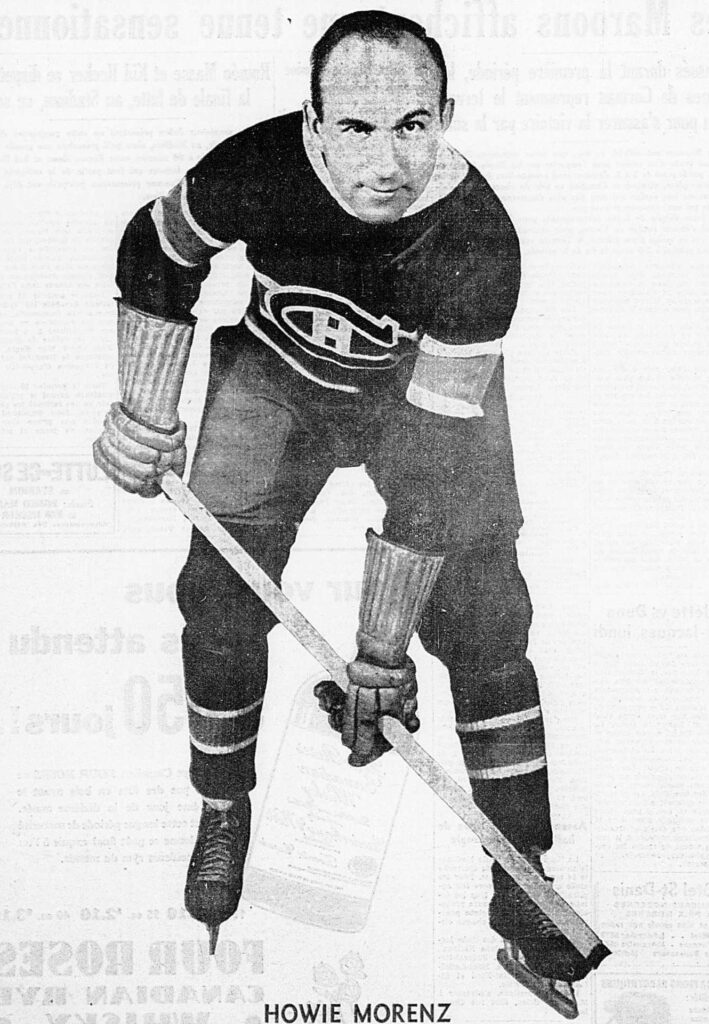
Howie Morenz, once again starting up front between Gagnon and Joliat, launched the visitor’s attack with a determination and panache that seemed to surprise the Bruins::
La partie a commence en ouragon, le Canadien se lancant a l’attaque ave une ardeur irresistible.
La presse, 27 mars 1931, p.33, c.1 – 2
The Canadiens went into it with their nerves on edge . . . and that mental restlessness found its relief in speedy well-timed hockey. From the drop of the puck, the Bruins were outskated and outsmarted by their opponents . . . .
The Gazette, March 27, 1931, p.16, c.3
In the three minutes of play before the Bruins could manage their first shots at Hainsworth, Howie Morenz set the tone: the Canadiens were going to make a frontal attack against the Bruins, and were ready to go through them if necessary. On his first rush Howie carried the puck directly at Eddie Shore, and was dropped so heavily by the Boston defenceman that his body knocked Weiland down on the rebound. Morenz found the puck, and drove directly at the Boston defence again. This time both Shore and Lionel Hitchman floored him, but in the meantime Sylvio Mantha got deep with the puck, and fed Joliat from behind the Bruin net for the first shot of the game.
If the Bruins believed that Howie Morenz, or any of the Canadiens, could be discouraged by physical intimidation, they should have reconsidered as soon as Dit Clapper took a run into Marty Burke:
Clapper had skated at full speed into Burke, and threw his own shoulder out of joint with the collision. The Boston Globe, March 27, 1931, p.40, c.5
. . . and he lay writhing on the ice while the play left the Canadiens’ end and went the other way, . . . . The Boston Post; March 27, 1931, p.42, c.3
The Canadiens were in a mood to persevere despite any threats of heavy going. They immediately went back on the attack:
Howie Morenz and his wings got deep into Boston territory on Joliat’s rush. They peppered Goaler Thompson with hard drives but he cleared them all. The Globe, March 27, 1931, p.10, c.5
Despite Clapper’s experience, the Bruins remained committed to the idea that they could physically dominate the lighter Canadiens, particularly Morenz:
It was apparent that Bruins were concentrating on Morenz, and Shore charged him to the ice three times in the first ten minutes but Canadiens counter checked the big bump and biff man slowing him up somewhat, and they guarded their flanks with military precision darting back to cover up at the point of the blue line with Lepine’s stick patrolling pucks out of danger.
The Montreal Daily Star, March 27, 1931, p.40, c.1
As the Bruins progressively escalated their physical game against Morenz, it was perhaps inevitable that Shore would take the game’s first penalty. The Canadiens sensed an advantage, but the Bruins did not break, at least not then.
The pivotal moment of the period instead came when Pit Lepine used his stick to intercept a Bruin pass on a three man Bruin rush:
Ce fut Pit Lepine qui commenca la besogne. Alors que trois joueurs de Boston faisaient une attaque, il accrocha le disque avec son baton tendu en travers de la glace. Il fit und descente le long de la cloture, mais comme Shore le pressait sur la bande, il tira un coup que Thompson arreta avec ses jambieres. Le disque rebondit sur le cote droit de la glace ou Georges Mantha arrivait en cyclone. Shore et Owen se precipterent pour s’emparer de la rondelle, mais entraine par son elan, Mantha arriva avant eux et envoya le puck dans le coin du filet avant que Thompson put se mettre en garde.
La presse, 27 mars 1931, p.33, c.1 – 2
It was “Pit” Lepine who started the tallying play. . . . his sweep check broke up a three-man Bruin attack. He swept down the boards and as Shore shoved him against them, he let fly a shot that Thompson stopped with his pads. The rubber bounced out to the right where George Mantha was speeding in at a terrific rate. Shore and Owen rushed to head off the younger Mantha, but his speed carried him between them and he whipped the puck into the far corner of the net before Thompson could get into position.
The Gazette, March 27, 1931, p.16, c.3
Georges Mantha was playing, like his brother Sylvio, “encased in adhesive tape.” His jaw had been injured in the first game, and he would later observe that in addition to being ill before the game, he had played the whole game with a severe headache – proof enough that he was still suffering from the concussion that had disrupted him in the first game.
Scoring the game’s opening goal “with apparent ease” (The Boston Globe, March 27, 1931, p.40, c.3) demonstrated a defiance in the face of these troubles, and the Bruins. It was an attitude appreciated best in the moment by his own teammates.
Immediately after they had taken the lead, the Canadiens changed the pace of the game:
A partir de ce moment, le Canadien profitant de son experience de mardi ne prit pas de risque inutile. La presse, 27 mars 1931, p.33, c.1 – 2
Canadiens confined their own attacks to one and two man sorties. The Boston Globe, March 27, 1931, p.40, c.6
Albert Leduc made an appearance for the first time, wearing a boxer’s head protector. The headgear was intended to protect the large bandage wrapped around his head because of his own Tuesday night collision. Leduc soon tired of the headgear, spurning any potential protection that it offered in favour of the more familiar feeling of free motion and vision:
He soon discarded the headgear if not the headache, and played sound and steady hockey throughout. The Montreal Daily Star, March 27, 1931, p.40, c.2
The Gazette, March 27, 1931, p.16, c.4 reported that he waited until the second period to do so. See also: The Boston Globe, March 27, 1931, p.40, c.6. But Leduc’s availability and effectiveness were noticeably limited. The Gazette would continue to describe his head injury as a “slight concussion” a week later: The Gazette, April 1, 1931, p.20, c.3. The point for both the Bruins and his Canadien teammates was that this was another statement of defiance against the Bruins’ physicality.
Just before the first period ended, Shore crosschecked Burke – perhaps by way of an answer for Clapper’s self-inflicted separated shoulder – and was penalized. The Canadiens were back into the Bruins’ zone with a man advantage. Just as the period was ending, Shore returned to the ice, and was immediately hit hard by Sylvio Mantha. The Canadiens were not offering any open ice to the Bruins, and no opportunity to respond physically to the Bruins was going to go unanswered.
In the early moments of the second period the Canadiens continued to keep three skaters back while two attacked. Coach Hart had put Howie Morenz on the wing with Pit Lepine at centre, and in the first minute Lepine gave Morenz a chance with a pass out from behind the Bruins’ net. Thompson was forced to dive to make the save. Howie was responding to the disappointment of Game 1 with an eager game:
Le grand Morenz est tout a fait lui-meme ce soir et tout comme son confrere Joliat il couvre la glace a grande vitesse. La patrie, 27 mars 1931, p.12, c.3
At about the five minute mark:
Sylvio Mantha was given a unique penalty when he juggled the puck in his hand and was ruled off.: The Montreal Daily Star, March 27, 1931, p.40, c.2; The Boston Globe, March 27, 1931, p.40, c.5
The penalty was a particular surprise to the Canadiens supporters after the non-call by the same referees on Weiland two nights before. Shore immediately led a 4 man attack into the Canadiens’ zone and fed a pass to Clapper for the Bruins’ best chance of the period. Clapper was unable to poke the puck between Hainsworth’s skates, perhaps because of his increasingly uncomfortable shoulder. Then:
Hainsworth saved beautifully on a fierce Owen shot, which started another mess, with Morenz finally clearing. The Boston Globe, March 27, 1931, p.40, c.5
Whether Howie’s wrist was still bothering him after being bent against the boards in the first game, Coach Hart was relying on him heavily by double-shifting him on offence, as well as relying upon him for penalty killing and back checking: La patrie, 27 mars 1931, p.12, c.3, 4. That load increased when Lepine took a butt end to the face from the stick of Marty Barry during a goalmouth scramble, was cut for stitches, and forced to miss 5 minutes for repairs.
George Hainsworth stopped 4 good Bruin chances in the period, further knitting together the sense among his teammates that each one reinforced the efforts of the others. Then one Weiland backhand hit him in the neck, and another Weiland chance from the other side brought him to his knees. Barry tried to jab that puck under him, but Lepine was back and knocked Barry away as the play was whistled dead.
Marty Barry continued to play a rougher style into the early minutes of the third, and was creating chances as the Canadiens clung to their 1 – 0 lead. Early on he made a rink-wide pass to Clapper from the left side, which Clapper carried unopposed right to the goal mouth. Hainsworth dove “right into the shot,” stopped it:
. . . and George swept the puck aside with his hand as he lay on his back on the ice. The most spectacular save of the game. The Montreal Daily Star, March 27, 1931, p.40, c.2
Howie Morenz became more visible in response to that:
Morenz then in succession, evaded every member of “the dynamite” line and cracked open the Bruins’ defense. Just as he was ready to shoot, Barry swept in from the left and rear to steal the puck. The Boston Globe, March 27, 1931, p.40, c.6
Then it was Morenz again:
Morenz took a terrible checking when he tried to divide Shore and Hitchman. Morenz was holding down left wing on the play, Lepine working in the centre.: The Globe, March 27, 1931, p.10, c.5
Weiland had a chance at the other end that Hainsworth “stopped with his chin.”: The Globe, March 27, 1931, p.10, c.5.
Morenz persisted in this game where every one of his teammates was being called upon for self-sacrifice:
Morenz was playing one the best games he ever provided on Boston ice, but the Bruins’ defense was much too much for him. The Globe, March 27, 1931, p.10, c.5
Playing more consistently on the left wing, with Lepine still at centre, Morenz was called upon to use his speed within his own zone, and the Bruins’ zone, to disrupt the Bruins’ attack. One one chance while he was forechecking, the puck became available on the left side, and he chopped a backhander towards the net. Only a fast stick lunge by Thompson saved a goal. In his own end he was searching for the moment when he might rip the play away in the other direction. But he soon found himself in position to do even more.
It happened as he had been chasing a Bruin rush led by Hal Darragh down the ice. Darragh swept around behind the Canadiens’ net and drew Hainsworth out – too far, too far, Morenz thought. Howie dove towards his own goal, turned on his knees, and braced himself on the goal line – an ankle against each post:
Hainsworth lunged but missed, but Howie Morenz sat himself down in the cage, spread-eagled and when the puck came sliding in, clutched it desperately. Hainsworth was cut in the play . . .
The Boston Globe, March 27, 1931, p.40, c.6
Comparing the different journalistic reports of that sequence provide an approximation of the different camera angle replays we have come to expect both on arena scoreeboards and in broadcast presentations of the modern game:
Howie Morenz made one notable play when Hainsworth was knocked to the ice. He sailed into the nets, went to his knees and took a blistering shot from Barry right in the stomach, a drive that almost knocked his wind out but saved a goal.
The Montreal Daily Star, March 27, 1931, p.40, c.2.
[The Star’s is the only report that attributes the shot on Morenz to Barry. All others attribute it to Darragh.]
Morenz leaped into the cage behind Hainsworth and stopped a hard shot while sitting on the ice.
Montreal Herald, March 27, 1931, p.10, c.3 and 4
Morenz, covering it, stopped Darragh’s shot an inch outside.
The Globe, March 27, 1931, p.10, c.5
Morenz would fling himself between the posts to protect the net during a temporary absence by Hainsworth without a second thought. He had hurled himself into Hainsworth’s place before: e.g, The Globe, November 18, 1931, p.8, c.5. Now, when he had anticipated its necessity, he did it again without hesitation. It was part of how he played a complete defensive game.
More danger lurked in the scramble while chaos reigned around Morenz:
Chapman, Darragh and Lyons combined in a rush, and during a wild scramble about Les Canadiens’ net Hainsworth was injured. . . . Time was called, and Hainsworth left the ice for treatment.
The Globe, March 27, 1931, p.10, c.5
Darragh swung the net to force a redhot scramble in front of Hainsworth. The sticks were flying like toothpicks before an air blast. Hainsworth was down and Morenz was sitting in the goal mouth with legs far apart. Lucky he was for Darragh lifted and Morenz made the play. When the pile was unraveled Hainsworth couldn’t get up and blood dripped from his face. It was believed that on Darragh’s shot to Morenz Darragh’s stick smacked the goalie as it was lifted.
The Boston Post, March 27, 1931, p.42, c.5
Hainsworth may have been cut by a skate rather than a stick in the stew that surrounded him. The repairs to his face, and the scraping of his blood from the ice, provided the Canadiens with a breather. The Boston Globe, March 27, 1931, p.40, c.7 suggested 15 minutes, The Montreal Daily Star, March 27, 1931, p.40, c.1, suggested 10 minutes. The Gazette, March 27, 1931, p.16, c.4 said 8 minutes.
As soon as Hainsworth returned, Shore led Weiland with a pass. Weiland drove for the net while Hainsworth dove towards the puck, and the chance collapsed. Morenz replied by setting up George Mantha, but Mantha “muffed sadly on his shot”: The Boston Post, March 27, 1931, p.42, c.4
The Bruins started sending 4 men up the ice with about 4 minutes remaining, putting additional pressure on the Canadiens. As solidly and carefully as the Canadiens were playing:
Les Canadiens rendirent “body check” pour “body check” et defendirent leur fortress avec une energie que rien ne put laisser.: La presse, 27 mars 1931, p.33, c.1 – 2
Obviously tiring, they “played not their usual fine hockey, but dogged, grim, desperate hockey”: The Boston Globe, March 27, 1931, p.40, c.4.
The unexpected and disappointing loss in the opening game had shown Morenz and the Canadiens the reality of failure. Their common fear of losing now spurred each diligent and mutual effort in a “doggedly-fought, if not sensational, game”: The Montreal Daily Star, March 27, 1931, p.40, c.1 – 2.
Marty Burke’s defensive play began to stand out. He had been hitting heavily all game, with “a lot of effective jabbing and soul-stirring body checks . . . given with fervor and abandon”: The Montreal Daily Star, March 27, 1931, p.40, c.1, 2. In addition:
He used judgment in placing long shots down the ice in the third period, making Bruins go the full length of the rink to bring the puck back into play fully a dozen times.
The Montreal Daily Star, March 27, 1931, p.40, c.2.
There was no whistle and new face-off in the defensive zone as a consequence of icing at the time.
Meanwhile, Howie Morenz by turns pressed the attack, and checked back:
The Bruins . . . crowded five men into Canadiens territory during a long series of rushes. Morenz got ahead of the Boston pack on a counter drive but was overtaken by Shore and checked out of his shot. Shore gained the puck on Joliat’s wide shot but lost it at the enemy blue line. Morenz broke loose again and got inside of Owen and Shore. George, however, yanked the puck away from him with the prettiest hook check seen here this year.
The Globe, March 27, 1931, p.10, c.5
It was perhaps inevitable then that the two main protagonists of the early third period – Burke and Barry – would collide again in the last 10 minutes. They met each other along the boards at speed, bounced off each other and then whirled upon each other with their sticks high. First one and then the other made a motion to poke the other with a stick blade. When they reached in to grab at each other, both were penalized for “hooking”
The Montreal Daily Star, March 27, 1931, p.40, c.2
While Burke and Barry watched from the penalty bench, the lightly used Johnny Gagnon picked up the puck in the Canadiens’ zone. Gagnon skated out over the Canadiens’ blueline but hesitated in centre ice and turned back towards his own zone. Then he threw a pass back:
Morenz chased back over his blue line for it but it was too late: The Gazette, March 27, 1931, p.16, c.4
This constituted a “stalling” infraction under the rules of the time, according to Referee Mickey Ion. According to him, Gagnon had sufficient open ice in front of him to continue his attack. Morenz objected, but the penalty stood as yet another assault on the mental equanimity of the Canadiens. With the Canadiens now two men short, Morenz stayed on the ice:
Morenz made Weiland his special play and he transformed himself from a rushing rip-tearing forward to a calculating defensive factor racing back to intercept rushes with canny consistency. The Montreal Daily Star, March 27, 1931, p.40, c.1
Morenz in his new role of back-checker was a regular rampart and his work going up was sensational as he skated round Shore four times and away from him twice in racing for the puck. The Montreal Daily Star, March 27, 1931, p.40, c.2
This was the game that The New York Times would eventually use as the example of Morenz’s superior qualities as a back-checker:
In addition to his unquestioned offensive ability, the Stratford flash is an able defensive player, as he demonstrated only recently in the second game of the Bruins-Canadiens series, when the Frenchmen scored a goal in the first period and held it . . . . In that contest Morenz harmonized perfectly with his defense men and interrupted many a sturdy Boston advance by his clever back-checking.
Nichols, Joseph C., “Players of the Game: Howie Morenz – Speedy Centre of the Canadiens,” The New York Times, April 6, 1931, p.28
Morenz also drew on his capacity for speed, not only on defence, but when he found an opportunity on the penalty-kill for offence:
Morenz broke away from the jam and raced down to beat Shore but Big Ed wouldn’t be fooled and forced the wizard to overskate his shot and lose at the back boards. The Boston Post, March 27, 1931, p.42, c.5
Burke and Barry came back on, and immediately became involved in the play:
Burke broke away when all Bruins but Shore were up on the attack. Morenz went with him, took the pass and easily circled Shore, but George Owen made a phenomenal save. He hurled himself at full length along the ice and slid right into Morenz’s stick, ruining his shot. Montreal Herald, March 27, 1931, p.10, c.3
The Bruins changed. Red Beattie’s line came on, while Shore and Owen continued on the defence. The Bruins were still on the powerplay, Gagnon in the penalty box, and Morenz still directing the penalty kill. In the midst of it. The Boston Globe, March 27, 1931, p.40, c.7, told the story:
Morenz got a swell break, catching everyone but Shore down the ice.
At last the fans were to see the duel they had waited for so long. The world’s greatest forward against the world’s greatest defense man. As Morenz approached Shore, he bore to the right and half got past the Bruins’ star. His angle for the goal was not too bad and he was 10 feet out. Then two things happened at once. . .
The Boston Post, March 27, 1931, p.42, c.5 picked up the narrative:
As Howie crossed centre he was churning along at a terrific pace and ragging like lightning. Shore swung back and then forced Howie a bit to the right and with outstretched stick hindered him from getting one of his bullet shots away.
The Globe, March 27, 1931, p.10, c.5, weighed in:
Shore tried to force Howie to the boards, but the Canadiens’ star cut sharply inside and banked a shot against the goalpost. After shooting a high stick caught Morenz’s face, opening a cut over his eye.
Or, according to The Boston Post, March 27, 1931, p.42, c.5:
Morenz’ shot bumped off the goal post and it appeared as though Howie tumbled into Tiny. Morenz laid there and when he did get up his forehead was cut.
Shore . . . forced Howie a bit to the right and with outstretched stick hindered him from getting one of his bullet shots away. As he lifted, Tiny came out and Shore crossed his path. Morenz’ shot bumped off the goal post and it appeared as though Howie tumbled into Tiny. Morenz laid there and when he did get up his forehead was cut.
The Boston Globe, March 27, 1931, p.40, c.7, speculated otherwise:
Shore dove and Howie shot. The shot was off before Eddie hit his target but the puck hit the near post and skidded out. Morenz fell face forward on the ice and was partially stunned. . . . . Morenz either at the hands of Shore, Thompson, or the ice had been cut in the face . . . .
La presse had no doubts:
Dans la derniere periode, Morenz a ete presque mis hors de combat par Shore. Le brilliant centre du Canadien s’elanca avec la disque, distance tous ses adversaires a l’exception de Shore, qui etait devant lui. Comme il etait sur le point de tirer, il fit un ecart vers la droite pour eviter Shore. Ce dernier, lui embarrassa les jambs et let fit s’etendre avec force sur la glace. Owen tout assouflé arriva une demi seconde plus tard, mais seulement pour voir Morenz etendu sur la glace.: La presse, 27 mars 1931, p.33, c.1 – 4
The sequence of events kept flashing back, sometimes exploding like a pinwheel in the fans’ memories, but the Montreal Herald, March 27, 1931, p.10, c.1, offered its own authoritative take:
Bruins were forcing the attack in most desperate fashion with four men up on attack and Shore coasting about the Boston line as a lone sentry to guard against a possible Canadien break-away. The break-away materialized when Morenz snared a loose puck and darted away at top speed. Shore backed up slowly watching intently the speeding figure which flew toward him. Five feet away from Shore Morenz swerved to the right like a flash. Shore lunged desperately with his stick and either his own stick jabbed Morenz in the forehead, or he lifted Morenz’s own stick. On that point Morenz himself is not quite clear, so kaleidoscopic was the play, but at any rate, Morenz flashed around Shore and raced for the nets. Thompson flung himself straight out in a last desperate effort. Morenz blazed his shot, the puck hit the post and Morenz catapulted into the sliding form of Thompson. Going at blinding speed, the impact threw Morenz high in the air spinning end over end and he crashed face downwards on the ice with a stunning thud and laid there.
The Gazette, March 27, 1931, p.16, c.4 thought there had been a trip by Shore:
Morenz got a break. He tore away from the milling Bruin attack with only Shore to beat. The centre star tried to swerve to the right around the defenceman but as he was about to get his shot away, Shore swung in and tripped him heavily. Owen came panting down a split second later only to find Morenz laid out on the ice from the impact.
The Montreal Daily Star, March 27, 1931, p.40, c.1 considered that it had been an errant slash:
Morenz . . . sped down centre, and went round Shore who wheeled in pursuit, and, as Howie shot, up-ended his stick and hit a stunning blow across the face which opened up an inch gash over his eye and left a trail of lumps across his forehead. Morenz reeled and stumbled over Thompson’s stick, and was out cold as a mackarel. . . . the puck hit the post when Morenz fell.
The Boston Post, March 27, 1931, p.42, c.2 – 3 attributed Morenz’s “slight gash” to his own stick, while Horace Lavigne of La patrie did not attribute any participation in the incident to Shore at all:
Owen etait a la cloture pour cinq minutes, a la suite de sa sauvage attaque contre Howie Morenz. La patrie, 27 mars 1931, p.12, c.1, p.13, c.1 – 2
What had happened was almost less important than the fact that that sudden elixir of speed, confrontation, and violence made for “as thrilling a play as the Garden has seen” according to people who were there:
Some 16,500 people held their breaths as this duel between the irresistible force and the immovable body became apparent. In the ensuing play within the space of a few square feet and a split second, Howie’s shot hit the post, Shore knocked Morenz cold with a desperate dive and then, as a sad anti-climax Referee Mickey Ion ruled George Owen off the ice for five minutes, presumably for inflicting on Morenz a cut which Howie actually sustained either at the hands of Shore, Thompson, or the ice.
The Boston Globe, March 27, 1931, p.40, c.3.
When asked about the play later, Howie Morenz was diplomatic:
Morenz stated in the dressing room after the game that it was Shore who hit him but it was an accident as he was trying to knock his stick up, and away from the puck.
Howie Morenz displaying a large cut on his forehead, and a series of lumps where Shore’s stick rasped him. Morenz declared that it was an accident as Shore had tried to hook his stick and missed. He was skating low at the time with his head down, and the stick flew up, and stunned him with the force of the blow and he tripped over Thompson’s stick as he shot.
The Montreal Daily Star, March 27, 1931, p.40, c.1 and 2
There is a photograph in The Boston Post that was taken some moments after Morenz landed. Morenz and Thompson are prone on the ice. Shore is still skating, while the puck sits just inches from Thompson’s near (left) goal post. George Owen is standing behind the right goal post. The referees have not arrived at the scene.
As fans and reporters quibbled about the cause and grievousness of Howie’s tumble, the unarguable result was that Morenz was on the ice, unconscious and bleeding from a head injury. When referee Mickey Ion caught up with the play he assessed George Owen a five minute penalty for having tripped a player in scoring position, even though Owen had been 20 feet away from the play: The Gazette, March 27, 1931, p.16, c.4.
After some moments of unconsciousness, Morenz:
. . . was assisted to the side but shook himself free of the supporting hands and despite the cut in his forehead from which blood was trickling skated out again towards centre ice. Montreal Herald, March 27, 1931, p.10, c.1
Though perhaps Shore might have deserved a penalty on the play, the Garden fans reacted to the penalizing of Owen with the same kind of righteous injustice that Canadien fans had suffered the game before. The fans’ reaction was immediate:
. . . un tonnere de protestations, et un grele de projectiles s’abattit sur la glace. . . . Des batailles eclaterent a plusieurs endroits dans la foule. Les exhortations au public de ne plus rien lancer sur la glace n’eurent pour effet que de faire tomber une nouvelle avalanche dans la rond.
La presse, 27 mars 1931, p.33, c.3 – 4
. . . the crowd made one of the most violent demonstrations in the history of the N.H.L. Programmes showered onto the ice, fights started here and there in the stands and the exhortations from the speakers to desist only brought more paper down. President Charles Adams of the Boston club walked majestically across the ice to inquire into the penalty, and then Manager Art Ross sent his charges into the dressing room as attendants tried to clear the ice. Canadiens followed a few moments later . . . .
The Gazette, March 27, 1931, p.16, c.4
The game was held up for 20 minutes: The Globe, March 27, 1931, p.10, c.5.
That pause created by the Boston Garden riot gave Morenz and the Canadiens time to recover before the final Bruin onslaught. There were just under four minutes left, but Gagnon still had another minute to serve for stalling. When play was ready to resume, Morenz was at his post. In the language of the day, Morenz had been “stretched out, but recovered.”: The Gazette, March 27, 1931, p.16, c.4
The Boston crowd was still surly as play resumed. Gagnon returned to the ice after about a minute of the Owen penalty – giving the Canadiens a man advantage for the final three minutes of the game. The Canadiens remained firm and “technically perfect” – an expression used both in The Montreal Daily Star, March 27, 1931, p.40, c.1; and the Montreal Herald, March 27, 1931, p.10, c.1.
Even as Howie returned to the ice:
Shore got the puck and went down, followed by all the other Bruins. The Pack, however, was left behind as Morenz leaped out with the puck and started back. Shore overtook him and hooked the puck from him. With two minutes left, Canadiens were strictly on the defense. The Globe, March 27, 1931, p.10, c.5
Art Chapman managed a close-in chance against Hainsworth, but the goaler smothered the play. There were “some 40 seconds” left: The Gazette, March 27, 1931, p.16, c.3, 4. Despite all that had already happened in that night’s game, something else that had never happened in hockey before was about to happen. Bruin Coach Art Ross motioned for his goaltender to leave the ice: McFarlane, Brian; 50 Years of Hockey: A History of the National Hockey League, Pagurian Press Ltd. (Toronto:1970), at p.47; McFarlane, Brian; The Stanley Cup, Pagurian Press Limited (Toronto:1971), at pp.78 – 79.
It was Art Ross’ innovation, but not against Chicago, as claimed in Irvin, Dick; Behind the Bench: Coaches Talk about Life in the NHL, McClelland & Stewart Inc. (Toronto:1993), at p.30. Ross sent Shore, Beattie, Clapper, Chapman, and Weiland out onto the ice without a goaltender. The Montreal newspapermen were generally dismissive of the “stunt,”: La presse, 27 mars 1931, p.33, c.1 – 2; Montreal Herald, March 27, 1931, p.10, c.1 – 2; The Montreal Daily Star, March 27, 1931, p.39, c.4; though Ross’ use of the uncommon stratagem received some grudging admiration from Horace Levigne in La patrie, 27 mars 1931, p.12, c.1. Levigne’s game report noted that this was the first time the strategy had been used in Boston: La patrie, 27 mars 1931, p.13, c.2, which may suggest that Levigne was better informed than some of the other journalists. The Boston Post was intrigued by the potential of the strategy: The Boston Post, March 27, 1931, p.42, c. 3.
The Bruins managed to keep the play within the Canadiens’ zone for the remainder of regulation time, but never managed a shot on goal: The Boston Globe, March 27, 1931, p. 40, c.7. The game finished 1 – 0 for the Canadiens.
Morenz was getting a headache, but the important thing was that the series was tied. According to Arthur Duffey in The Boston Post, there was no doubt about why:
“Howie” was here, there and everywhere, and when it came to his solos down the ice, he never looked better and should have scored at least a couple of goals. No wonder Morenz has been hailed the most valuable player in the National Hockey League ranks. He certainly was the most valuable player in the Bruins-Canadiens’ clash last night.
The Boston Post, March 27, 1931, p.42, c.7. See also: The Gazette, March 27, 1931, p.16, c.4
It had taken every available ounce of him, and of his teammates, to leave Boston on even terms. He had had no goals, nor assists, but once again he had been essential. Would he be well enough to continue?
Canadiens Starters: Hainsworth, S. Mantha, Burke, Morenz, Gagnon, Joliat
Canadiens Subs: Mondou, Leduc, Lesieur, G. Mantha, Larochelle, Wasnie, Rivers, Lepine
Boston Starters: Thompson, Hitchman, Shore, Weiland, Clapper, Barry
Boston Subs: Darragh, Chapman, Lyons, Galbraith, Owen, Beattie, Pratt, Gainor
Referees: Mickey Ion, Bobby Hewitson
First period
1. Canadiens G. Mantha (Lepine) 13:40
Penalty: Shore (hooking)
Shots: by Boston 7; by Canadiens 6
Second period
No scoring
Penalty: G. Mantha (handling puck)*
Third period
No scoring
Penalties: Gagnon (stalling)**, Burke (hooking), Barry (hooking), Owen (major for hitting Morenz)
Stops: Hainsworth 20, Thompson 15: Boston Globe, March 27, 1931, p.40
* All game descriptions attribute the “handling puck” penalty to Sylvio Mantha rather than “G. Mantha” as appeared in print in The Montreal Daily Star and other papers.
**Montreal Herald, March 27, 1931, p.10, c.3 says that the Gagnon penalty followed the coincidental penalties to Burke and Barry.