
An Alternative Approach to the Game
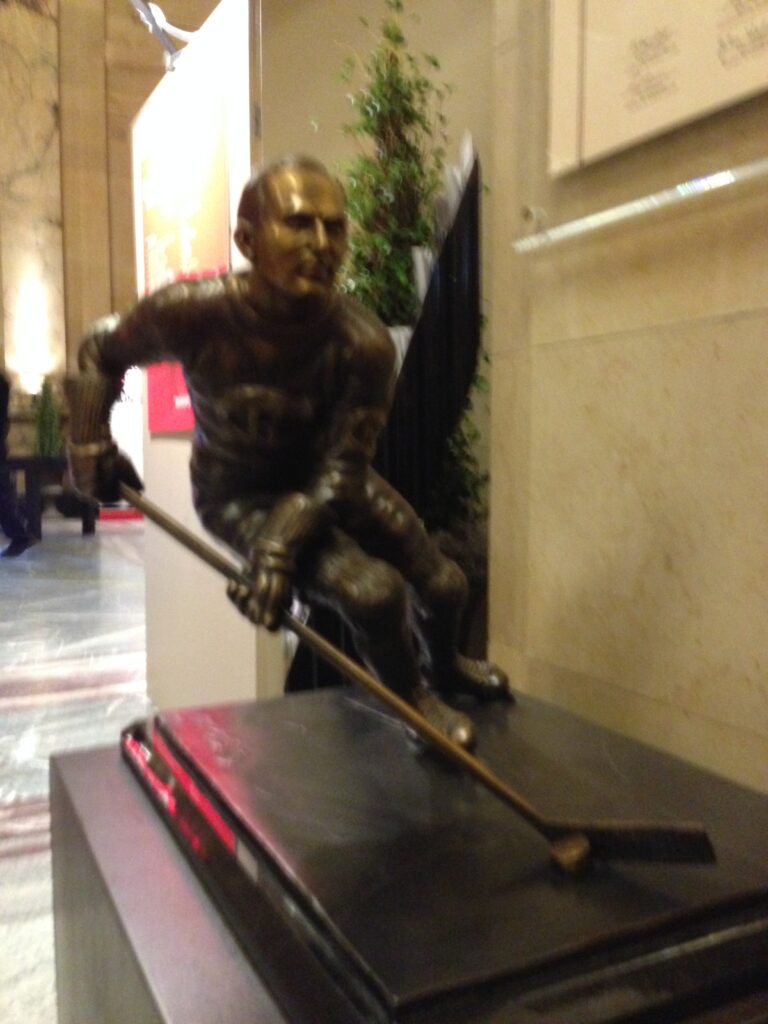
Marc-Andre J. Fortier’s imagined rendering of Morenz as creative inspiration
G.D. Lawrence in The Montreal Herald described what it was like in the late winter of 1931 watching the Canadiens play at hockey without Howie Morenz in the line-up:
It’s like a glass of beer without a collar, Boston without Eddie Shore, Ross without Art, Yanks without Babe Ruth, . . . The Montreal Herald, March 11, 1931, p.7, c.3
Howie Morenz had come to inhabit so much of the fans’ imaginations, that a hockey game without him in it seemed less than what it was supposed to be.
When he had learned his own game twenty years before on the Thames River in Mitchell, he had played for hours at a time. He had played for as long as he had the energy to scurry away from opponents, or to chase and harry them in turn. If he became breathless he might try to slow the pace of the game for a spell, but he kept himself in the play until, re-invigorated, he could turn to the attack again. In that kind of game, the players on the ice controlled the pace, and tested the fitness, durability, and endurance, of each other. Out on the river ice, he grew up with that “no substitution” game.
It was an attitude that still made sense for him when there were seven players and no subs on an organized team. It was an approach that was necessary when there was less than a full complement of substitutes waiting on the bench. It was even an assumption of how the six-man game was played when he first arrived at the NHL level in the fall of 1923. The Canadiens had played their Stanley Cup games that year with a roster of one goalkeeper and just 10 other players. e. g., The Gazette, March 26, 1924, p.16, c.1 – 2.
The game he had played on the river was also a possession and dispossession game. The object of the game was to control the puck and to score. That meant that the game was often personal – to keep the puck, or to steal it back when he didn’t have it, and to pass it only when and where he chose. Whole afternoons of playing keep-away on the Thames River built the skills that created his ability to monopolize the puck, to stickhandle through opponents, to skate through or away from an opposing defence line, and to regroup before trying to create another way to score.
These were the kind of individual skills which, in the professional game of the early 1910s and 20s, had produced offensive stars such as One-eyed Frank McGee, Cyclone Taylor, Cecil “Babe” Dye, and Newsy Lalonde. Howie Morenz’s best season playing that way would probably have been his second in the NHL – the 1924 -1925 season when he scored 27 goals in just 30 games, and had 7 assists as well. He had personally scored more than 30% of the Canadiens’ goals that season, and was statistically involved in more than 36% of the Canadiens’ offence.
One of the continuing joys of both playing and watching hockey is experience of how the game itself changes – based on the number of players that owners are willing to pay, the number of those available to contribute to a 60 minute game, how to adjust the minutes each of the available players might play, at what points in the game or game situations they might be deployed, which should play against which opponents or types of opponents. It is a process now often comprehended by the term “load management,” and managing the use of players based on their limitations.
Players with exceptional skill are simply expected to play, and to play as much as they want, and how they choose. Howie Morenz was that kind of player. He had remained a star even as other teams began to promote “combination play” – a style that involved more passing and less of one player launching successive rushes end to end, d’un bout a l’autre, like him.
This was the Morenz captured by Michael McKinley:
At first glance, Morenz didn’t seem like all that much. Only five-foot-nine and 165 pounds, with thinning hair and perennial five-o’clock whiskers shadowing his amiable, earnest, sometimes puzzled face, Morenz liked to wander out of position as if playing a game in his imagination and not on the ice. He looked like somebody’s uncle who had stumbled into the rink by mistake.
Like all great players, Morenz was inside his head, seeing the ice the way no one else could. . . . Morenz would pounce on the puck and speed along with it on his stick as if he had invented his own laws of physics.
McKinley, Michael; Putting a Roof on Winter, GreyStone Books (Vancouver:2000), at p.115
Passing was originally conceived as the most efficient way to accelerate the game toward a particular scorer. Red Dutton explained:
Generally speaking, hockey is a game of individual efforts, with these efforts directed toward one object – putting the man who is the best shot into the best possible position to make a scoring shot: Dutton, Mervyn “Red”; Hockey: Fastest Game on Earth, Funk & Wagnalls Company (New York:1938), p.86.
The Leafs’ Kid Line of Joe Primeau, Harvey Jackson, and Charlie Conacher largely promoted the scoring of Conacher. The Rangers’ “Bread Line” of Bill and Bun Cook with Frank Boucher primarily supported Bill Cook’s scoring. For a season, the Bruins’ “Dynamite Line” successfully supported two extraordinary scorers. Cooney Weiland and Dit Clapper scored 43 and 41 goals respectively in the 44 game 1929 – 1930 season, while their third man, “Dutch” Gainor, contributed another 18. As gaudy as Weiland’s numbers were in winning that season’s scoring championship with 73 points (43 goals and 30 assists in 44 games), his scoring output only represented 24% of the Bruins’ goals. However his assist totals raised his involvement to the point where he participated in over 40% of the Bruins’ scoring.
The Bruins and the Rangers were perhaps the first to turn towards designing plays that benefitted from the co-ordinated participation of three players: e.g., Dutton, Mervyn “Red”; Hockey: Fastest Game on Earth, Funk & Wagnalls Company (New York:1938), pp.85 – 86; Boucher, Frank, with Frayne, Trent; When the Rangers were Young, Dodd, Mead & Company (New York: 1973), at pp.89 – 92
Chicago’s Black Hawks had not followed the Boston or Ranger method in building their team offence, nor had they been successful with the Canadiens’ style of giving room to creative soloists like Morenz, and Joliat, Lepine and Wasnie. Chicago didn’t have those kind of strikers. Their best ever centre to that point in their existence had been their now coach – Dick Irvin.
Lloyd Percival observed a generation later how there was a significant institutional (both league and cultural) resistance to thinking about how to play hockey differently:
The development of the tactical and strategical elements of hockey is probably still on a fairly low level. So far it has not undergone the high level “brain trusting” that contributed so much to such games as baseball, football, and basketball.
Percival, Lloyd; The Hockey Handbook, The Copp Clark Co. Ltd. (Toronto:1951), p.116.
The prescience of Percival’s observation would not be fully appreciated until the Summit Series of 1972: e.g., Ludwig, Jack; Hockey Night in Moscow, McClelland and Stewart Limited (Toronto:1972), at pp.46 – 47. See also: Kendall, Brian; Shutout: The Legend of Terry Sawchuk, Viking (Toronto:1996), at p.27
That highlights how the tactical and strategic decisions being made by Bill Tobin, Dick Irvin, and Major McLaughlin in the early 1930s were as radical and forward-looking as Tarasov would be a generation later. They were in imagining how to play hockey successfully by playing it differently: MacSkimming, Roy; Cold War: The Amazing Canada-Soviet Hockey Series of 1972, GreyStone Books (Vancouver, BC:1996), at p.96.
The willingness of this Chicago triumvirate to think differently about the game allowed them to challenge traditionalists. They expanded their total roster to allow players to get extra rest during a season of games. That expanded roster also allowed platooning of certain players to games against certain opponents, or in certain rinks. Players who were amenable to play a particular style, or to fulfil a specific and predictable need were preferred to those who played with more imagination.
The Hawks had noted the trend of teams carrying more players. Instead of the 11 players that dressed when Howie Morenz entered the league, the Canadiens now regularly carried 13 or 14. The Hawks had decided to be even more extravagant. They had become known this season for arriving in town with as many as 19 players, and then dressing a chosen 15 – which was the league maximum. They had even toyed earlier in the season with the idea of carrying 2 goaltenders: La presse, 30 octobre 1930, p.20, c.3 – 4.
For this game against the Canadiens, Tobin had only brought one goaltender and 14 skaters to town:
Bill Tobin bounced in last night to remark the team had been cut down to a mere 15 men, which is a small personnel for Hawks. Desjardins and Jenkins were left at home. Hawks carried the heaviest playing personnel in the league, but are thinning down as play-off time approaches: The Montreal Daily Star, March 10, 1931
Rotating the three forward lines at relatively regular intervals throughout the game was the important corollary of Chicago’s expanded player roster:
Irvin had ten forwards at his beck and call throughout the evening, three complete lines and one to spare. Irvin did not stint in generous use of them: The Gazette, March 11, 1931, p.18, c.1.
Il s’est servi de ses 15 joueurs, envoyant trois lignes d’attaques regulierement sur la glace, quatre joueurs de defense et un autre que jouait indifferemment sur les trois lignes d’avants: La presse, 11 mars 1931, p.22, c.2.
Chicago rotated its defence pairs as well: The Gazette, April 9, 1931, p.16, c.1
The length of a shift was also continuing to shrink. Actual scientific research in the 1970s suggested that the optimum shift length from the point of view of physical capacity might be as short as 60 seconds: Taylor, Joe; Lloyd Percival’s Total Conditioning for Hockey; Fitzhenry & Whiteside (Toronto:1978), at pp.66 – 67. See also Dryden, Ken; The Game, Macmillan of Canada (Toronto:1983), at p.221
As shifts shrank, students of the game, and players, began to bemoan the fact that coaches, technocrats, and autocrats were taking over the game. Non-players were using the bodies provided to them to create efficiencies, and a greater work rate, to move the whole pace faster with more disciplined play: Robidoux, Michael A.; Men at Play: A Working Understanding of Professional Hockey, McGill-Queen’s University Press (2001), at p.29.
That process had begun in earnest with Major McLaughlin, but Irvin’s rotation of players was not entirely governed by the clock, nor by his Hawk superiors:
Irvin, by dint of some arduous work, has leveled the Hawks down to machine-like smoothenss, yet behind it all there is much strategy and careful planning, as well as quick changes of front to meet changing conditions as these arise.
Irvin, for instance, does not limit each front line to three-minute stretches unon the ice nor does he change his defence men at stated intervals. Irvin, like all hockey managers, enters each game with some preconceived plan. He does not, however, stick to it assiduously, regardless of happenings upon the ice. If he finds Mush March is going better than Vic Ripley, then March is kept upon the ice longer than his equally diminutive teammate.
. . . . Irvin is a great believer in changing his plans with the quirks of the game.
Even more noticeable is his handling of the backline. On the defense, Irvin is fortified with four players who can be juggled around to meet the different types of opposition. When facing a team which does not take kindly to bumping of the vicious order, Irvin, rather than switch his men regularly, will use big, stalwart Helfe Bostrom, the Hard Rock of hockey, most of the time. Taffy Abel, too, will get a preferred call under these circumstances, but where body checks have little effect and deceptive poke and sweeping checking are more successful, Ted Graham and Marvin Wentworth are on the ice more than their heavier running mates. Irvin took advantage Thursday of Canadiens’ faltering condition to toss body-checks at them in profusion, via Bostrom and Abel – clean, fair checks, but the sort that slowed up a team that has already absorbed tremendous punishment.
The Montreal Herald, April 11, 1931, p.10, c.1 – 2
Chicago’s method was able to keep nine physically fit forwards fresher, even late in a game. Instead of arriving at the critical point in the game with the team’s best, first line forwards exhausted, every one of the skaters should still be fresher than the best of their opponents. Indeed:
Irvin is working on the principle of fast changing lines which has become the trademark of the Hawks. In the Romnes, Couture and Gottselig line he has a shifty combination with considerable scoring punch. Desjardins, Ingram, Jenkins, Ripley and Arbour are lesser lights on the forward line, but they serve to keep up a strenuous pace while they are on and pave the way for the better lines to do the scoring: The Gazette, April 9, 1931, p.16, c.1
While the three minute shift was a radical departure for the National Hockey League, Irvin would fluctuate between three: e.g., The Gazette, April 13, 1931, p.22, c.1; McFarlane, Brian; Stanley Cup Fever: 100 Years of Hockey Greatness, Stoddart Publishing Co. Limited (Toronto:1992), at p.71; and a revolutionary two in the playoffs.: The Gazette, April 4, 1931, p.18, c.1.
It would take another 60-odd years for the science to catch up, and then pass Irvin’s, or Tobin’s, or McLaughlin’s, preference for shorter shifts: Twist, Peter; Complete Conditioning for Ice Hockey, Human Kinetics (Windsor, Ontario:1997), at p.46.
However effective the personnel and shift management might be, to be successful in hockey someone has to seize the game to create a winner. It was what Morenz would so often do.
Even as the three minute hockey shift became standard: Percival, Lloyd; The Hockey Handbook, The Copp Clark Co. Ltd. (Toronto:1951), p.131; and then dropped to two minutes or even 30 or 40 seconds: Malcolm, Andrew H.; Fury: Inside the Life of Theron Fleury, McClelland & Stewart Inc. (Toronto:1997), at p.117; coaches would always make exceptions: Strachan, Al; Go To the Net: Eight Goals that Changed the Game, Doubleday Canada (2005), at pp.39, 104.
Morenz was one of those exceptions – just as Orr and Gretzky, Lafleur and Lemieux and McDavid would be in their primes. That was because, and this is a common conclusion, the greatest “see” the game differently:
“I’m not sure you can ever explain it,” Orr said of why Wayne Gretzky is Wayne Gretzky or what makes Mario Lemieux. “There’s something there. . . . I think they just ‘see’ the game differently, they think so far ahead, they process things completely differently than everyone else. I don’t know how you quantify that. Everything in our game happens so fast, but the special few can process it faster and better than everyone else. That, to me, is what separates them. They can take a really fast game and slow it down in the their mind so they know where every player is on the ice.”
Per Bobby Orr: McKenzie, Bob; Hockey Confidential: Inside Stories from People Inside the Game, Collins (Toronto:2014), p.160.
See also: Klawans, Harold L.; Why Michael Couldn’t Hit And Other Tales of the Neurology of Sports, W.H. Freeman (1996), at pp.80 – 81. Not only do the elite players see the game differently, but every player sees the game and other players differently than mere fans do: King, Dave, with Duhatschek, Eric; King of Russia: A Year in the Russian Super League, McClelland & Stewart (Toronto:2007), at pp.20, 170; Joyce, Gare; Future Greats and Heartbreaks, Doubleday Canada (2007), at p.102
Harry Sinden had a similar take:
Gretzky sees a picture out there that no-one else sees. It’s difficult to describe it because I’ve never seen the game he’s looking at.
Quoted in Hunter, Douglas; The Glory Barons: The Saga of the Edmonton Oilers, Viking (Toronto:1999), at p.45.
Hunter comes back to the same issue at p.94 of The Glory Barons: The Saga of the Edmonton Oilers, Viking (Toronto:1999), discussing how Gretzky had a unique ability to see the game in motion, and how to manipulate the spaces between players. See also: Gzowski, Peter; The Game of Our Lives, Heritage House Publishing Ltd. (Surrey, BC: 2004), at pp.174 – 175, 181
Peter Gzowski approached the same idea from a slightly different perspective:
. . .trying to figure out what gifts Wayne had that so set him apart from all the other boys who had started playing as he had and who at least seemed to have similar physical gifts. When I returned with the theory I eventually expounded in the book, which . . . drew analogies from everything from chess to jazz piano, . . . for essentially my theory holds that where lesser players see the positions of other individuals in a game, Wayne sees situations. I reaction to any particular pattern of play, he simply summons up one of the chunks of information he has stored in his long-term memory, without having to go through the process of rational thought . . . .
Gzowski, Peter; “The Best in the World”, originally published in Maclean’s, 1988, and reprinted in Brunt, Stephen, ed.; The Way it Looks from Here: Contemporary Canadian Writing on Sports, Alfred A. Knopf Canada (Toronto:2004), at pp.209 – 210.
That ability to “see” the game better can be manifested in poorer skaters who know how to always make the right decision on successive plays, or slower players who are able to make the quicker reads, to respond ahead of pressure, understanding the geometry and physics of the game so well that he doesn’t need to take the time to think them through. See e.g., Joyce, Gare; Future Greats and Heartbreaks, Doubleday Canada (2007), at pp.206, 268; Progner, Sean, with Murphy, Dan; Journeyman, Viking (Toronto:2012), at pp.286 – 287.
Michael Posner captured the essence of it in this observation made during the 1976 Canada Cup tournament:
Viewed from the top of the arena, hockey is a game of geometry, a kind of high-speed chess. From the top it is possible to see not only the million things a player may do with the puck in any situation, but the one thing he should do. Nine times out of 10, Orr does that one thing – as if he too could see the flow of play from the top.
Posner, Michael, “The Deck was Stacked”, Maclean’s, October 4, 1976, in Benedict, Michael, and Jenish, D’Arcy, eds., Hockey on Ice: 50 Years of Great Hockey, Penguin Books (Toronto:1999), at pp.310 – 311.
See also: Hunter, Douglas; Yzerman: The Making of a Champion, Doubleday Canada (2004), at p.17.
Glenn Hall expressed it this way:
The thinking mind can’t keep up with the action and relay the message in time to react. Those guys [Howe, Gretzky, Lemieux, Orr, Lafleur, the Rocket] don’t think of the play they’re going to make, they instinctively take advantage of their opportunities.
MacSkimming, Roy; Gordie: A Hockey Legend, GreyStone Books (Vancouver:1995), at p.167. See also: Progner, Sean, with Murphy, Dan; Journeyman, Viking (Toronto:2012), at p.74
Ken Dryden and Roy MacGregor explained it well, describing a Guy Carbonneau goal at the Forum, in language that would have been familiar to Howie Morenz himself:
It is a game too fast to see, on too many levels to take in. Slow the game down, stop the action, and the game looks different. Carbonneau fights to control the skittering puck, then near the centre line he looks up. His brain takes in everything. He knows an Oiler is behind him and won’t catch up, though he doesn’t turn to see. He knows the crowd is just beginning to roar, though in the echoing silence of his concentration, he hears nothing. He remembers other games against Fuhr, other chances he has had, Burns’ words. He sees where Fuhr is standing. Consciously, he is aware of none of this. Unconsciously, he knows it all. He can feel the moment of climax draw near. He knows Fuhr can sense it, too. Like Star Wars pilots in a dog fight, Fuhr’s rhythm and Carbonneau’s rhythm jerk out of sync until, finally in each other’s sights, the lock. Carbonneau moves, Fuhr moves. And then the sound. From shin pads to red light, 6.9 seconds.
Dryden, Ken, with MacGregor, Roy; Home Game: Hockey and Life in Canada, McLelland & Stewart, Inc. (Toronto:1989), at p.121
Individuals of effervescent skill like Morenz and Richard, were able to hold their own, and regularly vanquish, teams of more ordinary players who relied upon systems to control the puck and then put it in the opposition’s net. The Russians of the late 1950s and through the 1960s suffered from this by approaching hockey as if it was soccer, and forever looking for the open shot. Pat Stapleton explained a half-century or so later:
Superskilled as they were, the Soviets had been trained to play in certain set patterns. The Canadians learned to anticipate those patterns, break them up in the later games, and exploit the advantage that resulted: “Our creativity within the individual athlete came out, and we found ways to beat them.”: MacSkimming, Roy; Cold War: The Amazing Canada-Soviet Hockey Series of 1972, GreyStone Books (Vancouver, BC:1996), at pp.36 – 37
Our evolutionary hockey history, with great individual players like Howie Morenz, the Rocket, Lemieux, Gretzky, and McDavid, urges us to prefer a game dominated by individuals with extraordinary, extravagant skills overcoming the system-bound teams. Michael Robidoux ultimately explained why that is so in Men at Play:
Clearly, despite these efforts to make play mechanical and predictable, the realm of possibility in hockey is simply too vast for it to be fully perfected. It is this inability to ever truly master hockey that attracts both players and spectators to the sport, and it is for this reason that repetition in practice can never be fully exhausted.
What I have described as the “realm of possibility” needs further clarification if readers are to comprehend how the game of hockey defies pure structure . . . the insurmountable number of variables that present themselves in any playing situation that simply cannot be foreseen in their totality The variables . . . force players to make creative decisions on the ice.
Robidoux, Michael A.; Men at Play: A Working Understanding of Professional Hockey, McGill-Queen’s University Press (2001), at p.88