Armand Mondou’s Best Days with Howie Morenz
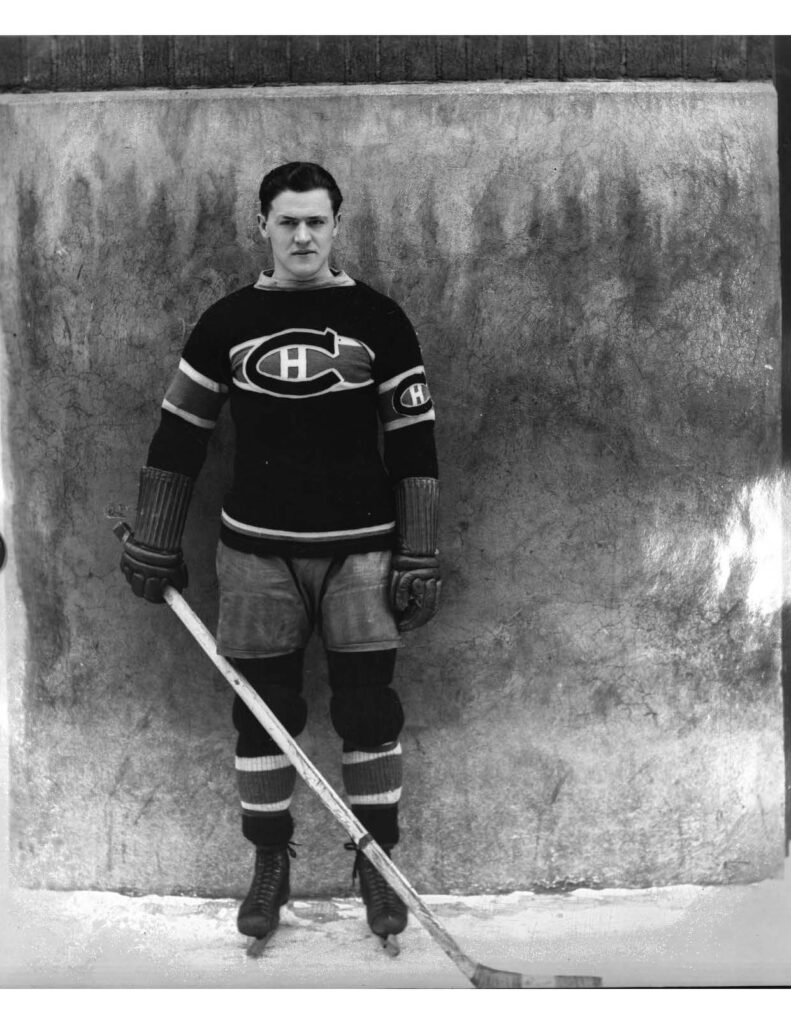
Armand Mondou had only learned to skate in 1917, when he was 12. His nine years of beginner, junior, and intermediate hockey had been at Montreal’s College St Francois Xavier, followed by the Montreal Bankers League. In all that time he might have been part of 135 games – averaging about 15 games a season.
In 1924 – 1925 and 1925 – 1926, the Bankers League played 9 game seasons. By 1930 – 1931, this had expanded to 12 games: The Montreal Daily Star, February 28, 1931, p.14, c. 2. The Bankers League games were held at the Forum. St Francois Xavier “intermediates” played in the Mount Royal League. In 1930, the Allan Cup winning M.A.A.A. played 21 games total from the start of their season until their championship victory: The Montreal Daily Star, March 11, 1931, p.27, c.1 – 2. This was a comparable playing load to the schedule of a dozen games being played by St Michael’s in Toronto during the 1930s: Shea, Kevin; St Michael’s College: 100 Years of Pucks and Prayers, Fenn Publishing Company, Ltd. (Bolton, Ontario:2008), at pp.38 – 48
Mondou played 82 games with the Providence Reds over two more seasons, and become known as “Le Morenz de la Canado-Americaine”: Le petit journal, 29 janvier 1928, p.21, c.3. Mondou described the experience when the Canadiens called him up:
Those were lush day [sic]. With George Hainsworth in goal raging at himself if he failed to score a shutout and Howie and Aurel getting the goals things were a pipe. By the time that third period came along, Howie would let out another notch, boom one in and out we’d come for the checking chores. George would do the rest.
Ralph Adams, “Canadiens’ Genial Centre Sets Pit Lepine As Example”; Unidentified newspaper article, likely autumn 1939, author identified as sourced at Library and Archives Canada, Charles Mayer Fonds. The sentiment expressed was the same half a century later in Edmonton:
“You could sit on the Edmonton bench and know you were in trouble, but also know that sooner or later, Gretz was going to do something about it.”:
Semenko, Dave, with Tucker, Larry; Looking Out for Number One, Stoddart Publishing Co. Limited (Toronto:1989), at p.80
While he had spent the whole of his short hockey life as a centre, the Canadiens switched Mondou to left wing when he joined the club, behind Joliat. Mondou shrugged at the change. He appreciated from the start that life couldn’t get much better than to be paid to play hockey behind Aurel Joliat, on a team led by Howie Morenz.
Like Morenz, Armand Mondou was renowned as a fast skater. He remained in awe of Morenz as “the peerless speedster at centre,” : Adams, Ralph; “Canadiens’ Genial Centre Sets Pit Lepine As Example”, Unidentified newspaper article sourced at LAC in the Charles Mayer Fonds. Likely fall 1939. The rest of Mondou’s personal all-stars were three other Canadiens who had made it fun to play: Joliat, Hainsworth, and Siebert, with Bill Cook and Eddie Shore also nudging their way onto his all-stars.
The Globe was generous about Mondou’s own competence:
Speed, and more speed, is what Armand Mondou has to offer to Canadiens. He breaks fast, carries the puck in a tricky manner, and is neat around the net.
The Globe, April 16, 1931, p.11, c.4. See also: La patrie, 31 mars 1931, p.13, c.3 – 4
Nearly a decade later, in December of 1939, and in his last season of NHL hockey, Mondou was called up to play his final NHL games at the age of 34. One of the reasons given was that he showed better skating speed than the regular line-up: The Gazette, December 29, 1939, p.16, c.5; Mark McNeil, at c.3 – 4
Unlike in the Canado-American, Armand Mondou’s scoring at the NHL level was occasional. In each of his first two seasons, Mondou had scored three goals. Yet as intermittent as the goals were, circumstance sometimes delighted Mondou with the opportunity to be involved in important ones. The stories he got to tell about them varied in content and mood and attitude over time, delighting him even more: The Gazette, February 18, 1935, p.14, c.5; The Gazette, December 29, 1939, p.16, c.5; Mark McNeil, at c.3 – 4; La Presse, circa 1967/1968 Jacques Barrette “Que Font-ils Aujourd’hui? Armand Mondou”
His career highlight included a goal against the Rangers in the spring playoffs of 1930: The Globe, March 29, 1930, p.11, c.2. He had also assisted on Morenz’s goal to eliminate the Hawks in the 1930 Cup semi-final as well.
Some would remember Mondou getting the first penalty shot in Canadiens’ team history, and missing against George Hainsworth, who was then in nets for the Maple Leafs. The Canadiens lost that game 2 – 1 at Toronto: e.g., The Gazette, November 9, 2010, p.B13, c.3. See also: McFarlane, Brian; The Leafs, Stoddard Publishing Co. Limited (Toronto:1995), p.54.
Others preferred to remember him scoring the Canadiens’ first penalty shot goal ever in a game that the Canadiens won 5 – 3 at the Forum: e.g., The Gazette, December 4, 2008, p.C2, c.3. In fact, Mondou was awarded 3 of the first 4 penalty shots ever awarded in NHL history: Morrison, Scott; By the Numbers: From 00 to 99, Key Porter Books (Toronto: 2007), at p.149
From time to time fans and reporters would remember Mondou as the originator of the slapshot: The Gazette, September 15, 1976, p.36, c.6, but teammate Nick Wasnie has been credited with that honour as well – as noted earlier. Others remembered how wild it was. One of them struck referee Mickey Ion in the face. Ion remembered it as an accident, but also as the worst mishap and injury of his career. The only game in which it could have happened was the March 19, 1938 game at the Forum won 1 – 0 by the New York Rangers: McGowan, Lloyd; “Mickey Ion Calls Cyclone Taylor Greatest Player,” circa 1939, The Montreal Star, in Charles Mayer Fonds, MG30-C76, volume 12; Library and Archives Canada. This was the second part of a two-part series about Ion, with the first titled “Mickey Ion Swapped Lacrosse Stick for Whistle”
Armand Mondou didn’t actually trumpet those particular moments. That was because the game, for him, wasn’t so much about the score. He had learned early that playing hockey as a member of the Canadiens was quite enough to provide his life with meaning. He could draw a harvest from his status as a member of the Canadiens for a lifetime. He lived what Paul Gallico recognized about being a professional athlete in the 1920s:
This remarkable ten years . . . saw the most fabulous set of champions arise in every game, amateur or professional, not only from the point of view of performance, but of character as well. Every one of them was a colorful extrovert of one kind or another. Each had a romance connected with him or her, and these legends themselves were reflections of our age of innocence, for they were all success stories, . . . the first such actually dramatized before our eyes.
Gallico, Paul; The Golden People, Doubleday & Company, Inc. (Garden City, NY:1965), at pp.25 – 26
Howie Morenz had shown Armand Mondou that just being a member of the Canadiens allowed a man to be as famous off the ice, on the streets, as he was in his skates. A reputation of being fast on the ice would allow him to be as fast off it as well.
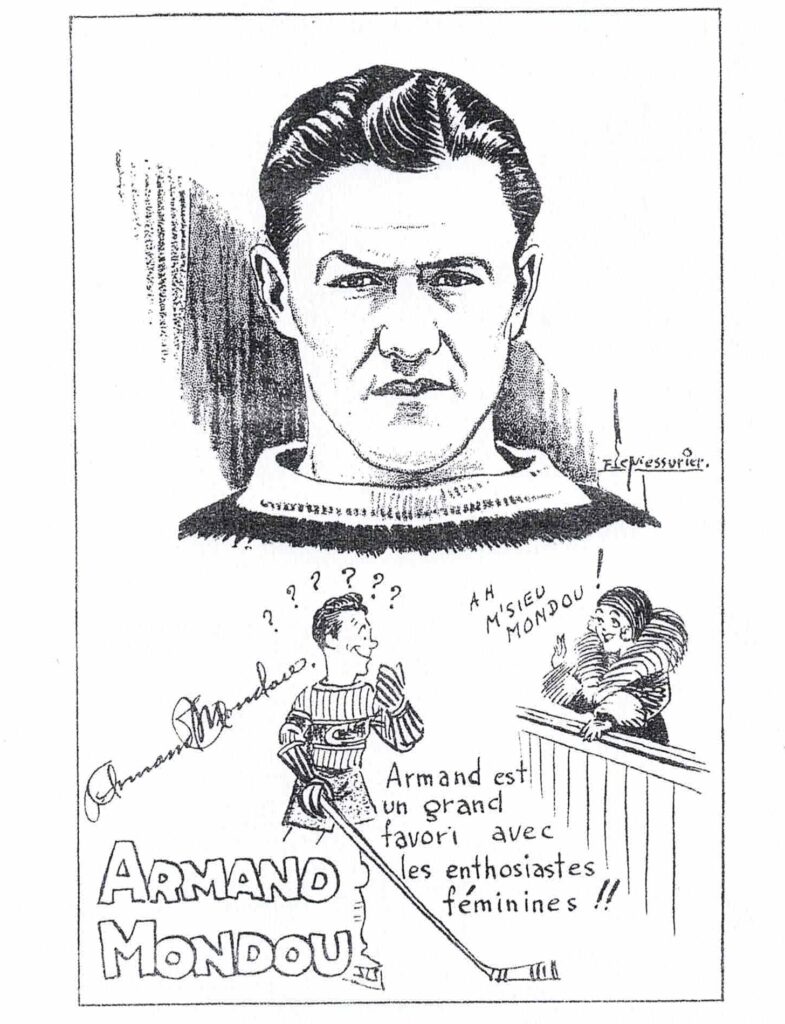
Armand Mondou embraced the opportunity to exploit any glory that might come from a good performance by the Canadiens. Ernest LeMesurier documented Mondou’s close association with Montreal’s young ladies. His caricature in Ernest LeMesurier’s Les Canadiens en caricatures depicted Mondou sharing space with an admiring female fan, and the caption:
Armand est un grand favori avec les enthousiastes feminines!!
Unlike the solicitousness shown to Morenz, both French and English reporters speculated about the kind of good times Mondou was enjoying. The Gazette described how Mondou breezed ostentatiously through the accessible haunts of St Catherine Street:
“When you’re on your way up, take Broadway; when you’re going down try Sixth Avenue” is a famous New York adage that had its counterpart here. It was revealed in the Canadien dressing room that Wildor Larochelle and Armand Mondou, the chums extraordinary of the team, be-took themselves to their home via Craig Street following the Detroit game on Tuesday. “It’s straight down St Catherine Street tonight,” was Larochelle’s laconic comment as he strode out with Mondou on Saturday night.
The Gazette, January 12, 1931, p.18, c.3.
The occasion for that particular remark was that the Canadiens had lost 6 – 2 to Detroit on the Tuesday, and then defeated Toronto 6 – 1 on that Saturday.
Broad hints about Mondou’s playboy habits persisted a decade later. A typical report included the intelligence that “at thirty-three years of age, Armand is still a bachelor, looks about twenty-four, thoroughly enjoys single blessedness.”: Adams, Ralph; “Canadiens’ Genial Centre Sets Pit Lepine As Example”, Unidentified newspaper article sourced at LAC in the Charles Mayer Fonds.
Mondou actively cultivated the attention he did receive. He wanted to compel people to recognize him and, perhaps more important, to remember him. To that end, he took such obvious guidance from the Canadiens’ fashion leader in how he dressed that a reporter once observed that “Mondou is Lepine all over again.”: Adams, Ralph; “Canadiens’ Genial Centre Sets Pit Lepine As Example”, Unidentified newspaper article sourced at LAC in the Charles Mayer Fonds. Likely fall 1939.
Mondou also chose to drive one of the most unique cars in Montreal. He would go riding around the city:
“. . . in Mondou’s big cream-colored Jordan special sedan, the only one in Montreal and one of the few of its type in the country.”
The Gazette, February 18, 1935, p.18, c.5.
1931 had been the last year for production of Jordan automobiles.
The point was that If he could look as famous and as memorable as a man like Morenz, people would treat him accordingly. It would be his best life.
Yet for all of his identical appreciation of a good time, Mondou also understood that the NHL brought extra pressure too. He felt that the incessant on-ice expectations, impatience with mistakes, and demands of unremitting commitment, required “too much pressing.” Mondou knew himself well enough to acknowledge that he could sometimes play better in “the Intam” where the pace was more relaxed [The “Intam” was the International American Hockey League].
Whether he scored or not, whether the Canadiens won or not, Morenz demonstrated to Mondou that being a hockey player in Montreal was always going to be his best life. Despite a rising toll of damage to his body including broken ribs, a dislocated shoulder, torn chest muscles, a broken ankle, and a broken kneecap during his career, Mondou always envisioned himself as a famous hockey player.
He contributed some of his NHL summers as a local sports celebrity. He stayed involved in the game after his NHL career was finally over in 1940 – returning to Montreal’s Bankers League, playing recreationally, and then creating the old-timers concept to support community skating carnivals: e.g,, The Gazette, February 5, 1943, p.17, c.5; Sports Parade 1945, Rotary Club of Montreal, April 6, 1945, at centrefold. This “oldtimer” initiative was a full decade or more before “oldtimers” began to be a thing in Ontario: Barris, Ted, Playing Overtime: A Celebration of Oldtimers’ Hockey, MacMillan Canada (Toronto:1995), at pp.14 – 18..
Mondou traded on and indulged in his status as a hockey player with the public through business: owning “The Krausman” tavern: La Presse, circa 1967/1968 Jacques Barrette “Que Font-ils Aujourd’hui? Armand Mondou”; his continuing connection with his ladies, as well as through a continuing association with his fellow players by running the Quebec Veteran Hockey Players Association into the 1960s: The Gazette, October 31, 1967, p.17, c.3: “Rallying time is 8 o’clock.” In fact, Armand Mondou remained involved with junior hockey and successor players, e.g,, The Gazette, June 27, 1959, p.35, c.1 – 2, including a young Serge Savard: e.g., Cantin, Phillippe; Serge Savard: Forever Canadien, KO Editions, Inc. (Montreal:2020), at p.54, for the rest of his life.