
“Black Cat” Gagnon and the Morenz School of Jazz
Dr. Gerry Wilson’s idea was that when three high skill hockey forwards took to the ice with complementary skills:
“It was like three great jazz musicians playing music together”
That was Dr Gerry Wilson speaking of Bobby Hull playing with Anders Hedberg and Ulf Nilsson on the WHA Winnipeg Jets in Willes, Ed; “The WHA Revisited”, originally published by the Ottawa Citizen, December 30, 1997, and reprinted in Brunt, Stephen, ed.; The Way it Looks from Here: Contemporary Canadian Writing on Sports, Alfred A. Knopf Canada (Toronto:2004), at p.194.
Chris Robinson also understands how hockey can work as jazz:
Hockey could . . . be beautiful, provocative, creative, intellectual and spontaneous as any poem, painting, song or film. Rocket Richard, Bobby Orr and Gordie Howe are artists in the same vein as the free-jazz improv of Cecil Taylor or Albert Ayler, the spontaneous chaos of Jackson Pollock, or even the cameraless cinematic dances of Norman McLaren.
Robinson, Chris: Stole this From a Hockey Card: A Philosophy of Hockey, Doug Harvey, Identity & Booze, Nightwood Editions (Roberts Creek, BC:2005), at p.36
So can Roy MacGregor:
Canadian poet Al Purdy who first noted that splendid hockey is like good jazz: improvisational, imaginative, and experiment in tempo and range, creation on the fly.”
MacGregor, Roy, Road Games: A Year in the Life of the NHL, Macfarlane Walter & Ross (Toronto:1993), at p.46
And Wayne Gretzky:
“The thing that makes hockey great is the zillions of possibilities in every game. To play it well you need to improvise.”
Gretzky, Wayne, with Reilly, Rick; Gretzky: An Autobiography; HarperCollinsPublishers (Toronto:1990), at p.32
And Herb Brooks too: Fischler, Stan, and Fischler, Shirley; Everybody’s Hockey Handbook, Charles Scribner’s Sons (New York: 1983), at pp.267 – 268.
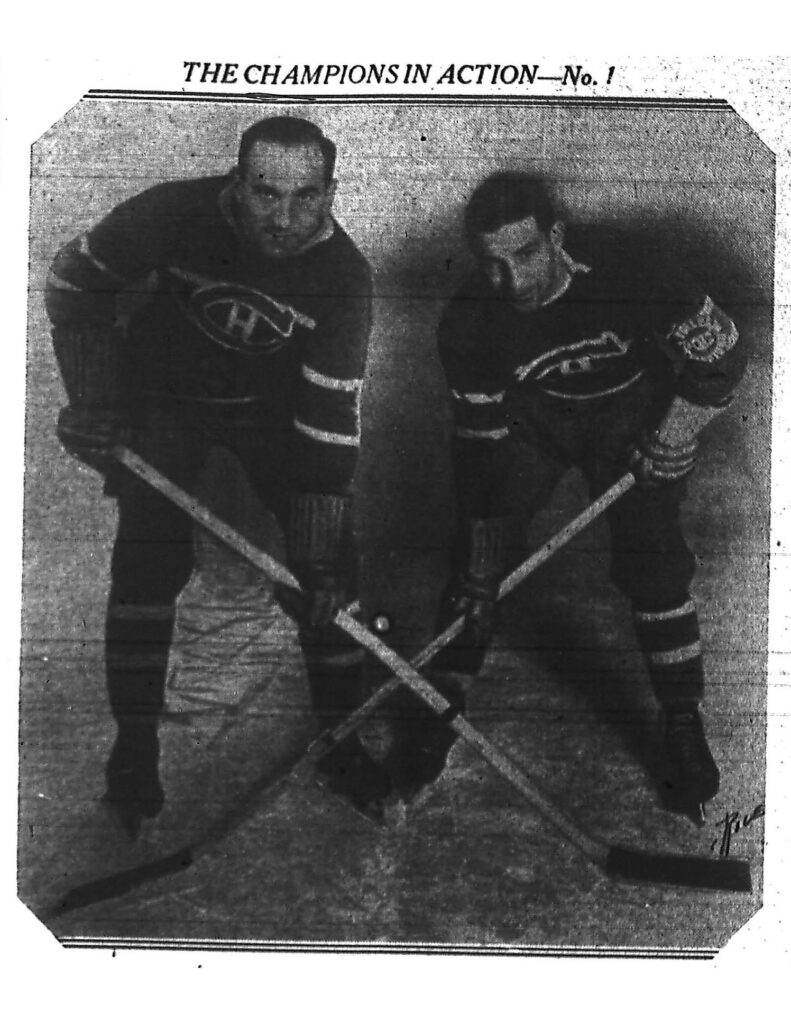
Howie Morenz ad Johnny Gagnon knew all that in 1931.
Professional hockey players were drawn then, as they are still, to that kind of music: See, for example, Finnigan, Joan; Old Sores, New Goals: The Story of the Ottawa Senators, Quarry Press (Kingston, Ontario:1992), at p.125; Baun, Bobby, and Logan, Anne; Lowering the Boom: The Bobby Baun Story, Stoddart Publishing Co. Limited (Toronto:2000), at p.109, and Morrison, Scott; The Days Canada Stood Still, Warwick Publishing Group (Toronto:1972), at p.136 per Rod Gilbert.
Listening to jazz gave them a way to hear melody lines that were evocative of what their own physiques sung during a game. Their ears could anticipate and recognize when shooting star notes burst independently from the band. They could identify the players who shone brighter than the rest: like Armstrong on the trumpet, Johnny Hodges on the alto sax, Don Murray on the clarinet, and Bix himself on the cornet.
There is a whole chapter that could be written in a different book about the correspondences between the careers of Bix Beiderbecke and Howie Morenz: both born within 6 months of each other, both sons of second-generation German immigrants, both familiar with fine material things, both athletic in their youth, both creating well-paying occupations out of their youthful “diversions,” and both burning out their talents and dying young.
But jazz also means the blues, and often as not, emotional turbulence beneath those unique jazz moves. That is where Johnny Gagnon really enters the conversation.
On this night, La Presse gave Gagnon the limelight:
Eclipsant ses deux camarades Aurele Joliat et Howie Morenz, Johnny Gagnon la troisieme membre de la fameuse ligne d’attaque du Bleu Blanc Rouge a ete l’etoile de la partie et a vaincu le Chicago pratiquement a lui-seul. La presse, 2 fevrier 1931, p.21, c.3
La presse had also given him the full page cover treatment in its Saturday Supplement just before Christmas: La presse, 20 decembre 1930, Supplement, p.1. Johnny Gagnon appreciated that kind of recognition from the French press.
The English press in Montreal and elsewhere focused on Gagnon’s size. At 5’5’’, Gagnon was the shortest player on the club, shorter by a couple of inches than Joliat, and shorter than George Hainsworth by an inch.
He was also light. His training camp weight was recorded at 139.5 pounds, La presse, 21 octobre 1930, p.23, c.7 – 8. Aurel Joliat had a listed playing weight of 136 pounds, and Morenz of 165. Even Gagnon’s 139 or 140 came with doubts and an apocryphal story about him loading his pockets with rocks before being weighed by Leo Dandurand: The Gazette, December 13, 2004, Section C, p.2, among other sources, including Gagnon himself: Fischler, Stan; Those were the Days, Dodd, Mead & Company (New York:1976), at p.90; Fischler, Stan and Fischler, Shirley, Heroes and History: Voices from the NHL’s Past, McGraw-Hill Ryerson Ltd. (Toronto:1993), at p.59; Cole, Stephen; The Canadian Hockey Atlas, Doubleday Canada (2006), at p.83. True or not, that story followed him to the NHL:
It’s doubtful if he would weigh 150 pounds with a couple of window weights in his pocket. The big 14 on his back is very nearly as tall as he is, and he can’t reach the top shelf in his locker without standing on a ladder: The Brooklyn Daily Eagle, February 16, 1931, p.22, c.4 – 5.
The fact that all this was true scarcely justified the epithets used by the English writers such as Frank Orr, who referred to him as a “half-pint winger”: The Stanley Cup: The World Series of Hockey, Longman Canada Limited (Toronto:1976), p.74, while The Philadelphia Inquirer, December 3, 1930, p.16, c.4 called him “another half-pint Frenchman.”
The English press also harped on his remote origins in Chicoutimi:
. . . the country 100 miles north of Quebec. The name of the little village of his nativity has a tongue-twisting Indian cadence. On Johnny’s halting, stumbling tongue it was impossible to catch. He tried writing it on paper, but I couldn’t read what he wrote: The Brooklyn Daily Eagle, February 16, 1931, p.22, c.4
Despite the fact that he had been playing in big cities of the United States for the previous 3 years, his reputation as a “country hick” was reinforced by a story earlier in the season about how he missed the team’s train to Toronto: The Montreal Daily Star, January 5, 1931, p.21, c.2.
His supposed lack of ability to speak English clearly became a demeaning media trope. The Gazette, February 2, 1931, p.18, c.3 provides the most galling example, all the moreso for coming from a Jewish writer. It was an unfortunate sportswriting habit for non-Anglo, non-white athletes – even into the 1960s. See the discussion, for example, in Maraniss, David; Clemente: The Passion and Grace of Baseball’s Last Hero, Simon and Schuster (New York: 2006), at pp.79, 97, 155, and 173 – 174..
For Gagnon, this reliance on a caricature permeated his dressing-room experience: e.g., The Brooklyn Daily Eagle, February 2, 1940, p.16, c.8, where how he spoke English was identified as a source of amusement for his teammates, promoted by “teammate” Charlie Conacher. That persisted after Gagnon’s playing career.
The language taunting and the remoteness of his home from civilization were not, however, the most offensive aspects of the media’s attention. It was the “Black Cat” or “Ti-noir”: La patrie, 31 mars 1931, p.13, c.3, nickname itself.
He did have black hair, and he did bring attention to it by keeping it in place, and shiny, with Brylcreem: The Gazette, December 13, 2004, Section C, p.1,c.1; p.2, c.3; The Ottawa Journal, April 15, 1931, p.25, c.4 – 5 (cap). Brylcreem was a new product in 1928. See also: Fischler, Stan and Fischler, Shirley, Heroes and History: Voices from the NHL’s Past, McGraw-Hill Ryerson Ltd. (Toronto:1993), at p.57.
He wore a black cap as he played: The Gazette, December 13, 2004, Section C, p.1,c.1; p.2, c.3 – just like Aurel Joliat and others.
He had quick, possibly cat-like, moves: e.g., Orr, Frank; The Stanley Cup: The World Series of Hockey, Longman Canada Limited (Toronto:1976), p.74; Cude, Wilfred Lloyd Allan; Dear Red Light:Some Seasons in the Life of an NHL Goaltender, ISBN:9781777712204 (2021), at p.120
He was even reputed to sometimes carry a paper black cat in the hip pocket of his hockey shorts, for luck: The Gazette, March 30, 1931, p.18, c.8
But the fact was that every time the English media used that “Black Cat” nickname, they were uttering a succinct judgment about who they believed Johnny really was. He was struggling against doubts in the big city media that he was an elite player.
Montreal’s English newspapers at the time regularly used both coded and colourized language – even referring to the Chicago Black Hawks from time to time as “Chicago’s White Indians”: The Gazette, March 11, 1930, p.17, c.2. They regularly used the phrase “dark visaged” to denote outsiders, including other Canadiens such as Nick Wasnie.: The Gazette, February 20, 1931, p.18, c.3. The fact that the Canadiens’ “farm team” in Providence employed a black trainer – Pinky Lewis – was rarely spoken about at all: Isaacs, Neil D., Checking Back: A History of the National Hockey League, W. W. Norton and Company, Inc. (New York:1977), at p.58.
Every reference to the “Black Cat” amplified every suspicion that was already conjured by referring to his “dark visaged”: The Montreal Daily Star, April 15, 1931, p.38, c.1, and “swarthy” appearance: [See The Montreal Herald, April 14, 1931, p.6, c.1 – 2, and The Gazette, April 134, 1931, p.22, c.1] Situated beside the loud whispers about his remote home “village” with the “Indian” name in the forests of northern Quebec, the English media stereotype of Johnny “Black Cat” Gagnon was that he was different, and nearly foreign.
Gagnon’s treatment by the Canadiens had also been difficult. After an initial promise by Leo Dandurand in 1926 that “he will be with us next year,” Gagnon spent four years at Quebec and in the Can-Am League in Providence. When he was finally promoted to the NHL, his pay was set at just $35/week ($700 for a season of 20 weeks), while his teammates were paid thousands: The Gazette, December 13, 2004, Section C, p.2, c.5. The Canadiens would eventually trade Gagnon away, twice. It all made Gagnon seethe.
La presse writers noticed, and reported, on the fury that had started top appear in his play:
Gagnon a joue comme un forcent. Pendant toute la partie, il a joue a une vitesse phenomenale, faisant d’innumerables courses a toute allure et enmant la crainte chez son adversaires. Gagnon a ete combattif a l’extreme, attaquant avec furie puis revenant en toute hate preter main forte a ses compagnon de defense.
La presse, 2 fevrier 1931, p.21, c.3
Fortunately for the Canadiens in 1931, that is precisely who they needed Johnny Gagnon to be.
As intoxicating and as fulfilling as the soloist role could be for Bix, Morenz, and Gagnon, it came with high tensions as well. All three functioned brilliantly in their chosen forms of jazz, and managed to maintain their brightest performances for about the same length of time. But living the life of someone like Bix, or the Mitchell Meteor, brought expectations to be consistently and brilliantly creative. Those demands threatened to simultaneously consume their souls.
Gagnon always seemed able to score when he felt the need to prove himself. After injuries hobbled his return to the Canadiens at the start of the 1939 – 1940 season, he arrived back by scoring 3 goals with 3 assists in his first 4 games, including a couple of goals in that fourth game: Robert Clarke, Canadian Press, as it appeared in the Calgary Herald, December 8, 1939, p.6, c.1 – 2. Traded again later that season to the New York Americans, Gagnon scored the first goal in his first game there: The Brooklyn Daily Eagle, February 2, 1940, p.16, c.8. The same thing happened when he regained his amateur status and helped the St Jerome Papermakers to a surprise victory over the senior champion Montreal Royals in 1941, assisting on 3 goals in a 5 – 3 win: The Ottawa Journal, March 19, 1941, p.15, c.1 – 2.
But Gagnon was not immune to the exhaustion that consumed both Bix and Morenz. The same fury that would produce multi-point offensive nights would also immolate him.
The fury that fueled Gagnon’s temperamental demand for respect thoughout his career became explosive. He was sent from the Canadiens to Boston in 1934 after clashing with new coach Newsy Lalonde. Playing for the Canadiens in the 1939 playoffs, he took a penalty in overtime against the Red Wings, who proceeded to score the only goal of the game to win that series. Gagnon then physically attacked and injured referee Mickey Ion. It took him 7 months to apologize to his teammates for costing them the series: The Gazette, October 11, 1939, p.14, c.1. Playing for the Americans in the 1940 playoffs, he walked out on the team after one game of a 3 game series because of a dispute over his playoff money share: The Gazette, December 13, 2004, Section C, p.2, c.6. Gagnon preferred to recall that he played two games before walking out: Fischler, Stan; Those were the Days, Dodd, Mead & Company (New York:1976), at p.153; Fischler, Stan and Fischler, Shirley, Heroes and History: Voices from the NHL’s Past, McGraw-Hill Ryerson Ltd. (Toronto:1993), at p.66.
Despite the hubris, and the resentments, what eventually endured for Gagnon was his recognition that he really had been at his best at this very beginning of his NHL career. He had been at his best when he had earned the opportunity to play with Howie Morenz. He had been at his best, and both of them had been at their best, when they had the chance to challenge each other, to feed off each other, by teasing their own kind of jazz out of those shared opportunities.