The Morenz Bloodlines and Le Gros Lesieur
“There was some expectation of him to be the Second Coming . . .” – Howard G. Morenz, grandson of Howie Morenz, quoted in relation to his father, Howie Morenz, Jr.: The Globe and Mail, November 6, 2015, p.S8, c.1
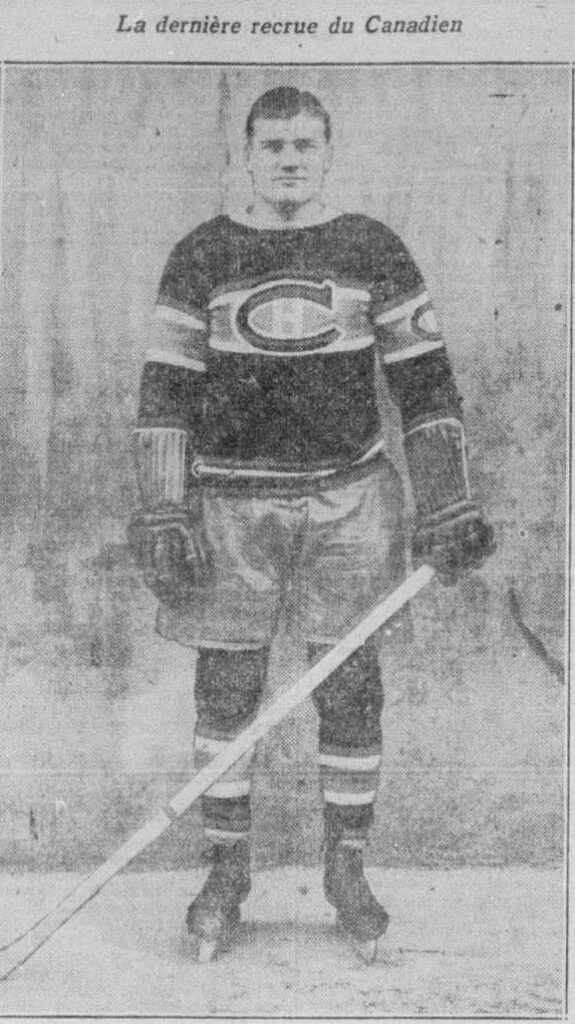
Despite those expectations, it was Canadiens’ newcomer Art Lesieur who would have a longer career in the NHL than Howie Morenz’s own son.
After his late January appearance on NHL ice in 1931 to drop the puck, Howie Jr’s next on-ice appearance at a National Hockey League event was as a player at his father’s Memorial All-Star Game on November 2, 1937: Robinson, Dean; Howie Morenz: Hockey’s First Superstar, The Boston Mills Press (Erin, Ontario:1982), at p.124. He joined the Canadiens and his dad’s old Stratford teammates at another memorial game in Stratford just 4 nights later: Robinson, Dean; “Howie Morenz was a very special person”, London Free Press, March 4, 1977, pp.10, 13.
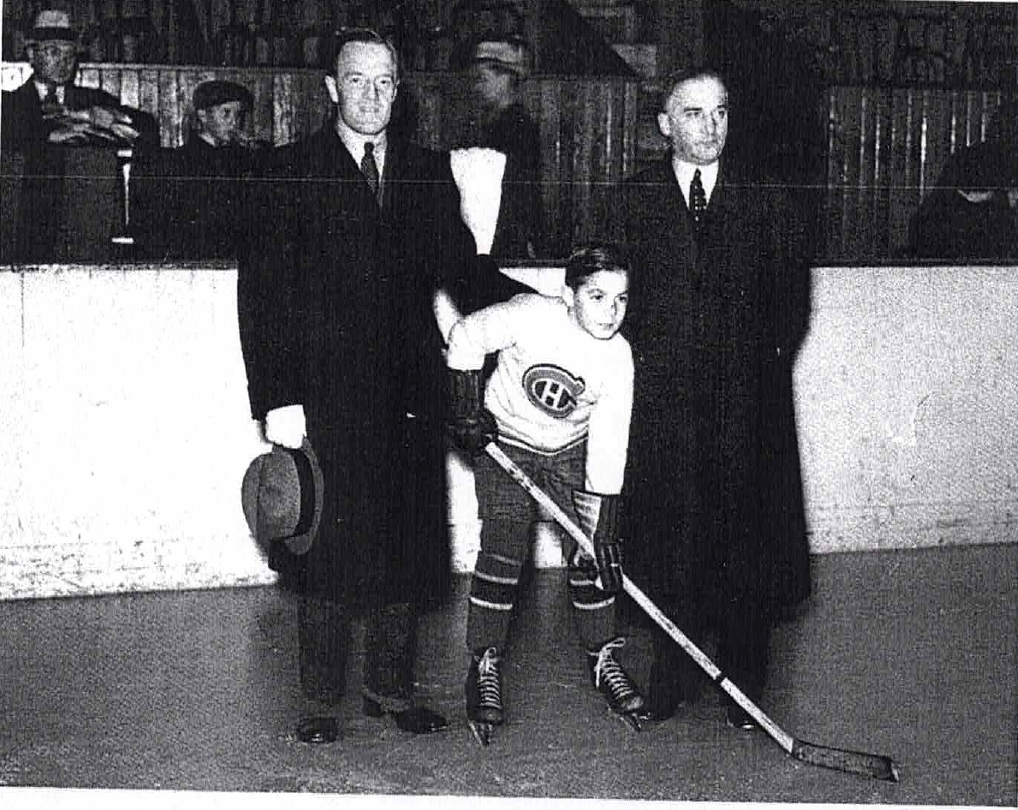
After his dad died, Howie Jr continued to visit in the Canadiens’ dressing room: e.g., The Globe and Mail, March 29, 1937, p.18, c.7. His enduring relationship with the hockey club provided some more exhibition opportunities to play with the Canadiens: a tour of the maritime provinces after the club’s elimination from the Cup playoffs in the spring of ’37: The Globe and Mail, November 16, 1937, p.2, c.8; and a wartime benefit game with the NHL oldtimers at the Forum a couple of days before his 15th birthday: The Gazette, February 25, 1942, p.18, c.1 – 8; Robinson, Dean; Howie Morenz: Hockey’s First Superstar, The Boston Mills Press (Erin, Ontario:1982), at p.155; Sports Parade 1945, Rotary Club of Montreal, April 6, 1945, at centrefold.
Howie Jr became a good enough player to be invited to the Canadiens’ training camp in the fall of 1946. He found a place in the Canadiens’ farm system – first with the Junior Canadiens, then the senior Montreal Royals, and finally with the Dallas Texans of the United States Hockey League. Then, in the spring of 1949, when he was 21 years old and almost exactly the age when his dad first arrived in the NHL, Howie Morenz Jr recognized that any NHL dream of his, or his father’s, was over without a single NHL game.
The Canadiens had first noticed Art Lesieur in 1928 when he was playing with the Providence Reds. They had called him up then, creating “a mild bombshell” in professional hockey circles according to the Associated Press, November 15, 1928, from Providence, R.I., as appeared in The Morning Call (Allentown, Pennsylvania), November 16, 1928, p.36, c.7.:
Lesieur’s experience borders closely to a Horatio Alger tale. He himself was hard to be convinced that he was wanted by Les Canadiens, for in hockey circles Lesieur is only a sand lotter.
He was also an American: a child of the French Canadian diaspora, born in Fall River, Massachusetts which was, at that time, the third largest French Canadian city in North America.
Fall River had been a leading textile manufacturing centre since before the American Civil War, as well as a nearby soft exile for patriotes and their sympathizers after the rebellion/insurrection of 1837. This southern migration was a cultural and demographic phenomenon, referred to explicitly in French Canadian literature of the early 20th century in such novels as Maria Chapdelaine by Louis Hemon, Trente Arpents by Ringuet (Phillipe Panneton), and also addressed in Lionel Groulx’s L’Appel de la race. See also: e.g., Belanger, Damien-Claude, “French Canadian Emigration to the United States 1840 – 1930”, Marianopolis College; Smyth, Egbert C., “The French Canadian in New England” in American Antiquarian Society, October 1891. See also Noel, Jacques, La Diaspora quebecoise, Les Editions GID (Montreal:2016), and even Sirois, Bob; Discrimination in the NHL: Quebec Hockey Players Sidelined, Baraka Books (Montreal:2010), at p.27.
After keeping him for 17 uneventful games in 1928, the Canadiens had loaned him to the new Chicago Black Hawks. Lesieur then returned to the Providence Reds for another year under the tutelage of Sprague Cleghorn. He had attended the Canadiens’ camp in October, at a camp weight of 200 pounds, but had not been able to beat out Bert McCaffrey as the Canadiens’ fourth defenceman. He had returned to Providence. Still, his re-ascent to the National Hockey League on January 14, 1931, generated some excitement according to The Globe, April 16, 1931, p.11, c.4:
He is a phenomenon, in so far as he stepped in with the world champions only six years after he first learned the game.
The Gazette, January 2, 1947, p.13, c.3, described Lesieur as “one of the biggest men ever to play hockey,” with a style that was persistently more physical than true finesse, according to the Pittsburgh Post-Gazette, October 17, 1940, p.20, c.1:
One of the biggest men in any hockey league, Lesieur is subject to considerable kidding from both players and fans. But he uses his poundage to good advantage, perhaps not with spectacular body checks, but rather by squeezing his opponents into the boards as they try to break through. After a couple of encounters with Lesieur’s anatomy the opposing rushers are reluctant to try it again.
His checking was “robust”: The Gazette, January 26, 1931, p.20, c.3, which meant that he could occasionally create an exciting, crowd-pleasing spill.
Bert Perry in Toronto was dubious about what Lesieur brought to the Canadiens:
He was used on three or four occasions, and impressed the fans with his speed, but he didn’t seem equal to the task of working through the Toronto defense. He starts his rushes by circling the net, and gains great momentum by the time he crosses the first blue line. But he did not look so impressive the rest of the way . . . .The Globe, January 19, 1931, p.9, c.3 – 4
Lesieur’s goal this night against the Quakers would be his sole counter of the season. He would not score again for the rest of the year, and only twice more in his entire NHL career. He would stay with the Canadiens for the rest of this season, and the playoffs, but only half of the next season, and then for another partial season in 1935 – 1936: The Gazette, October 25, 1935, p.14, c.1.
In statistical terms, Art Lesieur put together a rather indifferent NHL career: 100 regular season games, 4 goals, 2 assists, and 50 minutes in penalties; with 4 penalty minutes in 14 playoff games.
Although a marginal NHL player, he made a professional playing career away from the Canadiens until the fall of 1946 – just as Howie Morenz Jr was creating his best years with the Montreal Junior Canadiens. Lesieur also officiated in the American Hockey League into the late 1950s, a decade after Howie Morenz Jr had given up the game: The Gazette and Daily (York, Pennsylvania), March 29, 1957, p.38, c.5.