The St Christopher Medal of “Battleship” Leduc
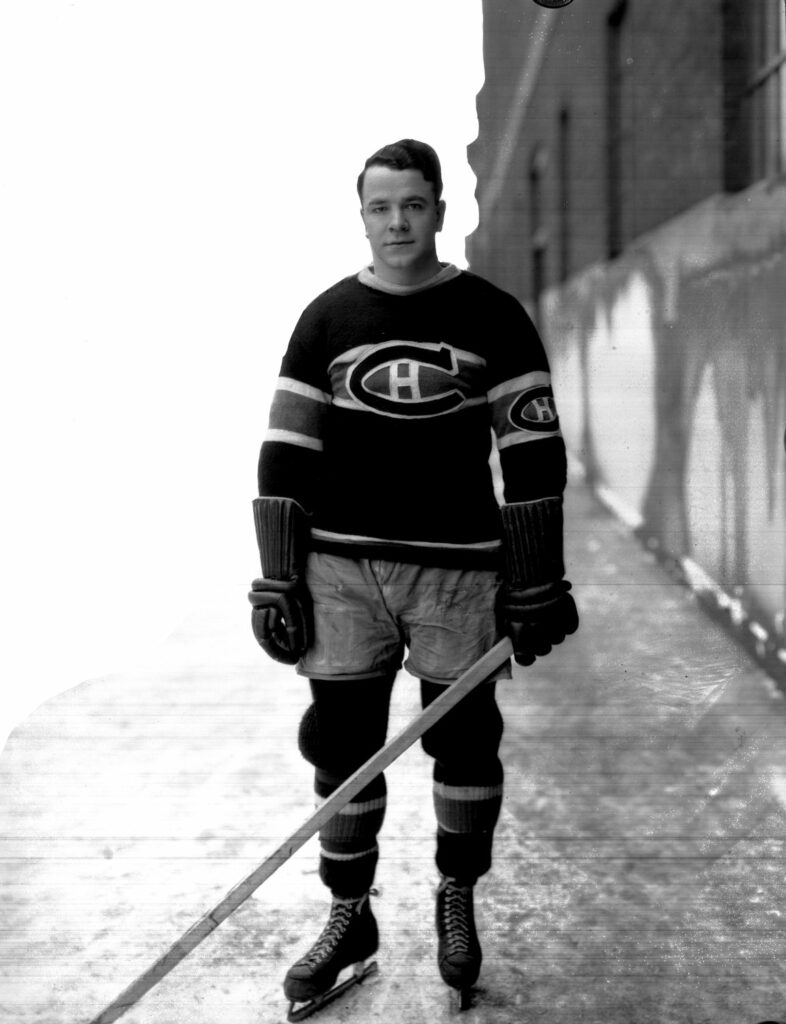
Last night another Habitant rose to starry heights, in the person of Albert Leduc: Ottawa Citizen, January 23, 1931, p.11, c.1
With Howie Morenz missing his second game in a row, Battleship Leduc stepped up to have his best and most complete game of the season to that point – and his first scoring points in nearly a month.
Leduc was Howie’s closest Quebecois friend on the team. Howie and Albert constituted two of the four Musketeers: that quartet of regular traveling companions which also included George Hainsworth and Marty Burke. Leduc was the bridge between the three unilingual men from southwestern Ontario and all of the Quebecois players on the team.
Now in his fifth NHL season, Leduc was playing with a solid sense of competence and accomplishment. He was in his late 20s, just a couple of months younger than Howie. in two years After missing 2 games in early February 1929 Leduc had not missed a game since, and just 8 of the 192 that the Canadiens had played since his first NHL game in December 1925. In the five seasons beginning in the fall of 1926 and ending in the spring of 1931, Leduc missed a total of 3 games – including those 2 in 1929. In his final two seasons with the Canadiens, he would miss 3 in 1931 – 1932, and none at all in 1932 – 1933. At the moment, he was a Stanley Cup champion. Every day that he came to the rink, the Canadiens’ number 8 felt he was at his athletic peak.
Nominally a defenceman, Leduc played an aggressively physical game, employing what were described as fan-popular “rough-and-ready tactics.”: The Gazette, October 7, 1937, p.14, c.7. In the French press he had become known as “Firpo,” based apparently on an imputed resemblance to the Wild Bull of the Pampas who had fought for the heavyweight championship of the world against Jack Dempsey in 1923.
Leduc did have a preference for a game controlled by “power players”: The Gazette, October 7, 1942, p.16, c.6.. While he was indeed the heaviest of the Canadiens at 190 pounds, he was not really a big man – and shorter than many of his own teammates at 5’ 9”. Despite his earned reputation for occasionally violent encounters resulting from uncontrolled passion, he chose his own moments. He never did lead his team in penalty minutes during his career.
His own game was really a style characterized by the force of happy enthusiasm. Howie Morenz had noted this from the time of Albert’s arrival in the League in 1925:
Leduc – A mon avis, cet autre courageux joueur s’est ameliore sensiblement, cette annee. Il a du coeur au supreme degree. . . . ce joueur est un de ceux qui manient le mieux le baton. Sa seule faiblesse, celle des jambes, disparait tous les jours.
La patrie, 27 mars 1928, p.11, c.1 – 2
In this game at Ottawa, Leduc was immersed in his own passion and exhuberance, which occasionally allowed him to carry the whole team on his shoulders. That exhuberance rested on a true sense of gratitude that infused his appreciation of every aspect of his professional hockey experience.
The first money he ever earned playing hockey had been during the first world war, when he was only 15 or 16. Art Ross had given him a chance to play in an exhibition with the Montreal Wanderers against an Ormstown team. Leduc had requested $5 to play, and scored a goal for the professionals. After the game Ross tripled his pay to $15: as reported in The Winnipeg Tribune, January 1, 1935, p.11, c.6.
Blessings had continued to follow him. His first game in the National Hockey League had been in New York in 1925 – the night they opened Madison Square Garden. Breathing in the grandeur of that occasion had been unique, but the biggest “kick” of the night happened when he scored the Canadiens’ first goal, and the first goal of his own NHL career: The Gazette, October 7, 1942, p.16, c.6. While he liked to remember his goal as the first ever scored at the Garden, his counter at 12:17 of the second period actually followed the Americans’ opening goal, which had been scored by Shorty Green at 11:55 of the first period: The New York Times, December 16, 1925, p.29, c.2. Leduc’s was the first goal by a visiting player.
He cherished memories of being tested as a rookie by rough veterans like Bert Corbeau, recounting them with pleasure when he might easily have reported with rancour:
Bert was a great guy, both on and off the ice, and I well remember him especially one game when he was with Toronto. On my first rush down the ice Bert and I tangled and I was sent off for repairs. I needed six stitches to close a cut over my eye. Before the game was finished I had 16 more stitches put in various parts of my face, resulting from three other accidents, but none of these from Corbeau.
The Gazette, October 7, 1942, p.16, c.6
Late in his career (1933), when he had been moved to the Senators, and then to the New York Rangers, he continued to express excitement about the new opportunities those trades gave him to play. He recalled the New York experience fondly, as he got to play beside all 235 pounds and 6 feet and one inch of Taffy Abel: Parsley, Al; “’Battleship’ Leduc Added Color to Bygone Era of Pro Hockey,” [unidentified newspaper article circa November 1961 found in Charles Mayer Fonds, MG30-C76, volume 12; Library and Archives Canada.]
Of course being willing to embrace opportunities sometimes led to embarrassment. On December 2, 1931, when George Hainsworth had to personally serve a penalty, Leduc replaced him in the nets against the Chicago Black Hawks. Leduc allowed a goal during his two minutes of work, leaving him with a lifetime goals against average of 30: In allowing that single goal against the Black Hawks, Leduc was also tagged with the loss. [The available online report of the game is accessible at http://www.nhl.com/stats/goalies?reportType=game&seasonFrom=19311932&seasonTo=19311932&dateFromSeason&gameType=2&playerPlayedFor=franchise.1&filter=gamesPlayed,gte,1&sort=wins,savePct&page=0&pageSize=50.] Even that was worth a joyous chuckle.
Though he didn’t score many goals, nor accumulate a lot of assists (over the course of 384 games over 11 different seasons at the NHL level, he scored 58 goals, with just 35 assists), he could score when the team needed that from him. When the team needed him to bludgeon and batter opponents, he was more than willing to do that too. And if there was a defensive play to be made, he would devote himself to that effort as well. For a period, or perhaps even a whole game, he could be as influential and as masterful over a game’s outcome as his friend Howie Morenz could be.
But his contribution to the Canadiens was measurable in other ways. He could provide performance with a personally memorable style. The signature element of his game became the Leduc solo rush:
. . . his steaming rush down the ice is sometimes the “piece de resistance” of an otherwise dull game. His legs working like pistons, Albert dashes down and swerves at no defense. The outer-guard combination that Albert has backed up before has not yet been evolved, and he dives headlong into the opposition when he reaches it.
The Globe, April 16, 1931, p.11, c.3 – 4
Just like his friend, Howie Morenz.
Leduc’s labored skating style once led a Montreal Star editor to describe his rushing as “like an infuriated buffalo.”: Al Parsley article circa 1961, Forum program.. The Gazette similarly remembered those rushes as “elephantine.”: The Gazette, October 7, 1937, p.14, c.7. In Toronto they called him “Steamer”: e.g., The Toronto Daily Star, January 19, 1931, p.8, c.1. In New York he was “Al ‘Bear’ Leduc.”: e.g., New York Daily News, January 1, 1948, p.41, c.4 – 5.
But the nickname most often associated with Albert Leduc (based on these unique rushes), was “Battleship.” The same nickname would eventually be given to Bob Kelly, but for more pugilistic reasons: Cherry, Don, with Fischler, Stan; Grapes: A Vintage View of Hockey, Avon Books of Canada (Scarborough, Ontario:1983), at pp.185 -187
Henry Diskin, the Montreal correspondent for the Boston Advertiser and other Hearst papers, claimed to have bestowed the nickname for Leduc:
The nickname arose partly from Leduc’s barging, tearing rushes at top speed, regardless of all obstacles, . . . .
Parsley, Al; “’Battleship’ Leduc Added Color to Bygone Era of Pro Hockey,” unidentified newspaper article circa November 1961 found in Charles Mayer Fonds, MG30-C76, volume 12; Library and Archives Canada
Marcel Desjardins, a long-time sports editor for La presse who knew Leduc personally, subscribed to a similar explanation:
Ce surnom lui avait ete octroye en raison de son style . . . . Ce solide defenseur n’etait peut-etre pas un elegant patineur, mais il etait tres agressif. Quand il se portait a l’attaque, il filait droit devant lui, quitte a tout renverser. D’ou son surnom.
La presse, 3 aout 1990, p.Sports2, c.1 – 2
When people asked Leduc directly about the nickname, he would sometimes murmur modestly about how he had worked on the lake boats, or about how his father was a ship’s captain: Al Parsley again. None of that ever detracted from the image created by the “Battleship” name: an armoured and impermeable vessel carrying willing and irresistible danger and violence directly towards an enemy. He could play as if he was the largest and most forbidding piece of war technology known to man at the time.
“Battleship” was nevertheless the moniker that Albert Leduc himself happily embraced. When he moved into the hockey stick business after his professional career was done, he branded his products with the “Battleship” name. Although famous in Quebec in the 1950s, the brand did not survive. There is not even a mention of the brand in Bruce Dowbiggan’s The Stick, Macfarlane, Walter & Ross (Toronto:2001).
Leduc understood the evocative power of the nickname had become. Anyone with a passing knowledge of hockey knew that it evoked how he had played. As Al Parsley reported in “’Battleship’ Leduc Added Color to Bygone Era of Pro Hockey,” unidentified newspaper article circa November 1961 found in Charles Mayer Fonds, MG30-C76, volume 12; Library and Archives Canada, and Forum program:
He says that in his travels it has served as an immediate source of identification.
There may have been greater defencemen down the years in the NHL; certainly none more popular. His headlong drives in those limited forward-passing days endeared him to countless fervid supporters, . . . .
Al Parsley observed that Leduc had “always been a most congenial out-going character with a genuine gift for making friends.” The Gazette referred to his “unfailing good humor.” He could be just as friendly on the ice with his opponents as with his own teammates, even as they thrashed at each other:
For two persons who pound the wind out of each other for sixty minutes, Albert Leduc and Bill Phillips appear to be particularly good friends. They laughed with and at each other throughout the game and when both were sent to the penalty box, they were actually hilarious.
The Gazette, February 6, 1931, p.18, c.3.
Leduc and the Leafs’ Busher Jackson would do the same: e.g., Le petit journal, 1 mars 1931, p.21, c.3
The Chicago Sunday Tribune and the Boston Globe often referred to Leduc simply as “Affable Albert.,” or by the courtly, aristocratic style of his name: “Le Duc”: e.g., Chicago Sunday Tribune, April 12, 1931, p.25, c.8; Boston Globe, April 1, 1931, p.27, c.2. During the height of Leduc’s hockey career his unfailing cordiality and social ease may well have been his most significant contribution to the Canadiens as a team. It was he who prompted the mix of personalities on the team to feel comfortable with each other, even across the divides of language, religion, and geography.
His obvious facility with inter-personal skills that allowed him to become one of the first of the former Canadiens to work as a brewery representative for the Molson companies after retirement, and later in promoting his own lines of beverage products: under the Frontenac label: La presse, 3 aout 1990, p.Sports2, c.1 – 2.
Among all of the Canadiens, he was probably also the most religious in a formal institutional sense. His sense of Roman Catholic spirituality not only supported his extensive community-based charitable work with the Knights of Columbus. He could be seen as the Canadiens’ Saint Christopher, transporting the team across otherwise impassable challenges on his back – as he had demonstrated that January 22, 1931 night in Ottawa.
Leduc started two rushes at the beginning of the third period. On the second:
This time it was “All Leduc.” The Canuck rear guard swept up center, split the Ottawa defence, barged through and tricked the Ottawa netman with a brilliant bit of stickhandling when right at the net mouth: Ottawa Citizen, January 23, 1931, p.11, c.1 – 2
He broke alone, barged his way through the Ottawa rearguard, and scored after drawing Beveridge out of position with some smart stickhandling: The Gazette, January 23, 1931, p.16, c.3
Leduc boomed through on a swerving rush in the final session, split the Ottawa defence as though skating through a batter of butter, crossed in front of Beveridge and pulled him out of the nets to score handily: The Montreal Daily Star, January 23, 1931, p. 34, c.1
On a third rush he set up Johnny Gagnon for a silky score and a 3 – 0 lead, followed by an enveloping, congratulating, bear-like embrace in the Battleship’s arms. It propelled the two of them into the jubilation of their teammates.
This season Leduc had become more confidently demonstrative about his commitment to gluing the Canadiens together. He had become effusive. It had “almost” happened in the Cup final the previous spring:
When McCaffrey scored, Leduc rushed up to him, threw his arms around his neck and all but kissed him: The Montreal Daily Star, April 4, 1930, p.40, c.6
This season he had begun to give his teammates ecstatic hugs regularly after goals. When his good friend Howie Morenz scored an important goal, Leduc would not only hug him, but kiss him too – sometimes even twice, as had happened at the Forum at the end of November, during a close fought victory over the Bruins: Part II, Chapter 6; The Boston Post, November 30, 1930, p. 17, c.5; The Globe, December 1, 1930, p.11, c.3
The Boston papers had called Leduc “volatile” when the kiss happened at the end of November: The Boston Post, November 30, 1930, p. 17, c.5; The Boston Sunday Globe, November 30, 1930, p.29, c.3. The Gazette chose to describe him as simply “effervescent.”: The Gazette, December 1, 1930, p.20, c.3. Frank Selke once described Leduc as having a “highly excitable temperament.”: Selke, Frank J., and Green, Gordon; Behind the Cheering, McClelland and Stewart (Toronto:1962), p.104.
On this occasion La presse mentioned the embrace but not the kiss, although the La presse cartoonist had already had some fun with Leduc’s growing impulse to kiss his teammates on an occasion when he was tossed into the arms of a female spectator sitting at the boards: La presse, 29 decembre 1930, p.22, c.2.
As spontaneous as the kiss had appeared to the Forum fans back at the end of November, Leduc’s repeated public bursts of affection towards his teammates represented a calculated effort to bring his teammates closer, and demonstrated how close they had already become. That warmth was learned and reciprocated by his teammates.
When Leduc’s home community of Valleyfield honoured him with a dinner in the late spring of 1931, long after the hockey season was over, Howie Morenz and Pit Lepine and Aurel Joliat and Georges Mantha and Wil Larochelle and Armand Mondou all showed up in his honour. They celebrated what their friend had brought to their team, even on an occasion when there were so many friends of importance in Valleyfield at the head table that there was no room for any of the Stanley Cup teammates to sit with Leduc at the head table.