
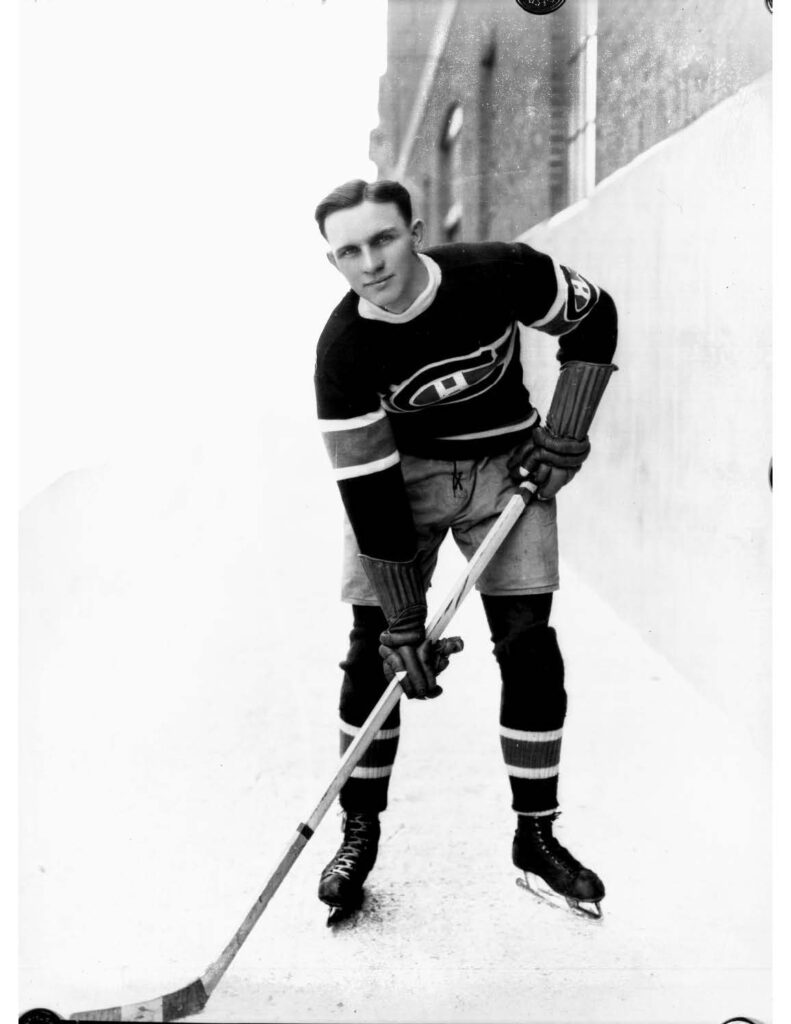
Gus Rivers, Howie Morenz, and the Business of Identity
The injured rib or ribs that forced Howie Morenz to miss the Canadiens’ game in New York against the Rangers was an abrupt opportunity for doubt about his future.
Since his arrival as a rookie in December 1923, Morenz had only missed 8 of the Canadiens’ 289 regular season games, and none of their 27 playoff games: Morenz missed 5 games during the 1925 – 1926 season, and another in 1927 – 1928, before missing 2 in 1928 – 1929. He never missed a playoff game in his career.
This was the first time in nearly two years that Morenz would not be part of the team. He had played in 96 consecutive games – perhaps an even hundred counting exhibitions – since January 24, 1929. The Montreal Daily Star, January 20, 1931, p.27, c.4 – 5, claimed it was the first missed game in 76, but in fact the previous game in which Morenz had not participated was against the Bruins at Boston on January 22, 1929. That had been the Canadiens’ 24th game of 44 games that 1928 – 1929 season. Morenz played the remaining 20, plus all playoff games that year, as well as all regular season and playoff games during the 1929 – 1930 season (44 plus 6). He had then played the first 23 games of 1930 – 1931.
Howie Morenz was, quite simply, a hockey player. That was his profession, and his vocation.
He never believed that he could ever do anything better than he could play hockey. It was a self-identity he had cultivated since his early teens. It was who he was. It was how the public knew him. To consider that existential identity coming to an end would have taken him to an emotionally catastrophic place. Whenever he contemplated what he would do when he could no longer play hockey for a living, his thought skidded into an empty, blank anxiety,[1] once grimly expressed to Aurel Joliat, as:
After I can’t play this game anymore, I want to die: As stated to Aurel Joliat: Robinson, Dean; Howie Morenz: Hockey’s First Superstar, The Boston Mills Press (Erin, Ontario: 1982), at p.78.
Morenz’s situation was similar to what professional hockey players continue to endure as they confront their departure from the spotlight and the game. See: Ryan Walter described in Walter, Ryan; OFF THE BENCH and into the game; Cygnet Publishing (Red Deer, Alberta: 2001),at pp.107 – 109. Morenz’s situation can also be compared with the views expressed in Lanny; McDonald, Lanny, with Simmons, Steve; McGraw-Hill Ryerson Limited (Toronto:1987), at pp.197 – 198.
Kenneth Whyte also observed in Nobody’s Fifteen Feet Tall” in Frayne, Trent, ed.; All-Stars: An Anthology of Canada’s Best Sportswriting, Doubleday Canada Limited (Toronto:1996), at p.110, that:
. . . sports heroes are usually tragic ones. We expect them, and they expect themselves, to meet with similar success in all avenues of endeavour, but their talents are nontransferable.
Compare: Ford, Richard; The Sportswriter, Vintage Books, Second Vintage Edition (New York:1995), at pp.114 – 115 (of 652) of the electronic edition; and quoted in Richler, Mordecai; On Snooker: The Game and the Characters Who Play It, Alfred A. Knopf Canada (Toronto:2001), at pp.177 – 178.
Gus Rivers, the forward sub who had joined the Canadiens a year ago, was barely 20 years of age. He played in the place of Morenz in New York, but he also worked as a mechanic in his family’s garage back in Winnipeg. Rivers had a skill, and an interest in a business, that he could rely on for an off-season, and eventually post-career, living.
Morenz might have envied Rivers for that. Howie had hung around Ron Brothers’ garage in Stratford, and even managed once to save the business from fire.: Robinson, Dean; Howie Morenz: Hockey’s First Superstar, The Boston Mills Press (Erin, Ontario: 1982), at p.37. But he hadn’t been there to pick up a skill. He had his hockey, and no particular incentive to develop any other occupation at all.
His own family history also discouraged entrepreneurial initiative. His father William had tried to support a family of seven by selling fine china from the family’s base in Mitchell, the middle of farming country. That hadn’t been successful. William Morenz spent the rest of his working life employed by other people: first as a clerk in a Mitchell dry goods store, and then with the railway at the Stratford shops.
Despite his father’s discouraging experience in business, several opportunities over the course of Howie’s first seven years in Montreal had served to give him a little financial confidence. His career coincided with a time when advertisers began to link products to “successful” people: Gruneau, Richard, and Whitson, David; Hockey Night in Canada, Garamond Press (Toronto:1993), at p.94. His name, and sometimes his photo, advertised products in print as diverse as corn syrup, cigars, and skates. Howie made money from that – quite a bit of money:
In eleven years he has drawn more salary from the Canadien club directly, and from various interests which wished to use his name, than he could have made in fifty years as a first-class mechanic: “A Real Tribute to a Great Player”
Montreal Herald, undated (circa October, 1934)
He had also tried sales work, reportedly successfully, selling home heating wood, coal, coke, and fuel oil for J.A. Munro’s Munro Coal Co. Ltd. and Dominion Fuel Oils Limited. However unlike his print ad work, this in-person kind of selling took real time and repeated effort. That kind of selling also demanded an aptitude for how to shut down the small talk about hockey and to close the deal with customers. That was particularly difficulty for someone who was happy to talk hockey all day – sale or no sale. Other players have faced similar trouble: Other players needed to learn the same lesson: e.g., Smith, Michael A.; Life After Hockey, Codner Books (St. Paul, Minnesota:1987), p.207
Gus Rivers had been a puzzling addition to the Canadiens. Even in his home town his signing was described as a “secret”: The Winnipeg Tribune, January 23, 1930, p.12, c.4. He had a more famous older brother, Romeo, who would enjoy both Allan Cup and Olympic glory based on his offensive skills: See, for example: Hewitt, W.A., Down the Stretch: Recollections of a Pioneer Sportsman and Journalist, The Ryerson Press (Toronto:1958), p.39; The Montreal Herald, April 4, 1931, p.10, c.6.
But it was Gus who signed the professional contract with the Canadiens. He had grown up playing in Winnipeg’s high school, midget, juvenile, senior, big four, motor, and C.P.R. inter-departmental leagues: e.g, The Winnipeg Tribune, January 12, 1924, p.14, c.7; March 2, 1927, p.18, c.1. Just prior to his arrival in the NHL, Gus had been playing for the senior “Winnipeg Winnipegs” in a small three-team local circuit playing at the Winnipeg Amphitheatre: The Winnipeg Tribune, January 23, 1930, p.12, c.7. The league consisted of the Winnipegs, the Elmwood Millionaires, and the Winnipeg Native Sons.
In all of his pre-NHL hockey, the “gawky” 5’11” 20 year old local hero had always been a defenceman – a defenceman who weighed just 160 pounds. That was 15 to 20 pounds lighter than most of Cecil Hart’s other defencemen. Hart’s initial thought had been to convert Rivers into a spare winger, and deputed Aurel Joliat to train him. After a year of Joliat’s tutelage, it was felt that Rivers might actually be better playing centre. The question of what to do with Rivers, what special talent he brought to the Canadiens, lingered in the background of his entire NHL career.
Added to the pressure of those transitions and expectations was the identity that the Canadiens fabricated for Rivers’ introduction. The Canadiens got The Gazette to introduce him as:
Gus Rivers, Canadiens’ most recent acquisition from Winnipeg, will likely be in uniform tonight with Canadiens. Rivers, whose real name is Gustaave Desrivieres, is expected to arrive this morning . . .
The Gazette, January 25, 1930, p.20, c.3
The team actively passed him off in those early months of 1930 to the Toronto Globe, Boston Globe, and New York Times, as Gus Desrivieres, sometimes Des Rivieres, and at least once in Boston as Riversieres. It was a conscious strategy, but by January 1931 some papers were in on the jest, and occasionally taunted the Canadiens with their own marketing ploy. Nevertheless, as late as the spring playoffs of 1930, La patrie identified him as “Jules Rivers”: La patrie, 27 mars 1931, p.12, c.2.
Gus Rivers didn’t seem to know how to play the role of “Gustave Desrivieres” anyway. He rarely emerged from his shy rookie reticence. He was sometimes described as the “lanky, sad-faced right winger”: The Gazette, April 4, 1930, p.20, c.2. He was the player who was described as seeming happiest when he was sitting by himself on the train, humming or singing popular songs to himself, while staring at the countryside passing by the window. He also seems to have been a bit of a target – a player who “received the joshing of all members of the team with a broad, good-natured smile.”
In an effort to fill out Rivers’ personality, reporters were reduced to describing him as “Honest”: The Brooklyn Daily Eagle, January 21, 1931, p.26, c.4; “Clean-cut”: The Winnipeg Tribune, January 23, 1930, p.12, c.4; and “useful”: The Montreal Daily Star, April 11, 1931, p.16, c.6 (photo c.4 – 6). In an age of defencemen like Eddie Shore and Ivan Johnson, these descriptors about him and his play came across more as condemnations than compliments. Scouting reports about him as a forward seemed similarly bland and pedestrian:
Gus possesses a neat poke check. He breaks fast and is dangerous around the goals. He is poison to the Rangers. . . . .: The Gazette, April 15, 1931, p.17, c.7
Rivers’ actual playing experience in the NHL with the Canadiens was intermittent. He often came on in relief, when there was some kind of trouble, or the rest of the team was tired, or someone was injured. After a run of using him, Cecil Hart would then revert to leaving number 15 out of the actual playing rotation for several games in a row: The Gazette, April 4, 1930, p.21, c.5; The Montreal Daily Star, April 11, 1931, p.16, c.6. As a result, most of Rivers’ game time at the NHL level was encapsulated in a comment by La presse:
Gus Rivers . . . depuis le debut de la saison rechauffait le banc des substituts du Canadien pendant la majeure partie du temps, . . . .
La presse, 21 janvier 1931, p.24, c.1
Tonight, with Morenz missing, was one of his rare opportunities to perform. His first goal of the 1930 – 1931 season, and the first since last spring’s playoffs, had unequivocally been a Morenz-style goal. The New York crowd was shocked into silence, but the players responded to the moment:
L’exploit de Rivers, s’il provoqua un froid dans l’assistance et dans le camp des Rangers, souleva une forte joie chez ses camarades du Canadien qui allerent aussitot le feliciter chaleureusement: . La presse, 21 janvier 1931, p.24, c.1
Rivers’ face reddened in embarrassment at the attention that his teammates, and then even the Rangers, lavished on him after his score: The Gazette, January 21, 1931, p.18, c.1; La presse, 21 janvier 1931, p.24, c.1. He had emerged briefly from hockey anonymity, and then retreated to the dressing room as quickly as he could:
Beyond the steel door of Les Canadiens’ room all France was singing and splashing in the shower like happy children: The Brooklyn Daily Eagle, January 21, 1931, p.26, c.4
There was a cachet to the Gus Rivers name, but for Rivers it was realized as a local, home town reputation. That reputation was associated as much with a business that had existed in parallel with, and even before, his limited and unlikely hockey career. Rivers played parts of 3 seasons with the Canadiens: 88 games and 16 playoff games. His NHL career was over by 1932. Unlike Morenz’s whole life being absorbed by professional NHL hockey, NHL hockey was a point of interest in Rivers’ life, not his entire life.