Trades and Discards: Bert McCaffrey
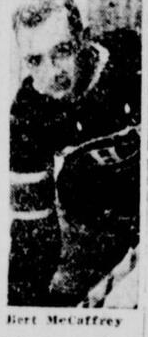
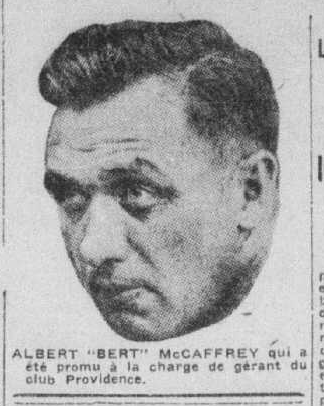
January 15, 1931 was Bert McCaffrey’s last game as a player for the Canadiens, and his last in the National Hokey League. It was to be a “midwinter madness” game against the Maroons: The Montreal Daily Star, January 15, 1931, p.38, c.1 – 2.
Howie Morenz felt an affection for Bert, sometimes “Mac,” and had gone out of his way to treat McCaffrey like part of the Canadiens’ family since his arrival in late 1929: Robinson, Dean; Howie Morenz: Hockey’s First Superstar, The Boston Mills Press (Erin, Ontario: 1982), at p.78.
Mac supplied calmness on the ice and within the dressing room. He had played in important games at three different levels of hockey, and never seemed to get anxious. Neither Hart nor Morenz knew what his departure would do to the team’s sense of common cause:
According to an individual close to the Canadiens, the players were not at all in accordance with the decision to send Bert McCaffrey to the Providence Reds.: The Globe, January 19, 1931, p.9, c.3 – 4
McCaffrey had been born in Chelsey, Ontario, but had created his reputation as a special hockey player in the Toronto area. He had been a left winger during eight seasons of OHA Senior A hockey – and shown himself off in the second of those eight seasons as a scoring ace with the Toronto Crescents in 1917 – 1918. He played 4 seasons with the Toronto Granites in the OHA between 1920 and 1924, and wa sstill scoring at better than a goal a game while winning the Allan Cup twice (back to back in 1922 and 1923).
There had been the Olympics in St Moritz in 1924, when he had gone to Europe and scored 20 goals in just 5 games. Podnieks, Andrew; Canada’s Olympic Hockey History, 1920 – 2010, Fenn Publishing Company, Ltd. (Toronto:2009), at p.239. McCaffery’s total was better than Smith’s 18 and Munro’s 17, but trailed teammate Harry Watson, who scored 30.
Then there was the Stanley Cup last spring with the Canadiens. McCaffrey could look across the Forum ice and see former teammates from the Granites and the 1924 Olympic team: Dunc Munro and Hooley Smith, now playing for the Maroons. Some 90 years later, Bert McCaffrey remains one of the few Canadiens to have played for Canada in the Olympics, and the only one of those to have won a Stanley Cup with the Canadiens and an Olympic Gold Medal while representing Canada. Carey Price and PK Subban both won an Olympic Gold medal at the 2014 Olympics in Sochi, Russia, but not the Stanley Cup. Bobby Rousseau came close – winning four Cups with the Canadiens in the 1960s, after claiming a silver medal at the 1960 Olympics in Squaw Valley, California. On Rousseau, see: Podnieks, Andrew; Canada’s Olympic Hockey Teams: The Complete History 1920 – 1998, Doubleday Canada Ltd. (Toronto:1997), at p.90
After the Olympics in 1924, McCaffrey had turned professional with the Toronto St Pats in October 1924, while Hooley Smith had gone to the Senators and Dunc Munro to the Maroons. In Toronto Mac continued to score at a respectable, but slowing, pace. Conn Smythe traded him to the Pittsburgh Pirates just before Christmas 1927. That is when his game began to evolve.
In Pittsburgh Bert transformed himself into a defenceman: e.g., The Ottawa Journal, February 15, 1928, p.22, c.1 – 3. At 5’10” and 180 pounds, his size, experience, and versatility – and his willingness to take on an assigned role and to perform it dependably – caught the attention of the Canadiens: The Gazette, December 23, 1929; December 30, 1929, c.1. McCaffrey had arrived in Montreal just before Christmas 1929 in exchange for Gord Fraser.
He had been at least 30 years old when he first pulled on a Canadien sweater, but could have been older. Different sources give different years of birth. Some say 1896: Podnieks, Andrew et al; Kings of the Ice: A History of World Hockey, NDE Publishing (Richmond Hill, Ontario:2002), at p.169. The Society for International Hockey Research identifies his birthdate as April 12, 1893.
At perhaps the age of 37, he continued to be the oldest player on the Canadiens’ roster, but in the fall of 1930 had still wanted to play at least another year with Canadiens. He had known that he would have to arrive at the Canadiens’ training camp in competitive physical shape: The Montreal Daily Star, September 17, 1930, p.31, c.4 . He had devoted the summer to road work to ensure that he could meet that challenge of camp, and arrived in Montreal at a remarkable 169 pounds – which was about 11 pounds lower than his normal playing weight: La presse, 21 octobre 1930, p.23, c.7 – 8, though described as above his normal weight: La presse, 31 octobre 1930, p.61, c.1 – 2. For reasons that were never explicit, it was claimed in La presse that McCaffrey was one of only two players who had shown up to camp overweight.: La presse, 31 octobre 1930, p.61, c.1 – 2, the other being Albert Leduc.
His notices in newspaper accounts were quite predictive of why he had become expendable. Last Saturday night’s game against the Leafs was typical. As Marty Burke had claimed more ice time, McCaffrey’s opportunity to play had shrunk, and tended to attract less notice even though little had changed in the competence of his play. While the English hockey writers continued to see his game as stable: The Montreal Daily Star, January 12, 1931, p.20, c.1; The Globe, January 12, 1931, p.10, c.2, La presse had shrugged about his performance in the very same game:
La defense, qui avait laisse a desirer lors des derniers parties du club, a joue une partie du toute beaute. Burke, Mantha et Leduc ont bloque admirablement hier . . . Leduc a ete beaucoup plus brillant que d’habitude. McCaffrey n’a joue que pendant quelques minutes.: La presse, 12 janvier 1931, p.18, c.2
There was some thought that he had become too slow – both for the game played by Canadiens, and by the Canadiens’ opponents:
McCaffrey could always hand out a hard body check, and it is said of him that he was the only defense player on the Canadiens who could play really effective hockey in a bumping game. He was not so prominent, however, in the wide-open style of game, with a fast-skating forward line opposed to him.: The Globe, January 19, 1931, p.9, c.3 – 4
Bert did not take part in any debates about his departure – instead taking a co-operative and respectful attitude to the impending transition:
Probably the best tribute paid to Hart as a manager and man came when Bert McCaffrey was traded to Providence for Art Lesieur early in January. When McCaffrey was informed of the trade, tears came to the veteran’s eyes, and he stuttered that he had never played with a club with which it was so pleasant and so gratifying to be: The Gazette, April 15, 1931, p.17, c.1.
There had been word that Bert might be reclaimed on a $5000 waiver by the Quakers. If he was kept in the NHL as a result of that claim, his departure from the Canadiens would be more definitive and permanent. Bert actually preferred the alternative of a demotion to Providence in the Can-Am League. He didn’t want to leave, and understood that he probably wouldn’t be back, but going to the Reds preserved the hope that he would remain “in touch,” and that he could be called back up to the Canadiens in case they needed him again.
As the game warmed with the Maroons, Cecil Hart eventually gave Bert McCaffrey his turn. He took his share of the physical load with the same characteristic attitude of willing obligation:
Canadiens were by no means reluctant at trading body checks and Mantha, Burke, McCaffrey and Leduc hurled jarring body checks without regard to reputations that had an unsettling effect.: The Montreal Daily Star, January 16, 1931, p.35, c.3
Les avants prete main forte a la defense et ont brise presque autant d’attaques du Montreal que Mantha, Burke, Leduc et McCaffrey. En somme, le Canadien a presente un mur infranchissable pendant toute la partie et n’a donne aucune chance au Montreal de reprendre ses aplomb au cours de la joute.: La presse, 16 janvier 1931, p.24, c.2
Those were the epitahs offered on his playing career in Montreal.
When Toronto had discarded McCaffrey to Pittsburgh, he had resolved to put in the effort to become better – making himself into the player that Pittsburgh needed him to be. Pittsburgh fans had shown their appreciation for that kind of conscientious play for a last place club when he returned there for the first time in his Canadiens colours. The Pittsburgh fans had celebrated him, headlining the evening as “Bert McCaffrey’s game,” and had given him a wrist watch: The Gazette, March 3, 1930, p.16, c.3; The Globe, March 3, 1930, p.11, c.4.
Now, as the game against the Maroons wound down, McCaffrey had already consolidated the psychological satisfactions he could take from his time with Canadiens. There was a moment on the ice:
Bert McCaffrey took an affectionate leave of his team mates who crowded round him and wished him luck.: The Montreal Daily Star, January 16, 1931, p.34, c.2
Joe Cattarinich showed up at the Forum for the first time in 1931, and presented Bert with a “bourse d’argent” from the club management: The Gazette, January 16, 1931, p.18, c.3, or perhaps the players: The Globe, January 17, 1931, p.10, c.3 – 4. There was a raffle among the players for a new made to measure suit from Amherst Street tailor, John Dion. Bert’s name was drawn for that: The Gazette, January 16, 1931, p.18, c.3; La presse, 16 janvier 1931, p.24, c.4. As he looked around the dressing room at the dozen players relaxing with beer and the contentment of victory Bert wasn’t sure that he could say anything at all in farewell to his teammates:
. . . the veteran of many a hectic N.H.L. battle was on the verge of tears when the presentation was made in front of his teammates.: The Gazette, January 16, 1931, p.18, c.3
La presentation a ete faites devant tous les compagnons de McCaffrey que eut venu les larmes aux yeux.
McCaffrey est desole de quitter le Canadien qui l’a toujours si bien traite. La presse, 16 janvier 1931, p.24, c.4
McCaffrey found his way back to Montreal for the Stanley Cup Finals, as a spectator who was still eager to cheer on his teammates.
Although he clung to that idea of being called back to Canadiens before the season was over, and while others thought that he would soon move from the playing ranks into coaching, McCaffrey was destined to finish out his playing career in the Can-Am League. He spent some time as a manager of the Providence Reds, and as a referee in the NHL and the senior ranks – even officiating in an Allen Cup final about 20 years after he had won the trophy himself. He worked a stint as a Toronto car salesman, as he had done during his off-seasons. Then he settled at the A.V. Roe Company in Toronto – the manufacturer of, among other things, Canada’s famous Avro Arrow aircraft.
Bert McCaffrey died in 1955, the year of the Richard Riot, and the day after the Red Wings had defeated the Canadiens in the Stanley Cup final. His hockey career had receded far into the depths of the public consciousness. His obituaries recounted some of the accomplishments of the “old-time hockey star,” but all of them failed to mention his last and perhaps greatest hockey accomplishment: the Stanley Cup that he had won exactly 25 Aprils before, with Howie Morenz, at the Forum in Montreal.
Neither the obituaries, nor the articles about his death that appeared in the Toronto papers, referred to his Stanley Cup win with the Canadiens. The Toronto Star mentioned the Olympic success with the Toronto Granites in 1924, but neither of the Allan Cup wins: The Toronto Star, Saturday, April 16, 1955, at pp.14, 37. The same obituary appeared in The Globe and Mail, Saturday, April 16, 1955, p.28.
In McCaffrey’s last game with the Canadiens, his favourite team would make it 4 wins in a row, with Morenz adding a goal and an assist for 26 points in 22 games:
Maroons 1 at Canadiens 4
Lineups
Canadiens Starters: Hainsworth, S. Mantha, Burke, Morenz, Gagnon, Joliat
Canadiens Subs: Leduc, Lepine, Larochelle, G Mantha, Wasnie, Mondou, Rivers, McCaffrey
Maroon Starters: Kerr, Gallagher, McVicar, Trottier, Phillips, Ward
Maroon Subs: Wilcox, Conacher, Smith, Siebert, Stewart, Roche, Boucher, Northcott
Referees: Bobby Hewitson, Jerry Goodman
First Period
No scoring
Penalties: Joliat (hooking); Ward (hooking); Trottier (trip); Stewart (fighting); Gagnon (fighting)
Second Period
1. Canadiens Lepine 8:40
2. Canadiens Larochelle (Joliat, Morenz) 9:59
Penalties: Gagnon (trip); Gallagher (trip); Stewart (scragging); Burke (scragging); McVicar 2 (holding, trip); Smith 2 (hooking)
Third Period
3. Canadiens Morenz 03:55
4. Maroons Conacher (Wilcox) 04:45
5. Canadiens Lepine 06:35
Penalties: Larochelle (trip); Mondou (trip); Phillips (holding); Leduc (hooking); Smith (trip)
____________________________________________________________________________________________
Halfway through their regular season the Canadiens started the game against the Maroons on a three game winning streak. The win against the Maroons made it four victories in a row. They were once again leading the NHL’s Canadian Division. Howie Morenz continued to lead the Canadian Division in scoring with 17 goals and 8 assists for 25 points in 22 games.
The league standings, halfway through the regular season, had started to show clear differences between the powers and the also-rans among the teams:
Canadian Section
P W L D GF GA Pts
Canadiens 22 13 6 3 64 50 29
Toronto 22 10 7 5 45 47 25
Maroons 24 11 10 3 53 54 23
Americans 22 8 8 6 36 31 22
Ottawa 22 5 15 2 41 65 12
American Section
P W L D GF GA Pts
Boston 24 15 6 3 77 49 33
Chicago 23 14 7 2 56 33 30
Rangers 24 10 8 6 60 49 26
Detroit 22 9 10 2 54 49 20
Philadelphia 23 2 20 1 35 94 5
The League’s statistics as of the next Tuesday (January 21, 1931) still listed Howie Morenz as the Canadian Section’s top scorer. Morenz’s credited participation in the Canadiens’ offence was approaching 40%..
The top 5 scorers in the Canadian Section had been shaken up, with only Morenz and Ace Bailey remaining in the top 5 scorers from the standings after 11 games:
G A Pts PiM
Morenz, Canadiens 17 8 25 35
Bailey, Toronto 13 9 22 28
Stewart, Montreal 14 5 19 40
Seibert, Montreal 11 5 16 43
Lamb, Ottawa 9 7 16 48
The top 5 in the American Section had been re-arranged but were otherwise unchanged, as follows:
G A Pts PiM
Goodfellow, Detroit 17 11 28 24
F.Cook, Rangers 13 13 26 44
Oliver, Boston 12 12 24 10
W.Cook, Rangers 19 4 23 29
Boucher, Rangers 7 15 22 8
Ebbie Goodfellow’s goal production continued to surprise the League. He had taken over the League’s overall scoring lead after trailing Morenz by 4 points after 11 games. He was now leading Morenz by 3, and Bun Cook of the Rangers was also a point ahead of Morenz.
It is worth noting the penalty minute totals of 5 of the top ten scorers. Morenz, Stewart, Seibert, Lamb, and Bun Cook all had 35 penalty minutes or more (Morenz was the one with 35), suggesting that League play – particularly in the Canadian Division – encouraged its best scorers to be physically actively involved in the play.