Howie Morenz and the Role of Officials
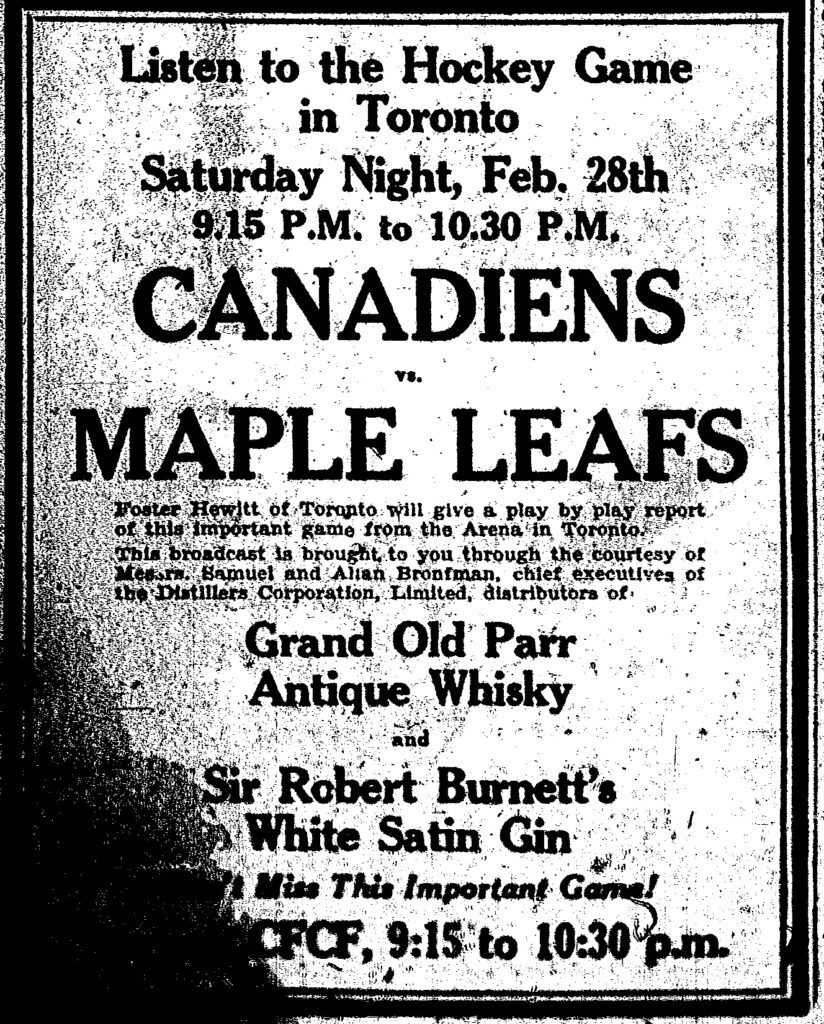
This late-season visit to Toronto was an opportune time for a show. As the play-offs approached and a season’s worth of anxiety and antipathy accumulated, every moment of competition was fraught with significance. This was confirmed not only by the effort to make a motion picture film of this particular game, but also by the fact that the game would be broadcast on radio back to Montreal. The game would be a media event.
Foster Hewitt’s play by play was to be broadcast through the CFCF channel, courtesy of the Bronfman brothers. The Bronfmans and Distillers Corporation had actually arranged for a full series of broadcasts on CFCF from Toronto which included the Maroons’ games on December 18, January 8, and March 5, as well as the three Canadiens’ games on January 3, 17, and February 28: La presse, 17 decembre 1930, p.23, c.7 – 8.
Hewitt had also been broadcasting Montreal games back to Toronto’s CFCA and CKNC since the start of the 1930 – 1931 season: e.g., The Toronto Daily Star, December 10, 1931, p.10, c.3 – 4. His “vivid word picture” of the upcoming playoffs would be broadcast locally in the Toronto market and somewhat “nationally” on the coast to coast Canadian National Railway stations: The Toronto Dailty Star, March 24, 1931, p.22, c.1, 2.
The first broadcast of an away game for the Canadiens had been 6 years earlier. It had been a French broadcast from Boston in 1925, with broadcasters Jacques-Narcisse Cartier and Joseph-Arthur Dupont: Martel, Jean-Patrice; Raconte-moi Les Canadiens, petit homme (Montreal, PQ:2015), at pp.42 – 43.
Hewitt had broadcast hockey games since 1923: Hewitt, Foster; Foster Hewitt: His Own Story, The Ryerson Press (Toronto:1967), at pp.25 – 27; Mellanby, Ralph, with Brophy, Mike; Walking with Legends, Fenn Publishing Company Ltd (Bolton, Ontario: 2007), at p.3; and Young, Scott; Hello Canada! The Life and Times of Foster Hewitt, Seal Books (Toronto:1985), pp.31 – 34. Foster Hewitt had previously provided the incorrect date of 1921 in Hewitt, Foster; Hockey Night in Canada: The Maple Leafs’ Story, The Ryerson Press (Toronto:1956), at p.135. The 1923 date was identified as the first hockey broadcast “from the Mutual Street Arena” in Kelly, Graham; Green Grit: The Story of the Saskatchewan Roughriders, HarperCollins Publishers Ltd. (Toronto:2001), at p.103
While it was not yet the “religious service, performed not by men, but gods,”: Gault, John; The Fans Go Wild: Paul Henderson’s Miracle, newpress (Toronto:1973), at p.15, play-by-play radio was beginning to do what the newspapers could not: take the listener to the game as it was happening. Radio allowed fans to “see the game through your ears,” according to the text of the Rogers Radio ad in The Montreal Daily Star, January 29, 1931, p.16, c.5 – 8; to live each moment in their imaginations:
When you listened to Foster calling the play-by-play on radio, you saw the action through his eyes. . . .Few people ever saw Charlie Conacher play, but thanks to Foster, countless fans could imagine they had. He was the link between the players and the fans, and you learned whatever you knew about the players from him. Foster used to say, “There was never a bad game when I broadcast it.”
Mellanby, Ralph, with Brophy, Mike; Walking with Legends, Fenn Publishing Company Ltd (Bolton, Ontario: 2007), at p.3.
. . . the game was not simply described to the radio audience: the game was description, an aural imagining, a distant and ghostly thing, electrifying through the implied action. It was Hewitt’s voice: dramatic, excited, forewarning. The players were invisible muses to Hewitt’s performances – they shaped his delivery, they were his cues. . . .
Hunter, Douglas, Open Ice: The Tim Horton Story, Viking (Toronto:1994), at pp.56 – 57
Consider also Bobby Clarke’s similar appreciation of the professional game from Flin Flon, Manitoba in the 1950s, which was still a radio experience: Cuthbert, Chris, and Russell, Scott, The Rink: Stories from Hockey’s Home Towns,Viking (Toronto:1997), at p.206, as well as Jack Batten’s memorial of the comforting and unifying role of the Saturday night radio broadcast, originally published in defunct Canadian magazine, and reproduced in Young, Scott; The Boys of Saturday Night: Inside Hockey Night in Canada, McClelland & Stewart Inc. (Toronto:1991), at pp.19 – 201
Listening to a game as it was happening captured the listener with the element of “real time” suspense, both the uncertainty of outcome, and what adventures or misadventures might befall the players who were engaged in the struggle: Whitson, David, and Gruneau, Richard; Artificial Ice: Hockey, Culture, and Commerce, Broadview Press (Toronto:2006), at p.165.
For the League itself, the greatest benefit of radio coverage would ultimately be its ability to expand the game’s commercial potential: Kidd, Bruce; The Struggle for Canadian Sport, University of Toronto Press (Toronto:1996), at pp.222 – 223. As a result, the games began to become structured as entertainment “performances,” rather than strict athletic contests – a notion embraced most successfully by the NFL, visible most clearly starting in the early 1970s: MacCambridge, Michael; America’s Game: The Epic Story of How Pro Football Captured a Nation, Random House (New York: 2004), at p.280.
We cannot ignore that there was also going to be an attempt on this particular night in Toronto to make the first live, sound film recording of a professional hockey game. The Globe, February 27, 1931, p.9, c.4 – 5 referred to the filming as an “experiment” by The Canadian Movietone Company, in conjunction with Fox Films. La presse, 28 fevrier 1931, p.44, c.1-2 identified the filming as an initiative of Famous Players. There are reports of earlier newsreel footage in Bidini, Dave, Tropic of Hockey: My Search for the Game in Unlikely Places, McClelland & Stewart Ltd. (Toronto:2000), at p.240, and of course there was hockey footage taken at the Olympics of 1924 and 1928.
This Toronto effort to film a whole game was going to be a $10,000 experiment: The Globe, February 27, 1931, p.8, c.4 – 5; The Toronto Daily Star, February 27, 1931, p.10, c.8. Special lights had been brought in from Montreal to brighten Arena Gardens. A single “movietone” camera would capture the action: The Montreal Herald, February 27, 1931, p.9, c.3; or in French, “un appareil sonore special”: La presse, 28 fevrier 1931, p.44, c.1-2; If the experiment worked, the game film could be shown in theatres. Although a film recording of the game would not retain the suspense of an uncertain outcome, the novelty of reproducing an event on film remained an opportunity to continue to build the game’s audience at a time when there were already not enough seats to sell in Toronto: Gruneau, Richard, and Whitson, David; “Media, Audiences, and the NHL Monopoly” in Hockey Night in Canada, Garamond Press (Toronto:1993), at pp.97, 165.
Howie Morenz felt once more like hockey’s salesman, just as he had in the middle years of the 1920s. This new chance to appear on the big silver screen would give his performance a permanence that teletype and telegraph machines, or even radio broadcasts, could not provide. Instead of relying on their memories, their imaginations, or the word of mouth of those who had seen him themselves, people around the world would have access to a permanent record of what he could do through their own eyes. That was the thought.
What no one knew during the game was that the film experiment was going to be “not up to expectation” due to lighting issues: The Boston Herald, March 25, 1931, p.30. It was an outcome that would become common with every effort to transpose Howie Morenz and his story onto celluloid and other motion picture technologies.
Short segments of film that depict a representation of him in motion, skating and playing the game, do exist. A short, black and white, silent film sequence of Morenz standing on the ice, and then skating on a rush, is available at the Hockey Hall of Fame Research Centre as part of a short film made by Dean Robinson as part of his academic work involving Howie Morenz in the 1970s. The NHL has other short segments. However, each of these is of frustrating brevity and disappointingly poor cinematographic quality. There may be segments extant somewhere from sound film taken in the first game of the playoffs at the Boston Garden between the Canadiens and the Bruins on March 24, 1931: The Boston Herald, March 25, 1931, p.30. This author has not been able to find them.
Other efforts to reproduce Howie Morenz on film proved similarly unsuccessful. After his death there was talk about a “life story”-type of film treatment that allegedly foundered on the family’s financial demands: The various film initiatives are recounted in an undated, unattributed newspaper clipping found in the “Howie Morenz” file at the HHOFRC.
Metro was said to have a plan to do a film starring Clark Gable that did not happen. In the 1960s James Telfer, a Montreal golfer associated with the Qaudrika Films of Canada, was promoting plans for a film starring Nova Scotia-born figure skater Michael Kirby in the role of Howie Morenz. Kirby was a North American and Canadian champion figure skater in 1941 and 1942. Later he skated in films with Sonja Henie in “The Countess of Monte Cristo” and also played opposite to Lana Turner in “Keep Your Powder Dry.” By the time of the movie talk he would have been older (35+) than Howie Morenz was when he died.
As those film projects foundered, Charles Mayer was drafting a proposal for a television show, or series, about Morenz. Charles Mayer Fonds, MG30-C76, volume 12; Library and Archives Canada. Mayer’s papers include what appear to be outlines for both a film, a pilot for a series of television shows, and an outline for what a series could cover. The film-pilot proposal is dated February 21, 1958. Those ideas came to naught as well.