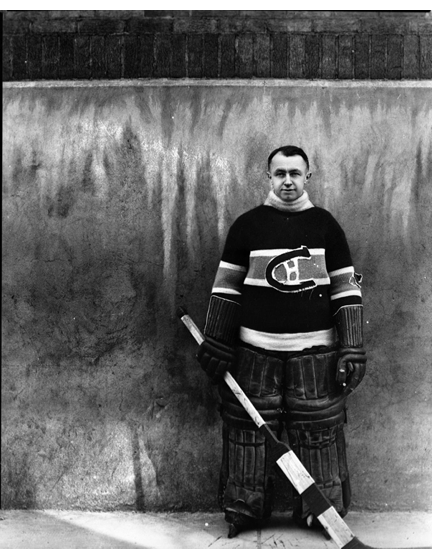
It is all part of the mythology of the position, anticipated, expected, accepted, and believed; and in many ways real. Predictably a goalie is more introverted than his teammates, more serious . . ., more sensitive and moody (“ghouliesâ€), more insecure (often unusually “careful†with money) . . . . – Ken Dryden (“The Goaltender’s Game†in Frayne, Trent, ed.; All-Stars: An Anthology of Canada’s Best Sportswriting, Doubleday Canada Limited (Toronto:1996), at p.55)
George Hainsworth was all of those things.
He collected nicknames: “the Shutout King,†“the imperturbable little goalie,†“the old icicle,†“as cool as a frigidaire,†and sometimes even “Cucumber George†– a homage to the other Georges, Georges Vezina. Vezina was the man who tended goal for the Canadiens when Morenz first arrived in Montreal, and who had identified Hainsworth as the goaltender of the future to Leo Dandurand.
Hainsworth’s success can be attributed in part to the attitude with which he played his position, and in part to the way he approached the game as an athlete – shaping his approach to goaltending according to his own physical advantages.
By the early winter of 1930, Hainsworth’s four years of NHL play had built his reputation for being unemotional, unflappable, and even “almost bored†by his job: Macgregor, Roy, “The puck stops here,†The Globe and Mail, April 26, 2008, p.S7, c.1 (article begins on p.S1); also collected in Macgregor, Roy; Wayne Gretzky’s Ghost and other Tales from a Lifetime in Hockey, Vintage Canada (Toronto:2012), at p.134.
He played in the nets with calm. Contemporaries recognized that his:
. . . unhurried manner, and almost phlegmatic attitude is deceiving enough to pass by expert eyes seeking gaudiness and sensationalism. (The Montreal Daily Star, April 9, 1931, p.39, c.3 – 4)
He apologized for the lack of showmanship. According to Roy MacGregor:
I’m sorry I can’t put on a show like some of the other goaltenders. I can’t look excited because I’m not. I can’t shout at other players because that’s not my style. I can’t dive on easy shots and make them look hard. I guess all I can do is stop pucks. (The Globe and Mail, April 26, 2008, p.S7, c.1 (article begins on p.S1); also collected in Macgregor, Roy; Wayne Gretzky’s Ghost and other Tales from a Lifetime in Hockey, Vintage Canada (Toronto:2012), at p.134).
It was a conscious posture and attitude (Le petit journal, 26 mars 1933, p.33, c.1 – 2) that imparted confidence and calm to his teammates (The Gazette, April 15, 1931, p.17, c.2). And so he continued to play effectively with that unruffled style:
He swept out rubber the way your Aunt Min sweeps the porch (Brandt, Bill; “Once in a Lifetimeâ€, April 1948, p.39, 101)
The previous spring’s successful Stanley Cup series against the Bruins had demonstrated the value of the calm he brought to the ice:
. . . the cool George Hainsworth who imparted all of his frigidity to the remainder of the team when they needed it most. The psychological effect of Hainsworth on his teammates is almost incalculable. (The Gazette, April 4, 1930, p.20, c.2)
The coolness was very much an act. Howie Morenz had sat in the dressing room with him while the goaltender cried after a playoff loss (La patrie, 4 avri 1928, p.8, c.3 – 4). Clancy had seen him dying with anxiety on the ice after a particular difficult save.
He was of course also more than his attitude. He was quick and athletic. He could, and would, dart about from side to side to the front of his net with a sharpness and speed that matched that of the best attacking stickhandlers in the game. When required, he would stack his pads on top of one another and slide across the goalmouth to take away shot opportunities as well.
His emergence as a successful NHL netminder paralleled that of other well-known goaltenders of the meso-medial type – contemporaries like Tiny Thompson and Roy Worters, and followers like Terry Sawchuk, Gerry McNeil, Frank Brimsek, and Harry Lumley: (Percival, Lloyd; The Hockey Handbook, The Copp Clark Co. Ltd. (Toronto:1951), p.210).
Rather than relying upon weight or girth, Hainsworth and these others relied more on glove and stick and skates to block and bat pucks away. Even perennial All-Star goaltender Chuck Gardiner was supposed to trail Hainsworth in those aspects of a goaltender’s skills (The Calgary Daily Herald, March 23, 1934, p.7, c.4).
The best part of Hainsworth’s game may have been how he took the initiative away from shooters. As a result, He was prepared to charge out, or dive out, to challenge a shooter, forcing them into more difficult shots. As Martin Brodeur would explain a few generations later:
“I didn’t mind making the first move if that meant I could dictate the moment.†(Brodeur, Martin, with Cox, Damian; Brodeur: Beyond the Crease, John Wiley & Sons Canada, Ltd. (Mississauga, Ont.: 2006), at p.55)
Perhaps in hopes of disconcerting his opponents, Hainsworth would also sometimes resort to laughing maniacally as he repulsed their attacks (Richard, Maurice “Rocketâ€, and Fischler, Stan; The Flying Frenchmen: Hockey’s Greatest Dynasty, Hawthorn Books, Inc. (New York:1970), p.59).
Hainsworth’s approach to his role endeared him to his teammates, and created a fan base that included a young Terry Sawchuk out in Winnipeg (Feige, Timothy; Hockey’s Greatest Tragedies: The Broken Heroes of the Fastest Game on Earth; Arcturus Publishing Limited (London, Eng.:2011), at p.191).
George Hainsworth wore the “C†as Captain of the Canadiens during the 1932 – 1933 season (Mouton, Claude; The Montreal Canadiens: A Hockey Dynasty, Van Nostrand Reinhold Ltd. (Toronto:1980), at p.257). He held the role as the team’s “adult†on the ice for even longer:
To be a goalie, you realize, is to be an adult too soon, to have too soon an intimate understanding of the inevitability of pain and failure. (Thauberg, Rudy, “Goalieâ€, in Beardsley, Doug, ed.; The Rocket, The Flower, The Hammer and Me, Polestar Book Publishers (Winlaw, B.C.:1988), at p.223)
Around the league he was certainly regarded as something of an “old man.†(The Toronto Daily Star, March 11, 1931, p.10, c.2). Except perhaps for Bert McCaffrey, he was quite obviously the oldest player on the team: 9 years older than Morenz, and 16 years older than both Gus Rivers at 21, and Georges Mantha, who had just turned 22 in late November, 1930.
Hainsworth’s performance in the spring of 1930 had been particularly satisfying for Morenz. A couple of years before Howie had publicly attributed some of the Canadiens’ surprising playoff failure in the spring of 1928 to Hainsworth’s lack of experience in how to manage a short series (La patrie, 24 mars 1928, p.21, c.1; 27 mars 1928, p.11, c.1; 4 avril 1928, p.8, c.3 – 4). In the spring of 1930, Hainsworth was the difference against the Blackhawks by a goal, against the Rangers, and then again against Boston by just a goal in the deciding game.
The game in Philadelphia on December 2, 1930, marked George Hainsworth’s 54th regular season shutout in his NHL career. He accumulated 8 more over the course of the season bringing his career total to 62, and then added 2 more in the playoffs – including in the Cup-clinching game. That meant that in 54 games (he played every minute of every one of 44 regular season games and 10 playoff games) he shut out his opponents 11 times – more than 20% of those games.
George Hainsworth remained with the Canadiens until he was exchanged for Lorne Chabot of the Maple Leafs in 1933. He was with the Toronto Maple Leafs for three full seasons and a few games into the fall of 1936, before returning to the Canadiens and closing out his career with 4 games that same fall.
His last appearance on Forum ice as a goaltender was in a wartime fundraiser oldtimers game, where he re-joined Aurel Joliat, Johnny Gagnon, Pit Lepine and Wil Larochelle against a Maroons’ oldtimer’s squad. The Victory Loan Sports Parade, of which the Canadiens/Maroons oldtimers’ game was the highlight, was organized by Leo Dandurand (The Gazette, February 17, 1942, p.16, c.6 – 7).
Goerge Hainsworth died as a result of an automobile accident near Gravenhurst, Ontario, on October 9, 1950. He was reported to have been 57 years of age (Kitchener-Waterloo Record, October 10, 1950, at p.1) and had been an alderman In Kitchener at the time of his passing. He had been retired from competitive hockey for 14 years.
It would be another 13 years yet before Terry Sawchuk tied Hainsworth’s shutout record on November 19, 1963 (Vipond, Jim; Gordie Howe Number 9, The Ryerson Press (Toronto:1970), p.54).