Her Half-Life as Mrs Howie Morenz
. . . the memory of love follows its victim everywhere: Liebling, A. J,; The Sweet Science, Grove Press Inc. (New York:1956), at p.267.
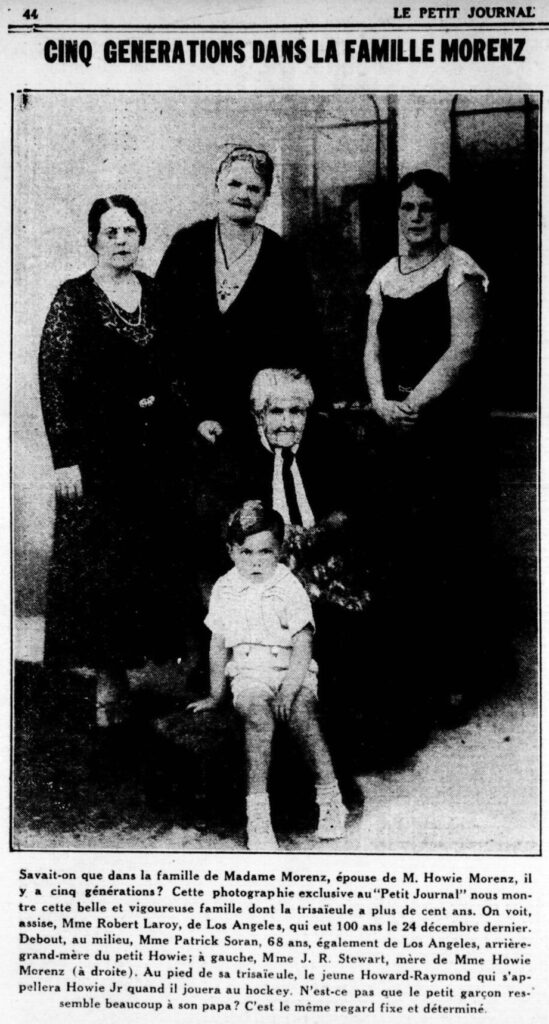
There is so much to consider about the life, or half-life as I have characterized it, of Mary Morenz. She arose from some old or established Montreal wealth, had a matrilineal line where the women all lived very long lives (her own mother lived into the 1970s!), had some family connection to the city’s professional hockey, had become a hockey fan or was matched up with Howie Morenz by Leo Dandurand, before embarking on teenage escapades when she might have been 17, or 18 . . . .
The 1920s started when she was 12, and ended when she was 22. In that 10 year span she had acquired an unexpected pregnancy, got married underage with parental permission and 8 months to spare. By the end of the decade she had already been married for 4 years, and had a 4 year old son! She was a famous mum herself, married to Montreal’s, or Canada’s, or maybe even the world’s most famous hockey player.
When Howie Morenz first signed with the Canadiens, the local clergy in Stratford had complained about the team “luring an under-age boy to the wicked city of Montreal.”: Frayne, Trent, “How they Broke the Heart of Howie Morenz,” Maclean’s Magazine, October 15, 1953, p.24, at p.90; repeated in Frayne, Trent; Famous Hockey Players, Dodd, Mead & Company (New York:1973), at pp.12 – 13
It was true:
These were happy times for Morenz. The boy who had been so reluctant to leave Stratford took to the bright lights, beautiful women and colourful characters of ‘the wicked city of Montreal: Feige, Timothy; Hockey’s Greatest Tragedies: The Broken Heroes of the Fastest Game on Earth; Arcturus Publishing Limited (London, Eng.:2011), at p.167
Howie had been introduced to the pleasures of the city under the morally suspect guidance of fellow Canadien Sprague Cleghorn, a gambler and card player, whose own departure from the Ottawa Senators and arrival to the Canadiens may have been prompted by the companionship of a woman (not his wife) that he had arranged for a post-season barnstorming tour to the west coast: Finnigan, Joan; Old Sores, New Goals: The Story of the Ottawa Senators, Quarry Press (Kingston, Ontario:1992), at p.156
The young man from Stratford embraced every opportunity that the city provided, just as Harvey Jackson and Charlie Conacher would do in Toronto: Smythe, Conn, with Young, Scott; If You Can’t Beat ‘Em in the Alley, PaperJacks Ltd. (Markham, Ontario:1982), at p.109.
Sex was the one pleasure that male and female athletes have ever consistently ranked above the pleasures of playing their sport well: e.g, Lichtenstein, Grace; A Long Way, Baby, Fawcett Publications, Inc. (Greenwich, Conn:1975), p.158
As Babe Ruth himself demonstrated: Pirone, Dorothy Ruth, with Martens, Chris; My Dad, The Babe, Quinlan Press (Boston:1988), at pp.194 – 196. See also: Golenbock, Peter; Fenway: An Unexpurgated History of the Boston Red Sox, G. P. Putnam’s Sons (New York:1992), pp.51 – 52; the sexual lives of the players in the mid-1920s could be just as risqué as the open sexual promiscuity that Derek Sanderson brought to the National Hockey League in the late 1960s: Sanderson, Derek, with Fischler, Stan; I’ve Got to be Me, Dell Publishing Company (New York:1970), pp.148, 149 – 150, as much of a nuisance as it sometimes became for athletes in Montreal during the 1970s: Barnes, La Verne; The Plastic Orgasm, McClelland and Stewart (Toronto:1971), at pp.76 – 77, and a similar banquet for young men and women that Terry Ryan was to describe as the Montreal he discovered in the mid 1990s: Ryan, Terry; Tales of a First Round Nothing, ECW Press (Toronto:2014), at pp.85 – 86
The twin lures of sex and hockey had always been distracting to new players arriving in Montreal, but his youth, enthusiasm, and the fact of being from out of town made everything fresh for Morenz and the women he met.
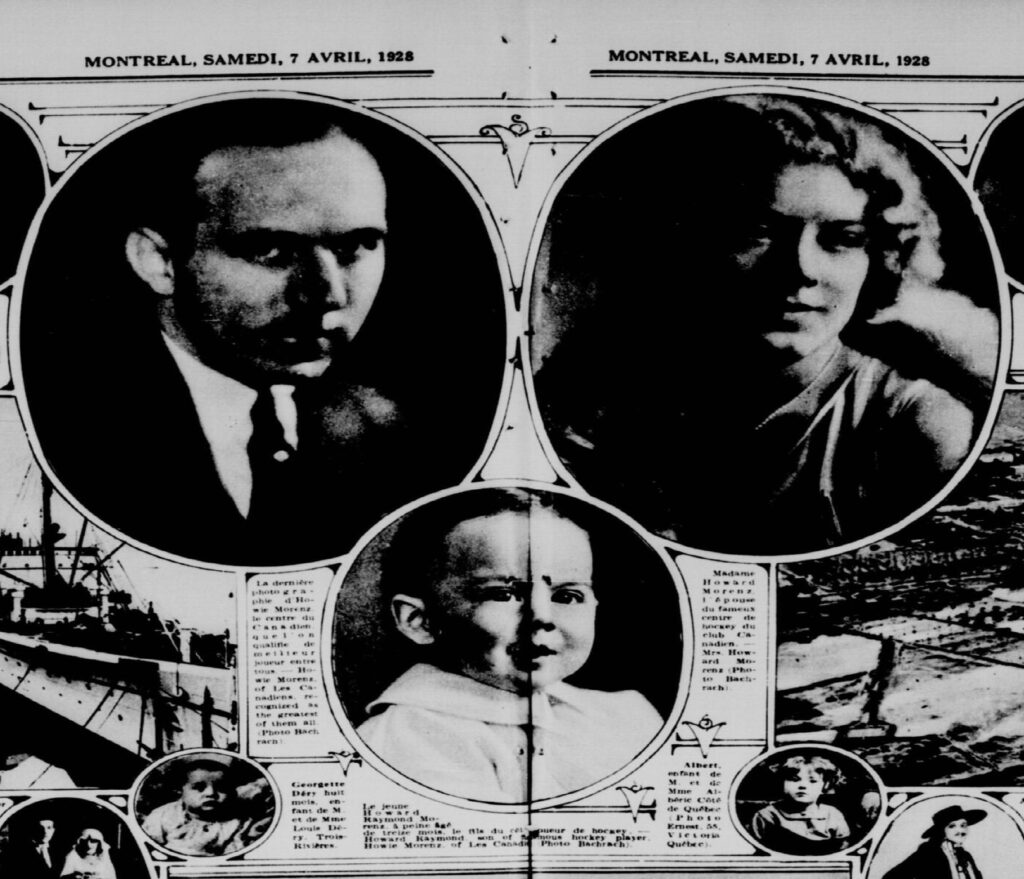
Howie’s specific romance with Mary MacKay echoed that of Zelda and F. Scott Fitzgerald – as it should have. Fitzgerald had become well-acquainted with a previous hockey phenomenon by the name of Hobey Baker when both were at Princeton, and is supposed to have modeled his hero Amory, in This Side of Paradise, after Baker: Fitzgerald, F. Scott; This Side of Paradise, Charles Scribner’s Sons (New York:1920), at pp.61 – 62. Mary seemed to be as much in the same flappery mold of Fitzgerald’s own Zelda, as described by Milford, Nancy Winston; Zelda, Harper & Row, Publishers (New York:1970), at p.36:
From Zelda’s point of view Scott was a new breed of man. . . . he represented a world she did not know and could not hope to enter, much less possess, without him. Beguiled by his palaver and sharing with him the view that anything done moderately was better left undone, she decided that she loved him. They were both eager to conquer New York, and their entire future rested upon Scott’s success there. . . . Zelda was both astonished and delighted by the fervor of Scott’s dreams for glory, and there is no doubt she shared them. “She, she told herself, would move brightly along high places and stop to trespass and admire . . . .”
Endowed with the name that was recognized on every street in Montreal, and in sporting circles from Toronto to Boston and New York City, Mary became invested in the whole promise of the fame of the name. What came next was a decade in the vortex of a whirlwind, with scarcely a moment to breathe, or to find her own footing. She had little time, or care, to ponder about who she would become. This was a consequence embraced by some, resented by others: Schultz, Dave, with Fischler, Stan; The Hammer: Confessions of a Hockey Enforcer, Totem Books (Toronto:1982), at pp.47 – 49
Mary would attend her husband’s games at the Forum, leaning forward on the boards at rinkside, without any glass or netting to protect her, in Box 22; a front-row seat to hear how the crowds roared when he carried the puck across the Forum ice. She could jump up and yell with the rest of the crowd as he passed her at full-speed, his legs pounding up and down like pistons to drive him into, around, and beyond his opponents.
That impact of being so close and intimate with the excitement on the ice has been captured by poet Scriver, Stephen; “Hockey Night in Canada 1978”, More All-Star Poet, Coteau Books (Regina, Saskatchewan:1989), at pp.103 – 105:
. . . the Forum is jumping tonight
as it always is before a game
because the Habs are warming up
swarming like frenzied
swallows in a circle around their net . . .
& the fans are in a party mood
no politics here they know
if a thousand games are played tonight
the best one is here . . .
and the Habs will be like Iriquois
storming a doomed stockade
& too soon it will be over
I will sink back in my chair
My breath escaping slowly
& I am like a lover
after love
Al Purdy also attempted to capture the mood in his poem “Hockey Players,” from The Collected Poems of Al Purdy, McClelland and Stewart (Toronto), reproduced in Gowdey, David; Riding on the Roar of the Crowd: A Hockey Anthology, Macmillan of Canada (Toronto:1989), at pp.122 – 124:
. . . suddenly three men
break down the ice in roaring feverish speed and
we stand up in our seats in such a rapid pouring
of delight exploding out of self to join them why
theirs and our orgasm is the rocker stipend
for skating through the smoky end boards out
of sight . . .
Those were heady moments.
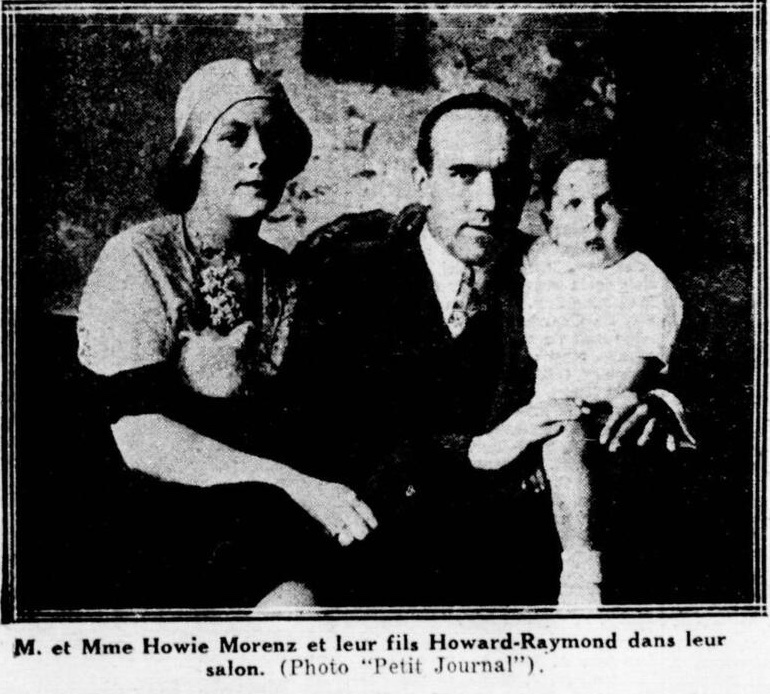
The other half of Mary’s life as the wife of a professional hockey player was that when the Canadiens were away, as they were for nearly half of every season, or when her man was busy at practice, or socializing with his teammates at golf or other diversions, Mary’s life was much quieter. That mood was caught in the words of Leo LeSieur’s brand new “Ah! le hockey!” (Recherche de Benoit Melancon, UMontreal) song that came out in the fall of 1930:
J’ai pour epouse une petit femme
Tout a fait comme il faut
Elle est jolie, aimable et douce
Elle n’a pas de defauts
Mais lorsque du jeu de hockey
Arrive la saison
Il n’a plus moyen
De la garder
A la maison.
Mary was about to become pregnant again. She gave birth to Donald on April 14, 1932, and then became pregnant again. She gave birth to Marlene on April 8, 1933. Mary was suddenly 25, after nearly two consecutive years pregnant, and now with three children under the age of 6 at home. Then in October 1934, with children 8, and 2, and 18 months, her husband was sold to Chicago. The idle days of indulgence and opportunities, cottage holidays and summer afternoons at the races or the golf course, evaporated like the dew.
When Howie Morenz made that first drive from Montreal to Chicago after being sold to the Hawks in October of 1934, the family stayed in Montreal – for a season, and then another half season. They stayed in Montreal while he played for the Rangers in New York. He would come home, too briefly, when his other teams played at the Forum. Meanwhile Mary lived the life of a single parent with three small children.
Howie’s time with the Hawks and Rangers exposed the fact that his true heart was committed first to playing the game. The greatest players have always had the capacity for love, and now in the modern age are even trained in enhancing the experiences it offers, in relation to the game: Miller, Saul L.; Hockey Tough, Human Kinetics, (Champagne, Ill.:2003), at pp.82 – 84. Love feeds devotion, and then compulsion. It creates commitment, confidence, and affirmation. Guy Lafleur gave candid voice to the conundrum:
Hockey is the most important thing in my life. It even comes before my family, my wife, my son. . . . he hadn’t worked like a madman for fifteen years with the goal of being a model husband or an exemplary father, but to be a great hockey player.
Germain, Georges-Hebert; Overtime: The Legend of Guy Lafleur, Viking (Markham, Ont.:1990), at p.222.
See also: Esposito, Phil, and Golenbock; Thunder and Lightning: A No-B.S. Hockey Memoir, McClelland & Stewart Ltd. (Toronto:2003), at p.86; Green, Ted, with Hirshberg, High Stick, Dodd, Mead & Company (New York:1971), at p.156.
Roy Macgregor explained it cleverly in Wayne Gretzky’s Ghost and other Tales from a Lifetime in Hockey, Vintage Canada (Toronto:2012), at p.51 regarding a young Paul Kariya:
“The focus is hockey, and it leaves very little room for anything else.”
Lafleur later expanded on his own thought, in what Ted Mahovlich described as an “insight,” but which only cemented the hockey player’s challenge:
He was reminiscing about the Montreal Canadiens when he first joined the team. “I miss the type of team we had when I first came up with the Montreal Canadiens. Guys like Frank, Jim Roberts, Peter Mahovlich, Ken Dryden, and Yvan Cournoyer – all the guys on that team. We formed a family, and the family we were playing for was maybe more important than the family we had at home.
Mahovlich, Ted; The Big M: The Frank Mahovlich Story, Sports Publishing Inc. (Toronto:1999), at pp.168 – 169.
From the time of Howie Morenz, to that of Guy Lafleur and after, that primary love of the game has disrupted the relationships that players are forced to negotiate with their wives and children. Igor Dimitriev, once the coach of the Red Army team, similarly demanded that his players accept their relationship with the game as if it were as exclusive as a marriage:
The artist has to be locked up for a month or so to get in the frame of mind to produce his masterpiece. If hockey is to be treated as the creation of a masterpiece, one must live with, and in, hockey. One has to refuse everything else.
Hartje, Tod, with Martin, Lawrence; From Behind the Red Line: An American Hockey Player in Russia, Maxwell Macmillan Canada, Inc. (Don Mills, Ont.:1992), at p.45
That was the kind of exclusion that Mary lived with most obviously during the later hockey seasons, but it was really fundamental from the beginning. As Nancy Marshall would observe out of the experience of being a baseball wife in Montreal:
Think of relationships in terms of a wheel. I think that for years Mike was the hub of my wheel and all my interests were spokes that originated with him. On the other hand, I think I was just a spoke in Mike’s wheel, along with his career, his education, and lots of other interests.
Bouton, Bobbie, and Marshall, Nancy; Home Games: Two Baseball Wives Speak Out, St. Martin’s/Marek (New York: 1983), at p.171
Between the time of their marriage and Howie’s death, Mary spent just over a decade with him. Their ten years and nine months as a married couple had completely defined her as a Morenz.
“She had become a nameless extension of a famous man.”
Schultz, Dave, with Fischler, Stan; The Hammer: Confessions of a Hockey Enforcer, Totem Books (Toronto:1982), at pp.49, and 55
Then there had been the accident, 6 weeks of visits to the hospital, anxious talk about a testimonial game, the death, having to testify at the inquest into her husband’s hospital death, and then the funeral.
As her life disintegrated around her she finally insisted that he at least be buried in Montreal – and not be returned to Stratford: The Stratford Beacon-Herald, March 9, 1937, p.1, c.3. It was a small insistence lost amongst the confusion of her many more incalculable losses. Space was found beneath the stone intended, and engraved, for her mother. Then Mary’s situation became even more financially impossible.
At the age of 29, she had been left unprepared to manage a household without an income, without much education, and unknown marketable skills as a woman with childcare commitments in the middle of an economic depression. The financial worries that had snarled at both of them in his last months with the Canadiens, now bit urgently at her heels again. Mary’s financial ability to maintain a proper home for her children deteriorated immediately.
Howie’s teammates responded to the need by voting him a full playoff share in the spring of 1937, and there was a memorial fundraising game scheduled for the fall. The NHL clubs made contributions to a Memorial Fund, as did others – though quite a bit short of their original promises of several thousand dollars a year for the “maintenance of the widow and education of the children.”: The Stratford Beacon-Herald, March 15, 1937, p.∆ c.7; The Toronto Daily Star, March 18, 1937, p.14, c.5 – 6
There was a Memorial Game Programme that earned some revenue, but attendance at the Memorial game itself on November 2 wasn’t particularly good. Several revenue streams eventually raised $26,595.32. It was a substantial amount for the family in depression times, but her access to the money was restricted..
By the time of the Memorial Game, Mary had already become the target of kidnapping threats against Howie Morenz Jr, the newspapers had given unnecessary space and attention to a claim by a crippled miner in New Waterford, Nova Scotia, that he was Howie’s only living relative. There were thefts from her home of memorabilia that had been earned by her late husband.
Whether Mary Louise’s drinking became problematic after Howie’s death had left her alone in misery, or whether it only became more exposed by his death after a near decade of hedonism and celebrity excitement, cannot be known. Mary’s own daughter Marlene recalled that her mother’s fabulous decade with Howie had been followed by “a downward spiral into alcoholism.”: Howe, Colleen and Gordie, and Wilkins, Charles; After the Applause, McClelland & Stewart, Inc. (Toronto:1989), at p.102. Howie Jr hinted in later years that his mother had had a mental health stress reaction to Howie’s death:
“I could imagine that it would be a little traumatic for her to go to the Forum, having been there so many times when my father was alive.”
Quoted in Robinson, Dean; Howie Morenz: Hockey’s First Superstar, Boston Mills Press (Erin, Ontario: 1982), p.155
In Howie Jr’s own obituary: The Globe and Mail, November 6, 2015, p.S8, c.2, it was acknowledged that:
After her husband’s death, Mary (nee McKay) Morenz took ill and was unable to care for children.
There are two versions of how Mary met, and married, her second husband. George Pratt was an alderman in the town of Outremont. He was wealthy. The Avenue where he lived carried his family’s name, as did a nearby city park. Pratt had graduated from Loyola College in 1910 (when Mary was 2), and been married to Hilda Gingras in 1911 (when Mary would have turned 3). He had been widowed, and in 1939 the newspapers already described him as “elderly.”: The Globe and Mail, January 21, 1939, p.2, c.7.
Dean Robinson’s account reports that Mary met George Pratt at a bridge party given by Pratt’s younger brother. George caught Mary’s attention. He was a widower, with three adopted sons. Robinson reports that Mary became Mrs George Arthur Frederick Pratt in the fall of 1939, at which point she moved into the Pratt Avenue mansion with her children: Robinson, Dean; Howie Morenz: Hockey’s First Superstar, Boston Mills Press (Erin, Ontario: 1982), pp.144 – 145.
The other versions of the remarriage cast a different perspective on Mary’s need, and her limited options for family survival. These other stories are also more consistent with contemporary third party accounts – and the actual re-marriage date of January 23, 1939 – Mary’s 31st birthday. There is an account that George Pratt discovered Mary weeping alone in a church, and that he had been moved to inquire about her distress.
There is another that the two met when Pratt discovered her forgotten purse and returned it to her. Whichever the mechanism of their meeting, the marriage brought an immediate solution to the Morenz family’s accumulating economic distress that had begun with Howie’s sudden death.
Mary was 31 years old. The marriage bans had already been read on January 9, 1939, when her son Donald had taken sick at the orphanage with pneumonia. Donald was taken to hospital, but died on January 16. Mary was convinced that she had been “cursed by fate.”: Robinson, Dean; Howie Morenz: Hockey’s First Superstar, Boston Mills Press (Erin, Ontario: 1982), p.144. Her wedding was only a week away. She wanted to postpone it, but the wedding went ahead just 7 days later:
Mrs Morenz wanted to postpone the wedding because of the child’s death, but had been persuaded to carry through with the plans and then spend a month in the South because of her poor health.: The Globe and Mail, January 21, 1939, p.2, c.7.
Perhaps to temporarily relocate to Florida: The Globe and Mail, November 6, 2015, p.S8, c.2
Four hundred people came to Mary’s second wedding. It would have been one of the first grand social occasions of the new year for upper class Montreal. The marriage record shows her both as Mary Louise McKay Morenz, and simply as Mary Louise McKay, widow of the late Howie Morenz.
Marlene described her mother during the years that followed as remote. Mary and her new husband provided Marlene with “very little spiritual support.”: Wilkins, Charles, with Howe, Colleen and Gordie; After the Applause, McClelland & Stewart (Toronto: 1990), p.102.
Howie Jr remembers that as his competitive hockey career developed through the 1940s, the mother who had shown him off at the Forum as a three-year old only managed to come to a single game.
Mary Louise Stewart McKay Morenz Pratt spent the dozen years after Howie Morenz’s death wandering as if she had lost connection with her own self as well. That 1939 winter, and after the war, Mary Louise and George Pratt appeared occasionally on passenger lists traveling through Miami, the Virgin Islands, Mexico, and New Orleans. There were occasional reports of her going away with George for a few months, and even a year.
Mary Louise died on February 9, 1950. Her daughter attributed the death to alcoholism. Though Mary died “suddenly” in hospital, it was after “resting at her residence” that Mary was buried in Montreal’s Cote des Neiges Cemetery from St Germain Church in Outremont. The grave was not with her first husband, nor with her son Donald, nor even in the place where her mother would eventually be interred. Instead, her place was on the back of her husband’s tombstone, the middle wife of three, described only as Mary Louise McKay.
Mary’s life had in fact burned out nearly as quickly as that of her famous husband. Had she lived as long as her own mother, she might have been interested in the observations of Nancy Marshall, former wife of one-time Montreal Expo, Mike Marshall in Bouton, Bobbie, and Marshall, Nancy; Home Games: Two Baseball Wives Speak Out, St. Martin’s/Marek (New York: 1983), at p.247:
Patti [Sutton] and I talked about what we would advise young women who are new to the game. We decided we’d tell them to avoid the fairy tale and recognize the reality. . . . . We’d tell them to make lives for themselves outside of their husbands’ careers. We’d tell them that the same ego that enables their husbands to perform well on the field may prevent them from performing well in their relationships. We’d tell them to be wary of letting all the attention and notoriety their husbands get detract from their own feelings of self-worth. We’d tell them all those things and more, but we agreed that they probably wouldn’t understand. Do you think we would have listened?