The Integrity of His Game
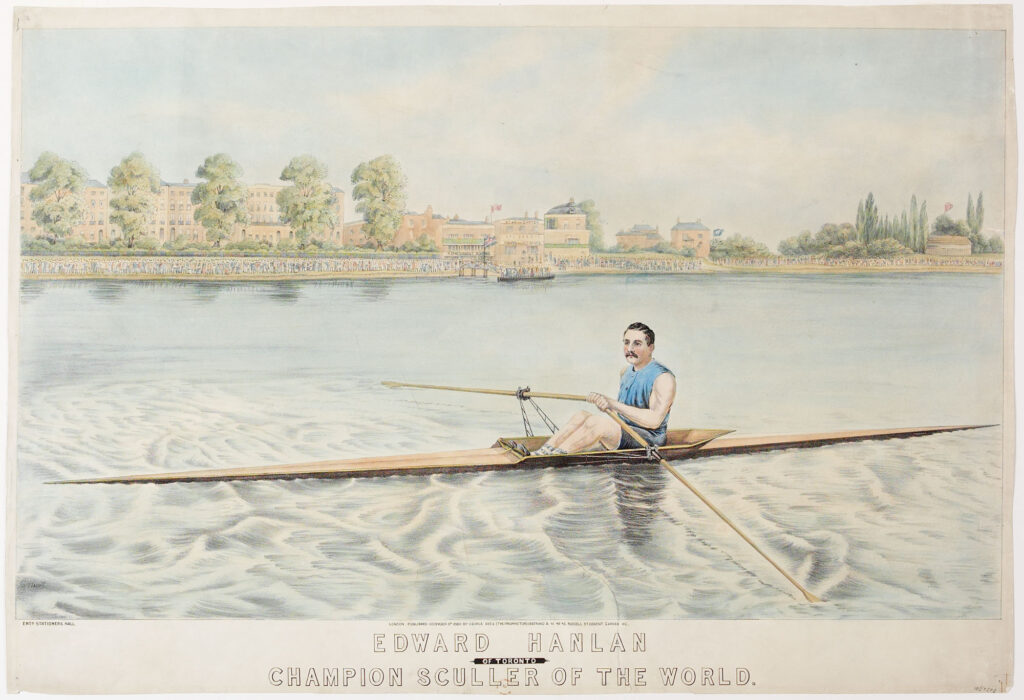
Edward “Ted”/”Ned” Hanlan, from the collection of Library and Archives Canada
The concept of losing on purpose in the sports industry appears to have first been first studied in the context of professional American basketball: Taylor, Beck A., and Justin G. Trogdon: “Losing to Win: Tournament Incentives in the National Basketball Association.”, Journal of Labor Economics, 2002, vol.20, issue 1, pp.23 – 41. However the actual idea, and the phrase “laying down” was in common use in Howie Morenz’s time, and remains reasonably current in boxing language: e.g., Rendall, Jonathan; This Bloody Mary Is the Last Thing I Own: A Journey to the End of Boxing, The Ecco Press (Hopewell, NJ: 1997), at p.178.
The Americans sat in the third and final playoff position behind the Canadiens and Leafs, but 3 points ahead of the Maroons, in the NHL’s Canadian Division. The Canadiens were in first place by 9 points and in little danger of challenge. Giving the game and two points to the Americans could help sink the Maroons’ playoff hopes.
There had already been some local Montreal talk that the “personal hatreds,” “racial” division, and general animosity between the Canadiens and Maroons would encourage a fix. The “fisticuffs, blood-letting, heavy checking, socking and other forms of mayhem” during the game on Thursday night had served to inflame rather than deflate the potential for that kind of an arrangement: The Montreal Herald, February 23, 1931.
In the late winter of 1931, professional hockey leagues, players, and their audiences were barely five years removed from a decade of lively public discussions about match-fixing in professional baseball: Burk, Robert T., Never Just a Game: Players, Owners and American Baseball to 1920, The University of North Carolina Press (Chapel Hill:1994), pp.229 – 235 – and that was entirely apart from the 1919 World Series scandal involving Charles Cominskey’s Chicago White Sox: Asinof, Eliot; Eight Men Out: The Black Sox and the 1919 World Series, Henry Holt (New York: 1987); Schecter, Leonard; The Jocks, Warner Paperback Library (New York: 1972), at pp.201 – 213, but particularly at pp.204 – 206 on how easy it was to do.
Well-known player/managers Tris Speaker and Ty Cobb had engaged in the practice, while New York Giants’ manager John McGraw had complained about his own players doing it: Burk, Robert T., Never Just a Game: Players, Owners and American Baseball since 1921, The University of North Carolina Press (Chapel Hill:2001), at p.16. A more detailed treatment, particularly of Cobb’s involvement, is provided in Alexander, Charles C., Ty Cobb, Oxford University Press (New York: 1984), at pp.185 – 195.
As recently as 1927, Baseball Commissioner Landis had felt compelled to establish standard suspensions for “laying down”, bribing or attempting to bribe a game official, and betting on games: Alexander, Charles C., Ty Cobb, Oxford University Press (New York: 1984), at pp.16 – 17.
Indeed, chatter out of Boston after the Bruins were eliminated in the 1931 playoffs would prompt suggestions that the League itself had actually fixed the Bruin loss, and was arranging a Stanley Cup championship for the Hawks: The Globe, April 7, 1931, p.10, c.3 – 4. However, the truth was that this rumour was not taken particularly seriously anywhere else than in Boston.
English sport fans of the time were very familiar with the fact that cricket fixes had allegedly been going on for more than a hundred years in Britain: Hill, Declan; Fix: Soccer and Organized Crime, McLelland and Stewart (Toronto:2008), at p.146. Of most recent interest was the Manchester United football scandal of 1915, when some Liverpool and Manchester United players colluded to avoid United’s relegation. Players from both teams had also benefitted from bets placed on the outcome. While the Football Association imposed some lifetime bans on players, several of those had been overturned just 4 years later: Inglis, Simon; Soccer in the Dock: A History of British Football Scandals, 1900 – 1965; Willow Books (London:1985). The world was also just 3 years away from a fixed match on March 25, 1934, between Italy and Greece, in their 1934 World Cup qualifier: Hill, Declan; Fix: Soccer and Organized Crime, McLelland and Stewart (Toronto:2008),, at p.100.
Canadians had their own history of fixed-outcome athletic performances billed as contests. As far back as the 1880s, rower Ned Hanlan had been involved in fixing races for his own financial benefit: Morrow, Don and Wamsley, Kevin B., Sport in Canada: A History, Oxford University Press (Don Mills: 2005), at pp.128 – 134; Schecter, Leonard; The Jocks, Warner Paperback Library (New York: 1972), at pp.228 – 231; and Howell, Nancy, and Howell, Maxwell; Sports and Games in Canadian Life: 1700 to the Present, Macmillan of Canada (Toronto:1969), at p.120.
More recently, marathoner Tom Longboat had been unable to complete a 1907 race after being doped with strychnine – perhaps by his own trainer “who stood most to gain by Longboat not finishing in terms of influencing betting odds.” That trainer was Tom Flanagan. Kidd, Bruce, The Struggle for Canadian Sport, University of Toronto Press (Toronto:2002), at p.34, following his own article “In Defense of Tom Longboat”, Canadian Journal of History of Sport, 14, 1 (May, 1983), pp.34 – 63. See also Morrow, Don and Wamsley, Kevin B., Sport in Canada: A History, Oxford University Press (Don Mills: 2005), at pp.78 – 79, 82 – 83, and 256 n63.
And of course the Maroons’ Lionel Conacher had been dogged by accusations of match fixing in both hockey and football since at least the early 1920s. There had been an “investigation” of sorts into Conacher. He was cleared, or “whitewashed”: Morrow, Don and Wamsley, Kevin B., Sport in Canada: A History, Oxford University Press (Don Mills: 2005), at p.85.
Gambling and bribery suspicions were common regarding American football as well: e.g., MacCambridge, Michael; America’s Game: The Epic Story of How Pro Football Captured a Nation, Random House (New York: 2004), at pp.48 – 49, 259
Through it all, the spectators still participated eagerly in the wagering: Howell, Colin D., Blood, Sweat, and Cheers: Sport and the Making of Modern Canada, University of Toronto Press (Toronto), at pp.59 – 63; Finnigan, Joan; Old Sores, New Goals: The Story of the Ottawa Senators, Quarry Press (Kingston, Ontario:1992), at p.39.
A number of the classic risk factors that create the incentive to fix professional hockey games certainly existed in the winter of 1931. Employment was fragile, and player income was limited. This has been consistently cited as part of the rationale for the 1919 World Series scandal: e.g., Weiler, Paul; Leveling the Playing Field: How the Law can make Sports Better for Fans, Harvard University Press (Cambridge, Mass.:2000), at p.51, as well a contributing reason for the English football fixes of the 1950s: Hill, Declan; Fix: Soccer and Organized Crime, McLelland and Stewart (Toronto:2008), at pp.109 – 114. Weiler is, with respect, naïve that modern salaries for professional athletes remove the incentive for game-fixing, as Hill’s work has shown.
Working conditions for players could also be abusive, which has been referenced as another part of the explanation for the commonness of match fixing in English football during the 1950s: Hill, Declan; Fix: Soccer and Organized Crime, McLelland and Stewart (Toronto:2008), at p.109.
The potential playoff impact of the result of the game between the Canadiens and Americans layered complementary lures for the clubs themselves. While a win by the Americans would solidify the claim of their players for legitimate League playoff money, it would also brighten the chances for home playoff game ticket revenue for the Americans’ owner Bill Dwyer. He had stepped forward to finance the balance of the season for Benny Leonard’s failing Philadelphia Quakers franchise, and could certainly use the playoff ticket revenue. The Montreal Herald, February 23, 1931, p.10, c.5 – 6 valued a Forum playoff date at $15,000 for the home club. If the Canadiens co-operated, they would see those very same benefits of player income and ticket revenue denied to the Maroons. The Canadiens’ situation would be unchanged whether they won or lost.
The idea of gamblers being involved in a National Hockey League game would not have shocked either fans or players at the Forum that night. Hockey people would continue to refer reverently to the legendary $75,000 bet on one Cobalt-Haileybury series before the first world war into the late 1980s: e.g., Fitsell, J. W.; Hockey’s Captains, Colonels & Kings, The Boston Mills Press (Erin, Ontario:1987), at p.132. Betting on NHL games was so common that the odds were regularly quoted in advance, as if games were horse races: The Boston Post, April 2, 1931, p.20, c.3; La presse, 1 avril 1931, p.32, c.1 – 2; The Montreal Daily Star, April 1, 1931, p.38, c.1; The Boston Globe, April 2, 1931, p.23, c.2. It was a practice that would continue to the end of the decade: e.g., Globe and Mail, April 5, 1939, p.18, c.4 – 6.
As the historians of the Montreal Amateur Athletic Association noted:
It was a period when people sought entertainment, and entrepreneurs drew large crowds by hiring good athletes with the aid of a powerful depression incentive – money. Team sports, especially football and hockey, attracted the greatest interest. Spectator gambling was widespread at professional contests . . . .
Morrow, Don; A Sporting Evolution: The Montreal Amateur Athletic Association 1881 – 1981 (1981), at p.112
The idea of fixing or arranging results between teams to manipulate League standings for playoff position has more recent historical support. In perhaps the most obvious from the modern era, on April 5, 1970 the Detroit Red Wings tanked their final game of the season to the New York Rangers by a score of 9 – 5. The Red Wings were going to finish in third place by a point whether the Canadiens or Rangers won their final game of the season. The Red Wings allowed a record 65 shots on goal by the Rangers. With the win, the Rangers moved into a 4th place tie in points with the Canadiens, and took the final available playoff position by virtue of two more “goals for”: 246 – 244. The Canadiens, defending Cup champions, were eliminated from playoff competition while the Rangers were in: Richard, Maurice “Rocket”, and Fischler, Stan; The Flying Frenchmen: Hockey’s Greatest Dynasty, Hawthorn Books, Inc. (New York:1970), pp.223 – 228, 306 – 308. See also: Mahovlich, Ted; The Big M: The Frank Mahovlich Story, Sport, Sports Publishing Inc. (Toronto:1999), at p.133.
In 1931, actual betting was also carried on openly by NHL players, former players, and owners. That kind of behaviour had preceded creation of the league itself: e.g., Cole, Stephen; The Canadian Hockey Atlas, Doubleday Canada (2006), at pp.124 – 125. In the spring of 1931, Sprague Cleghorn was able to walk around the Forum during playoff games and offer betting odds: The Montreal Daily Star, March 31, 1931, p.30, c.2. See also: The Globe and Mail, April 6, 1937, p.16, c.4 – 5; and Globe and Mail, April 5, 1939, p.18, c.4 – 6. Former Canadiens’ ownership partner, Louis Letourneau, had made no secret of offering an incentive to Maroon Babe Seibert during a game’s second intermission so that Letourneau could win a $100 wager on the outcome of Maroons/Bruins game just after Christmas: The Montreal Daily Star, January 5, 1931, p.20, c.2; La presse, 5 janvier 1931, p.18, c.3. As late as the spring of 1937 it was sports page news in Toronto what Conn Smythe was betting King Clancy and Charlie Conacher on the outcome of the Stanley Cup finals: The Globe and Mail, April 6, 1937, p.16, c.4 – 5.
Although there were no reports of players betting on their own games, it would also be no secret that the Canadiens themselves were sometimes paid a portion of “profits” from bets made on their playoff games in 1931: The Montreal Daily Star, April 3, 1931, p.18, c.1. It happened at other levels of the sport as well, even if the player is never cut in on the profits: e.g., Paris, John, Jr., with Ashe, Robert; They Called me Chocolate Rocket, Formac Publishing Company Ltd. (Halifax:2014), at pp.32, 100.
The National Hockey League, and its fans, were well aware that the games, and the play of the athletes, fed a gambling appetite across a broad public audience – and would continue to do so whether the betting was legal or illegal, and whether the motives of the bettors were immoral or merely mendacious and deceitful: Weiler, Paul; Leveling the Playing Field: How the Law can make Sports Better for Fans, Harvard University Press (Cambridge, Mass.:2000), at pp.43 – 55.
Without any favourable statistical or probability edge for the Americans on this cold February night in the depths of the 1931 winter, the only predictable way to enhance the odds in favour of those Americans would have been to engineer some fixed result.
Experienced gamblers can anticipate compromised games and refuse to take odds: Hill, Declan; Fix: Soccer and Organized Crime, McLelland and Stewart (Toronto:2008), at p.69. But something odd was apparent from the start of the game.
The expressions of disgust and disbelief at the Forum as the Americans constructed their 4 – 0 first period lead were flung quickly from the mouths of every fan like the spit of regurgitated beer:
Cynical smiles in some cases broke into open jeers. The “wolves” of the rush end, behind George Hainsworth, cheered ironically . . . Here at last they had found something spotty, something that looked very v-e-r-y queer, not to say very scandalous – a juicy morsel, for slander-mongering tongues to roll upon. In fact, the rolling was well underway
The Montreal Herald, February 23, 1931, p.10, c.5 – 6
Alors ce fut de la fureur, et des rires ironiques. “Chou, Canayen” On veut nous bourreri criaient certains spectateurs.
La presse, 23 fevrier 1931, p.18, c.1
The general sense of consternation was even whispered by the Star and The Herald:
Followers of Canadiens were too nonplused to bother figuring out what it all meant. What strange contest was taking place down there? . . . Were they making no effort to win?
The Montreal Daily Star, February 23, 1931, p.22, c.1
Hundreds of people who have that odd crooked quirk in their mental make-ups thought that very thing was going to happen. And when, in eleven minutes Americans had ripped through the Canadien defences for four goals, the biggest total scored in one period on the French team in many a season, they were sure of it.
The Montreal Herald, February 23, 1931, p.10, c.5 – 6
Scoring oddities are a particularly established feature of fixed games involving teams of players: Hill, Declan; Fix: Soccer and Organized Crime, McLelland and Stewart (Toronto:2008), at p.257. It isn’t just who scores. The important goals are scored early: Hill, Declan; Fix: Soccer and Organized Crime, McLelland and Stewart (Toronto:2008), at p.43, as happened here. See also: McGinniss, Joe; The Miracle of Castel di Sangro, Broadway Books (New York:2000), pp.388 – 404, particularly at p.398 for a description of the deciding goal. See also the travails of football in eastern Europe: Wilson, Jonathan; Behind the Curtain: Travels in Eastern European Football, Orion Books Ltd. (London:2006); and Galeano, Eduardo; Soccer in Sun and Shadow, Verso (London:1998), at pp.188 – 190.
The number of goals in fixed matches also go up in the first 10 minutes and down in the last ten minutes compared with “honest” matches: Hill, Declan; Fix: Soccer and Organized Crime, McLelland and Stewart (Toronto:2008), at p.44. That also happened here. So what the fans saw reasonably supported suspicion about the legitimacy of the game.
The Montreal Forum was also home to other kinds of gambling fixes:
. . . there was a major scandal in Montreal when a game timekeeper was coerced by a betting syndicate into allowing the clock to run under certain conditions. There is heavy betting in Quebec on the time a goal is scored. If the bookmakers found they had an unusually large number of bets on, for example, the 18-minute mark, they’d instruct the timekeeper to let the clock run for a few seconds if a goal was scored at that time.
Eskenazi, Gerald; The Thinking Man’s Guide to Pro Hockey, E.P. Dutton & Co., Inc. (New York:1976), at pp.111 – 112.
Gambling stories also clustered around Morenz himself – though sometimes with a sense of benign local fun. For example, there is a story that as a junior and a teenager, Howie had been knowingly snuck into a rink in Kitchener (against George Hainsworth’s senior team) so as not to hurt the odds that Stratford bettors were getting from Kitchener’s gamblers. The story recounts how his sudden presence as he emerged onto the ice upset the locals: O’Brien, Andy, Superstars: Hockey’s Greatest Players, McGraw-Hill Ryerson Limited (Toronto:1973), at p.119.
In Montreal, with the Canadiens, Morenz was also part of a gambling community that could benefit from fixed game results. One Christmas Eve, when he wanted to be on his way home from the Forum instead of giving a full effort to win, he had even made an impromptu suggestion to arrange a result with Joe Primeau rather than allow skill, chance and effort to have their way: Recounted by Joe Primeau in “The Play ‘I heard about’” in Roche, Bill; The Hockey Book, McClelland and Stewart (Toronto:1953), at pp.194 – 195; and Fitkin, Ed; The Gashouse Gang of Hockey, W. M. Baxter Publishing Co. Canada (Toronto), at p.100; and Fischler, Stan; The Rivalry: Canadiens vs. Leafs, McGraw-Hill Ryerson Limited (Toronto:1971), at pp.11 – 12. Primeau’s recollection of the game’s circumstances is accurate. On December 24, 1931, Toronto defeated the Canadiens at the Forum in Montreal in overtime, 2 – 1. Two nights later, in Toronto on December 26, 1931, the Canadiens won in overtime, 2 – 0. Morenz scored the 1 –0 goal after 2 minutes and 15 seconds of overtime in Toronto: The Globe, December 28, 1931, p.6, c.1
Howie Morenz also gambled compulsively himself – on horses, and on cards.
According to his sister: Robinson, Dean; Howie Morenz: Hockey’s First Superstar, The Boston Mills Press (Erin, Ontario:1982), p.87;
his teammates: O’Brien, Andy; Headline Hockey, The Ryerson Press (Toronto:1963), p.21; O’Brien, Andy, Superstars: Hockey’s Greatest Players, McGraw-Hill Ryerson Limited (Toronto:1973), at p.126; Isaacs, Neil D., Checking Back: A History of the National Hockey League, W. W. Norton and Company, Inc. (New York:1977), at p.88;
and Leo Dandurand himself: e.g., Dandurand, Leo, “Easy Come, Easy Go” in Roche, Bill; The Hockey Book, McClelland and Stewart Limited. (Toronto:1950), at pp.103 – 104,
Morenz was good at wagering on both cards and horses.
His contemporaries, Clancy and Conacher, as well as Smythe, Dwyer, Dandurand and Cattarinich, gambled compulsively as well.
It was rumoured that Morenz had been paid to be ineffective in the 1928 Cup playoffs: The Globe, April 14, 1931, p.10, c.3 – 4 per Mike Rodden. See also: Beddoes, Richard, Fischler, Stan, Gitler, Ira; Hockey!, Macmillan Publishing Co., Inc. (New York:1973), at p.294; Brown, William; The Montreal Maroons, Vehicule Press (Montreal:1999), pp.97 – 98. And yet, Peter Gzowski said that “no breath of gambling scandal ever touched his life.”: Gzowski, Peter;The Game of Our Lives, at p.118. Kind, but not accurate.
It was also rumoured towards the end of Howie’s career that he was only continuing to play in order to pay off personal gambling debts: Irvin, Dick; The Habs: An Oral History of the Montreal Canadiens, McClelland & Stewart (Toronto:1992), p.18. Though the grounds for suspicion were there, his contemporaries protected his reputation successfully enough that there is no verification for that idea.
Nevertheless, a result of those cumulative factors, there was an aroma on this night against the Americans. That is why it was up to Howie Morenz as the NHL’s premiere player to defend the league’s reputation, just as Babe Ruth had rescued the reputation of professional baseball after the Black Sox scandal: Rice, Grantland; The Tumult and the Shouting: My Life in Sport, A. S. Barnes & Company, Inc. (New York:1958), at p.106.
La Presse explained what happened that night, grounding that explanation in the honour of the game:
Loin de se demoralisen lorsque l’American mit le score 4 a 0 dans la premiere moitie de la premiere periode, le Canadien comme cingle par les success de ces adversaires et sentant son honneur au jeu, se lanca a l’attaque avec une energie irresistible et compta trois points en huit minutes . . .
La presse, 23 fevrier 1931, p.18, c.1.
Elmer Ferguson of The Herald picked up the same theme:
. . . it occurs to me that if the National Hockey League is today a rich and highly-imposing international sports edifice, as the oracular term goes, and if it is highly-regarded as to the honesty of its competition, then the Canadien hockey club deserves a vast deal of the credit.
The Montreal Herald, February 23, 1931, p.10, c.5 – 6
If the game had been an attempted fix, Morenz had disrupted it by his determination to protect the integrity of the game and his own reputation as the most influential player on the ice, and by having the biggest scoring night of his own, excellent season.
The scoring summary of the game which follows makes the rejection of a fixed outcome even more demonstrable and dramatic than the film adaptation of the similar crisis presented in The Natural (Tri-Star Pictures:1984). Of course the Bernard Malamud novel left the conclusions about match fixing more ambivalent than the film: The Natural, Avon Books (New York:1982), pp.174 – 217 (originally published 1952). The novel very effectively made the point that it is extremely difficult to distinguish between a weak effort, and an intentional effort to throw a game. See also Hill, Declan; Fix: Soccer and Organized Crime, McLelland and Stewart (Toronto:2008), at pp.29 – 33, 41.
For what it is worth in assessing the “legitimacy” of the outcome of this game, here is the game summary:
Canadiens 6 NY Americans 4
Canadiens starters: Hainsworth, S. Mantha, Burke, Morenz, Gagnon, Joliat
Canadiens subs: Mondou, Wasnie, Leduc, Lepine, Larochelle, Lesieur, G. Mantha, Rivers.
NY Americans starters: Worters, Dutton, Brydge, Emms, Patterson, Burch
Americans subs: Simpson, Dutkowski, Burmister, Carson, Himes, McVeigh, Sheppard, Massecar, Hughes
Referees: Geo Mallinson, Alex Romeril
First period
1 NY Americans Himes 3:28
2 NY Americans Sheppard (Hughes) 9:40
3 NY Americans Sheppard (Carson) 10:25
4 NY Americans Burch 12:05
5 Canadiens Morenz (Gagnon) 12:55
6 Canadiens Morenz (Gagnon) 14:25
7 Canadiens G. Mantha (Burke) 19:45
Penalties: Lepine (2), Himes, Brydge, G. Mantha
Second period
8 Canadiens Mondou (Wasnie) 17:36
Penalties: Brydge, Emms
Third period
9 Canadiens Gagnon (Burke, Morenz) 1:50*
10 Canadiens Joliat (Morenz) 16:42*
Penalties: Burke, Emms, Leduc
*The Gazette, February 23, 1931, p.18, c.2 has the third period goals at 3:50 and 18:42
The National Hockey League only started to enforce rules against player gambling during the Red Dutton’s term as President of the League, which began in 1943. There had been little sense of shame or embarrassment about the game’s connection with gambling. Hockey’s professional roots – and particularly Stanley Cup games – had been invigorated by extravagant gambling – a fact that was often celebrated: McFarlane, Brian; Legendary Stanley Cup Stories, Fenn Publishing Company Ltd. (Bolton, Ont.:2008), at pp.8, 44 – 45; Hewitt, Foster; Hockey Night in Canada: The Maple Leafs’ Story, The Ryerson Press (Toronto:1956), at p.32.
Dutton’s successor, Clarence Campbell, pursued Dutton’s enforcement policy even more aggressively, with lifetime bans, for example, against Don Gallinger and Billy Taylor in 1948 – though revoked in 1970.
There have been many comments on this topic of gambling in hockey, and its treatment by the leagues where it has happened, such as Addis, Fred; Gallinger: A Life Suspended, Chadburn Press ((Oro Medonte:2023); Lapp, Richard M., and Macaulay, Alex; The Memorial Cup: Canada’s National Junior Hockey Championship, Harbour Publishing (Madeira Park, BC:1993), p.61; Shea, Kevin, with Colle, Larry, and Patskou, Paul; St Michael’s College: 100 Years of Pucks and Prayers, Fenn Publishing Co. Limited (Bolton, Ont:2008), at p.192; Hunter, Douglas, Open Ice: The Tim Horton Story, Viking (Toronto:1994), at pp.78, 436 – 437; Mellanby, Ralph, with Brophy, Mike; Walking with Legends, Fenn Publishing Company Ltd (Bolton, Ontario: 2007), at p.206; Isaacs, Neil D., Checking Back: A History of the National Hockey League, W. W. Norton and Company, Inc. (New York:1977), at p.186; Batten, Jack; Hockey Dynasty, Pocket Books (Toronto:1971), at pp.135 – 136; Fischler, Stan; Bobby Orr and the Big, Bad Bruins, Dodd, Mead & Company (New York:1969), at pp.167 – 170
There was some attempt at journalistic inquiry and analysis of the gambling issue twice in the latter half of the 1930s, which came to naught. Isaacs, Neil D., Checking Back: A History of the National Hockey League, W. W. Norton and Company, Inc. (New York:1977), at p.186 refers to two articles by H. H. Roxborough in Maclean’s Magazine (1936) and The Canadian Magazine (1939).