
Telling the Howie Morenz Story
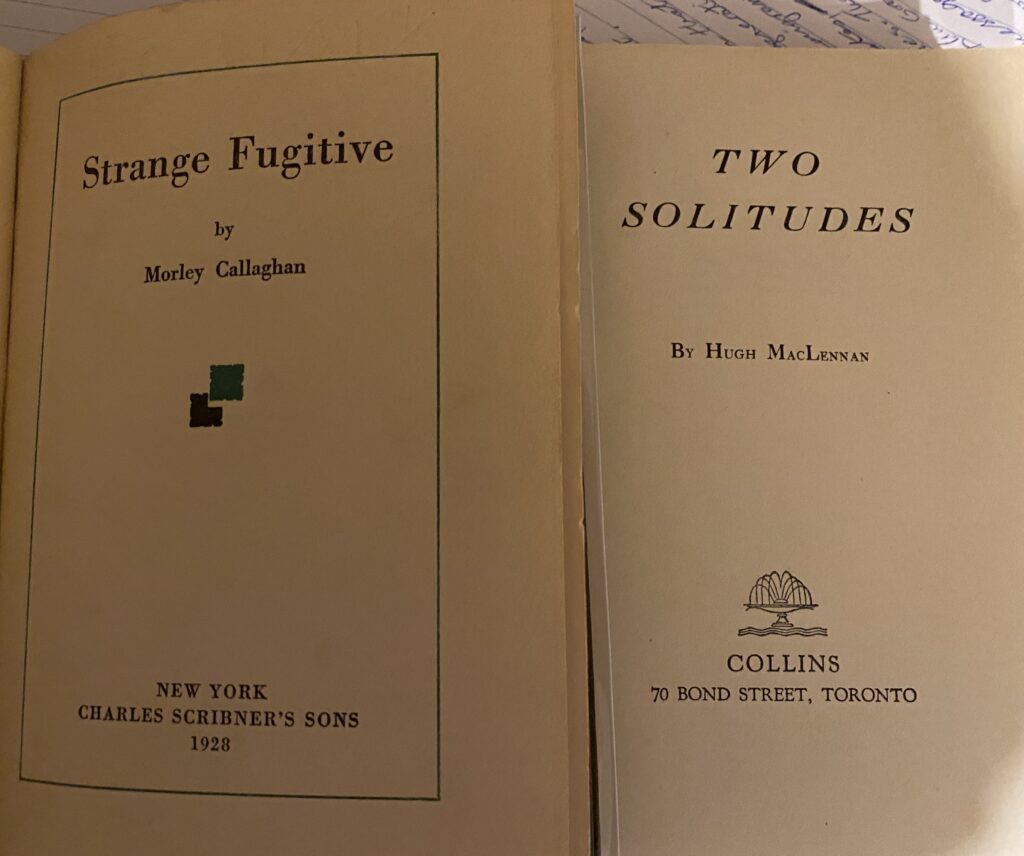
Morley Callaghan’s first novel, Strange Fugitive, Charles Scribner’s Sons (New York:1928), is not particularly well-known, and likely not much read or studied any more. The fact that an American publisher would take a chance on an unproven Canadian author is remarkable enough. The fact that the publisher would approve of Callaghan’s use of Howie Morenz by name as a referential character in the novel’s plot is even more remarkable.
However, this was the same American publisher which published Callaghan’s Toronto and Paris contemporary, Ernest Hemingway. Hemingway would rely on the same kind of reference to Joe DiMaggio in The Old Man and the Sea when it was published in September 1952.
Morenz was both an incident in Callaghan’s plot, as well as a stirring metaphor exposing protagonist Harry Trotter’s struggle for social acceptance and respect. Callaghan wanted to move his readers towards an understanding of how their real relationship with Morenz, and with the game of hockey, was fundamental to who they were:
. . . hockey has become something more than a sport; it has taken on the role of a national folk play, a folk play that combines the brilliant solo work of a Russian Ballet dancer, the intrepid hero storming the redoubt against the bruising shock of the guards, the massed precision attack of the forward sweep and the crowd’s rising crescendo like a great orchestral tone poem and the solitary undaunted figure of the goalkeeper as the classic figure of the man standing against fate.
Callaghan, Morley, “The Game that Makes a Nation” originally published in New World (February 1943), reprinted in Kennedy, Michael P.J., ed., in Words on Ice, Key Porter Books (Toronto:2003), at p.26; and in Gowdey, David, ed., Riding on the Roar of the Crowd, Macmillan of Canada (Toronto:1989), at p.52
Scribner’s recognized, as did both novelists, that using an identifiable athlete in their storytelling would allow them to effectively reach the heart and imaginations of their readership. The reference to the name was worth the equivalent of a thousand more words that were already known by the reader. The readers of both novels knew what Callaghan meant by the idea of “Howie Morenz,” just as they knew what Hemingway meant by the idea of “Joe DiMaggio.”
Hugh MacLennan’s heavy references to Howie Morenz, sometime specific, sometimes inferentially, in Two Solitudes, Collins (Toronto:1945) are of the same character and written into that well-known novel for the same specific purpose. His readers already knew what “Howie Morenz” playing hockey meant for Canadians, and the thought processes of Canadian boys about how to grow up to be a man.
MacLennan used hockey in Two Solitudes as vehicle to explain “a country that no one knew.”: Two Solitudes, Collins (Toronto:1945), at p.329. Howie Morenz, or the idea of “Howie Morenz,” was used in the novel as a character development counterpoint, or measure, for the novel’s protagonist, Paul Tallard. By endeavouring to emulate the athletic glory and accomplishment of Morenz, Tallard had pursued his own completion as a man: Two Solitudes, Collins (Toronto:1945), at pp.63 – 64, 204 – 206, 237 – 238, 284 – 286, 300 – 301, 311, and 334. In turn, Tallard defined what he had become, and what he had lost or given up, as he fell short of the Morenz ideal. MacLennan walked Tallard along St Catherine Street in Montreal in “grey summer weather,” thinking as he passed the brown and forlorn Forum:
It had seemed a good world when hockey was important in it.
Two Solitudes, Collins (Toronto:1945), at p.64
The way that Howie Morenz played, and the collective memory of MacLennan’s readers about how he had played, remained a cultural standard for human, and perhaps even moral, evaluation. The idea of Howie Morenz helped a generation “mark time in their lives,” as Mark Kriegel would later describe the influence of Pete Maravich: Pistol: The Life of Pete Maravich; Free Press (New York:2007), at p.123
As generations of Canadians grew up in the decades following the 1950s, the collective Canadian consciousness about who Howie Morenz was, what he meant for hockey, and why he remained an iconic kind of Canadian, began to become more diffuse. As the country found new athletic heroes after the second world war, and as Canadians explored different moral approaches to life, the appeal in literature to the memory of Morenz gradually disappeared. Perhaps fittingly, the last important reference to Morenz as an iconic, or metaphorical, importance, seems to have been the soft name and event references in Wayne Johnston’s The Divine Ryans, Vintage Canada (Toronto:1998), at pp.122 – 124, 198.
There are of course other “name-drops.” Given Morenz’s reputational dimensions, there are probably fewer of these than one might expect. These kinds of quick references do not really do anything in the books to expand our knowledge about Morenz the hockey player, or Morenz the social hero. Instead they seem added in to a narrative to give it an appearance of context or “reality.”
My personal identification of in-text references to Morenz are the following:
Childerhouse, R.J.; Winter Racehorse, Peter Martin Associates Limited (Toronto:1968), at p.187
Gutteridge, Don; Bus Ride, Tablo Publishing (2019), at p.66
McFarlane, Leslie; McGonigle Scores, McClelland and Stewart Limited (Toronto:1966), at p.43
O’Brien, Andy; Hockey Wingman, George J. McLeod, Limited (Toronto:1967), at pp.viii, 173
Wake, Bob; Level Ice, General Store Publishing House Inc. (Burnstown, Ont:1990), at p.13
As master storytellers, Callaghan and MacLennan understood from Howie Morenz’s stories that he was not merely a performer measurable by his statistical accomplishments. He was the kind of player who, through his relationship with his fans, had seized his generation’s imagination. He would inhabit the minds of that generation even after his games, and his seasons, and his life, were over. Callaghan and MacLennan, just like the fans, understood that Morenz was the kind of phenomenon whose real legacy lay in creating stories that offered his audiences a deeper understanding of their own lives. A mere mention would be sufficiently evocative for the reader to understand the author’s deeper message, until he became just another name.
Although it had been thought, at the time of Morenz’s death, that:
His life will be written many times, his deeds are part of the annals of the game, he is already a legendary figure.
Morenz Memorial Fund Program, November 2, 1937, p.36 per Baz O’Meara
Morenz fait couler plus d’encre que n’importe quel joueur de hockey.
L’Illustration Nouvelle, 9 mars 1937, p.1, c.3 – 5
the reality was that he could only truly occupy the imaginations of those who had watched him play, or heard broadcasters describe him play on radio. As compelling as he was for those thousands and millions prior to the end of the second world war, new generations would always be destined to embrace their own heroes, their own imaginative constructs.