
Pit Lepine: The Morenz Substitute
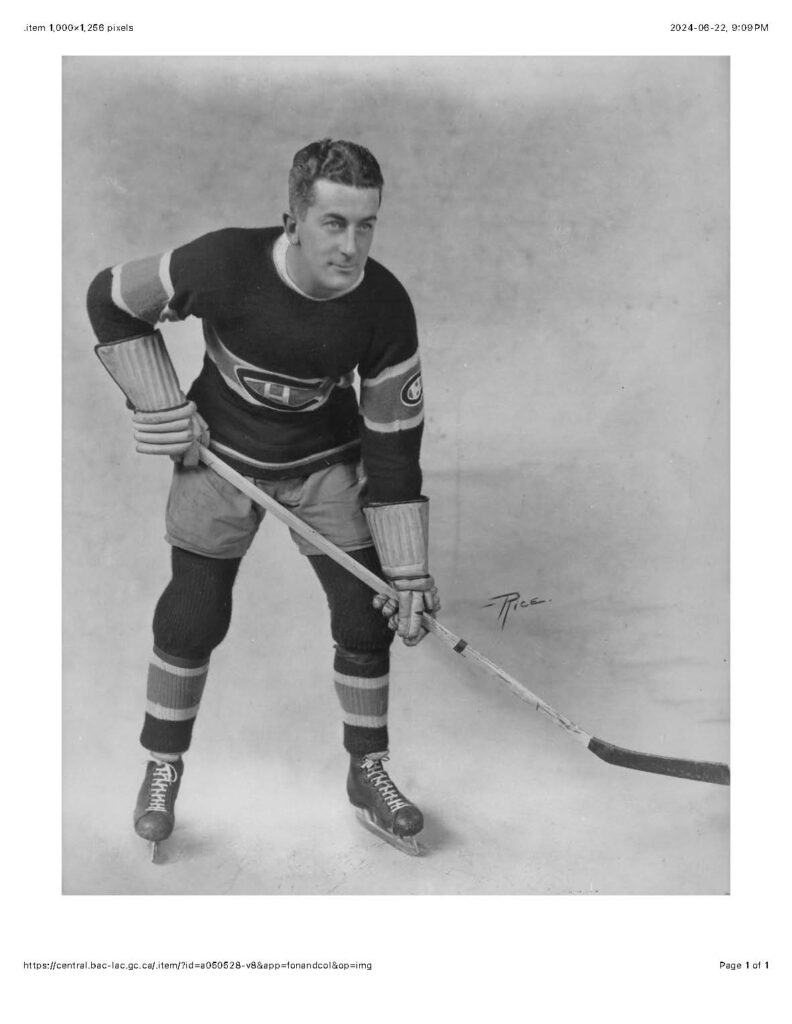
“un heros obscur . . .” – Jacques Beauchamp, Montreal Matin, 4 aout 1955
The general consensus in Montreal between the 1920s and the 1950s was that Alfred “Pit” Lepine was “le Beau Brummel des Canadiens.”: Montreal Matin, 3 aout 1955, p.27, c.7 – 8. See also: Le petit journal, 30 janvier 1927, p.11, c.3; 6 fevrier 1927, p.8, c.1 – 3; 13 mars 1927, p.9, c.2; 25 janvier 1931, p.21, c.1. The reference was to the famous George Bryan “Beau” Brummell who had been recognized as THE men’s fashion leader who had lived in Britain and France between 1778 and 1840. Others said that he looked like “the John Drew of hockey.”: Montreal Star, February 9, 1931 p.23, columns 4 – 5; comparing him to the recently deceased American stage actor who was known for performing “high society” roles.
On a club where sartorial elegance was important, Lepine’s distinction from his peers was based on how he wore his clothes. People noticed the conscientiousness in Lepine’s haberdashery. He presented himself like a movie star, a “boulevardier.”
Even if you hadn’t known that Lepine worked in women’s millinery during the off-season: The Gazette, February 22, 1935, p.14, c.5, it would have been easy to recognize how he brought style to professional hockey the way Derek Sanderson would bring it 40 years later: Sanderson, Derek, with Fischler, Stan; I’ve Got to be Me, Dell Publishing Company (New York:1970), pp.110 – 112.
You would notice it in something as subtle as how he wore his fedora: tilted about 30 degrees to the right, and forward a little less. The posture of his hat was perhaps convenient for a man who, at 6 feet even, was the tallest of his teammates. That same kind of discernment was notable in his choice of winter coat – camelhair for the train, but a large and bushy fur for every moment that he was walking around Montreal.
Ray Getliffe of the Canadiens described Lepine as wearing a “coonskin” coat when he was coaching the Canadiens in the winter of 1939 – 1940: Irvin, Dick; The Habs: An Oral History of the Montreal Canadiens 1940 – 1980, McClelland & Stewart (Toronto:1991), at p.14. However, the de rigeur winter coat for the stylish Montrealer more than a generation later was still the beaverpelt coat. With Montreal still very much the economic centre of the Canadian fur trade in 1930, it is as reasonable to picture Lepine in beaver as in raccoon. Maroons’ President James Strachan attended the February 5 game in a “bearskin coat”: The Montreal Daily Star, February 6, 1931, p.35, c.4. “Coonskin” coats were a more American phenomenon of the 1920s.
A frosting of grey hair had graced Lepine’s temples since his late teens: The Gazette, April 15, 1931, p.17, c.4; The Globe, April 16, 1931, p.11, c.4; The Brooklyn Daily Eagle, January 4, 1937, p.16, c.1. Adding to the overall impression of sophistication, Lepine often topped off his whole presentation with the presence of a good cigar: The Globe, April 16, 1931, p.11, c.4.
Lepine, like Jean Beliveau, was also able to transfer his carefully curated off-ice look onto the ice:
There is a touch of Menjou and a dash of Louis Stone to the sophisticated Lepine as he moves around in suave fashion on the ice. Never hurried, always moving, a restless spirit on skates: The Montreal Daily Star, April 6, 1931, p.23, c.3.
These a “movie star” social referenced Adolphe Jean Menjou, who was a Hollywood film star between 1914 – 1960; Lewis Stone was also a Hollywood actor who was nominated for Best Actor in 1929, and played opposite Greta Garbo 7 times.
Lepine was often acclaimed for Beliveau good sportsmanship. While never quite clean enough to win the race for the Lady Byng Trophy: The Gazette, August 3, 1955, p.20, c.5, his reputation as a “gentleman” on the ice troubled some of his teammates. Aurel Joliat allowed that:
Lepine avait bon coeur. Il a encaisse plusieurs coups durant sa longue carriere et il lui arrivaient rarement de repliquer. Il n’a pas ete assez violent. . . . : Montreal Matin, 4 aout 1955, p.22, c.3 – 8.
Lepine’s soft hands from the left could fill a hockey net when he was given room to play. He had scored 5 goals and assisted on the sixth in a single game against the Senators at the Forum the previous season: The Gazette, December 29, 1929, p.16, c.1 – 2.. That December 29, 1929, performance vaulted him into hallowed hockey company. Punch Broadbent, Charlie Conacher, and Howie Morenz were the only other players to to have scored 5 goals in a single game to that point in time.
Lepine’s most important team skills proved to be in relation to the defensive part of the game because he possessed the most felicitous defensive stick skills in the NH: Percival, Lloyd; The Hockey Handbook, The Copp Clark Co. Ltd. (Toronto:1951), pp.178 – 179. See also: The Gazette, April 4, 1930, p.21, c.5. He became known as the “rapier,”: The Montreal Daily Star, April 14, 1931, p.36, c.3 – 5; and “l’artiste de “poke-check.”: La presse, 6 fevrier 1931, p.25, c.4. This season, due to the retirement of Frank Nighbor, he had finally inherited the mantle of “The King of the Poke-Checkers.”: The Montreal Daily Star, February 12, 1931, p.36.
Lepine, had also become the Canadiens’ penalty-killing specialist:
When the team is shorthanded, out comes Lepine to hold the opposition at bay almost singlehanded.: The Gazette, April 15, 1931, p.17, c.4
Lepine a ete a mon avis le meilleur joueur defensive de tous les temps. Aucun adversaire ne pouvait l’approcher. . . . Il a brise une multitude d’attaques dans la ligue Nationale avec son celebre “poke-check”. Il etait superbe lorsque notre club jouait a court de deux ou trois joueurs.
Montreal Matin, 4 aout 1955, p.22, c.3 – 8
Even when he and Morenz were on the ice together, Lepine would often be given the nod to take face-offs because of his stick skills – remembered in action by The Gazette a generation later, at the time of Lepine’s death:
Lepine was a polished stickhandler and was a hard man to beat on the draw. . . . Each side had four men in the penalty box. The Maroons had Clint Benedict in goal and Punch Broadbent as forward. Canadiens elected to go with George Hainsworth in the net and Lepine up front. On the faceoff, Lepine got the draw, swept around Broadbent and beat Benedict for a goal.
The Gazette, August 3, 1955, p.20, c.4 – 5.
By the end of this particular game, the quality of Lepine’s skills and his value to the Canadiens were obvious:
Pit Lepine a joue une fameuse de partie. L’artiste du “poke-check” a ete l’un des heros de la rencontre. La grand Pit a ete continuellement dangereux a l’attaque et sur la defense. Il a ete une veritable muraille.
Son “poke-check” a souvent sauve le Canadien de dangereuse situations. Pit a ete envoye tres souvent sur la glace car chaque fois que le Canadien avait un homme a la cloture, Cecil Hart avait recours au grand Pit.: La presse, 6 fevrier 1931, p.25, c.4.
Dick Irvin once described Lepine as “un joueur scientifique.”: Montreal Matin, 4 aout 1955, p.22, c.3 – 8, which had become evident at the moment when Morenz’s pass arrived at the conclusion of this game against the Maroons:
Le Canadien egala heureusement le score quelques seconds plus tard lorsque Pit Lepine logea la rondelle dans le filet du Montreal au cours d’une furieuse melee: La presse, 6 fevrier 1931, p.25, c.3
. . . beating Wilcox by a fifth of a second to the drop: The Montreal Daily Star, February 6, 1931, p.35, c.4
. . . Lepine lurched forward and clouted the puck behind Kerr:The Montreal Daily Star, February 6, 1931, p.34, c.1; p.35, c.8
Leo Dandurand used to claim that Jack Adams had repeatedly asked to buy Lepine for the Falcons or Wings, and that Dandurand refused because of the high regard in which Lepine was held: Montreal Matin, 4 aout 1955, p.22, c.3 – 8. The New York Times expressed the popular and common view:
Lepine would encounter little difficulty in annexing the first-string position on several of the other teams in the league, but with Canadiens he must remain as the spare for Howie Morenz.: Nichols, Joseph C., “Players of the Game: Howie Morenz – Speedy Centre of the Canadiens,”
The New York Times, April 6, 1931, p.28
When Howie Morenz was sold to Chicago, it was suggested that Lepine could finally blossom, and step into his full potential. In fact, Lepine only scored 12 goals during his first season without Morenz, and only 6 and 5 in the two others. In the three seasons between the fall of 1929 and the spring of 1932, Pit Lepine had scored 60 times while playing as the defensive substitute behind Morenz.
The failure to blossom when he inherited the starter’s role may have been “physical”. For a big man, Lepine was unfortunately fragile. He suffered several broken bones throughout his body over the course of his career: The Gazette, February 22, 1935, p.14, c.5. The Canadiens’ playoff collapse against the New York Rangers in 1932, ending their drive for three Cups in a row, may well have been entirely due to Lepine suffering a broken leg early in the third period of the third game of that championship series: The Ottawa Journal, March 28, 1932, p.15, c.1, 4
Although Douglas Hunter has suggested that the Canadiens “might as well have hired a mannequin for all the good Lepine was able to do,”: Hunter, Douglas; War Games: Conn Smythe & Hockey’s Fighting Men, Viking (Toronto:1996), at pp.47 – 48, Toe Blake and Armand Mondou remembered how respectful and unfailingly generous Lepine was in his praise of the skills of other players.
Others, like Ray Getliffe, felt that as a coach, Lepine was unable or unwilling to enforce any discipline, and was uncaring about winning or losing: Irvin, Dick; The Habs: An Oral History of the Montreal Canadiens 1940 – 1980, McClelland & Stewart (Toronto:1991), at p.14.
Even as he became wheel-chair bound for the last couple of years of his life, he remained thrilled by the ever improving skills demonstrated by NHL players – a view that many former players find hard to take. Of course, when this was noted at the time of Lepine’s death, he had been fortunate to live just long enough to be able to watch Rocket Richard, Jean Beliveau, Doug Harvey, and Boom Boom Geoffrion, playing together in their prime: Montreal Matin, 4 aout 1955, p.24. See also: Montreal Matin, 6 aout 1955, p.22, c.1 – 2.
In the vernacular of the time:
. . . when the original Canadiens were winning Stanley Cups, he was a star, even though, big and quick as a cat on skates he had to play Gehrig to Howie Morenz’ Babe Ruth.
The Brooklyn Daily Eagle, January 4, 1937, p.16, c.1
Lepine had grown up in a Quebec that had not experienced its Quiet Revolution. French Canadiens had their place. He had always been the younger brother on every hockey team he had played for. That had been Hector Lepine (December 7, 1897 – March 29, 1951), 3 and a half years older than his younger brother. They had plaved together with their home teams in Ste Anne de Bellevue, and then downtown on intermediate and senior teams in Montreal, then with the Fort Pitt Hornets of the United States Amateur Hockey Association, and then with the Canadiens in the fall of 1925. Marc T. McNeil of The Gazette, February 22, 1935, p.14, c.5, identified the team as the Pittsburgh Hornets.
Pit Lepine was also a modern, gregarious and convivial Montrealais. He reveled in the fame of his personal style. He had never aspired to play the lead role in a foreign city, or even in Montreal. His ambitions were entirely satisfied by playing for the Canadiens and reaping the material and psychological community benefits of that. He could be a professional athlete, and enjoy the glamour of near-stardom, all while continuing to live quietly at home in Ste Anne de Bellevue, where he had been born. Indeed, he would live his whole life in that community at the western edge of the island of Montreal. He died there, still quite young, in 1955, having just turned 54 years of age.
It mattered not a whit that he might have had a chance to be more famous than he was. It was enough that he had made his own contributions to two traditions of Canadien hockey that endured and were recognized for another half century – fair play, with style. Looking good while being good was important:
Traditionally the Canadiens are a hockey team of skill and speed. Style really. They appear to be skating in Pierre Cardin velvet blazers. Not that there aren’t some muscles under the velvet. And a few elbows. But basically, the Canadiens play hockey the way it’s supposed to be played.
Anderson, Dave; Sports of Our Times, Random House (New York:1979), at p.117