
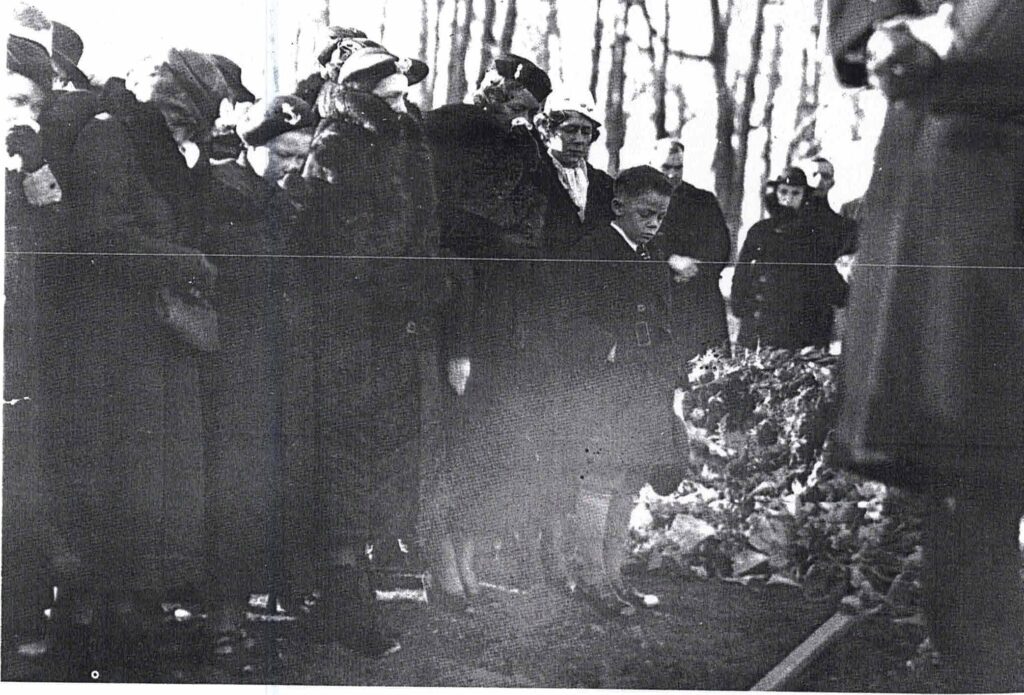
Return of the King
The words that his admirers used to refer to him whiie he was alive, and after he died, make it pretty clear how they viewed him – what status he enjoyed in their minds. John Murray was quoted in “Sportsmen Pay Tribute To Greatness of Morenz” in The Stratford Beacon-Herald, March 9, 1937, p.1, c.2, as saying:
“I always looked upon Howie Morenz as king of the hockey world. . . .”
The French were even more eloquent. To many, Howie Morenz became, and remains, how he was anointed in L’Illustration Nouvelle, 10 mars 1937, p.1, c.1 – 5. He would forever be:
. . . le grand disparu.
The Millionaires, Howie Morenz’s most fervent fans, knew how the descriptions of Morenz as the “blow torch” of the Canadiens’ offence (The Montreal Daily Star, January 24, 1931, p.15, c.4), while the rest of the Canadiens’ offence were “le feu roulant,” (La presse, 26 janvier 1931, p.18, c.1) were references to “fire” as a sign of apostolic experience. Their Christian education had taught them that having “fire” was a holy gift, described in the words of the Bible, and depicted in religious imagery, as men touched by a flame:
Matthew 3, verse 11: He himself will baptize you with the Holy Spirit and fire;
Acts 2, verse 3:And there appeared to them tongues as of fire . . .and they rested on each one of them
(New American Standard Bible)
Wil Larochelle recalled Howie Morenz in precisely the same way, describing him as the:
. . . inspiration of Canadiens when it was possibly the greatest team that ever played hockey. In leadership and for dynamic play, Howie had no peer and it was his fire that raised the whole team to the heights of hockey accomplishment: Unidentified newspaper clipping, March 10, 1937 under the title: “Dressing Room Tributes to Memory of Morenz”
Leo Dandurand also knew that Howie Morenz. Dandurand spoke of sport as a spiritual, religious and Christian endeavour:
Cette forme de l’activite humaine (le sport), que l’on associat dans l’Antiquite aux ceremonies religieuses, traduit fort bien de nos jours les principes que nous enseigne le Christianisme. En procedans a notre developpement physique et en suscitant les actes de courage, d’endurance, en cultivant l’esprit de corps et la maitrise de soi-meme, on repond parfaitement a l’ideal chretien qui tend a nous inculquer le sens de la justice et du fair-play.
Quoted in Mayer, Charles, “Le Leo Dandurand que j’ai connu,” Le Journal de Montreal, 29 juin 1964.
When he reflected on the Morenz in his final season of 1936 – 37 season, Dandurand was quoted in Le petit journal, 14 mars 1937, p.51, c.2, as describing Morenz in spiritually evocative terms:
Le bonheur rayonnait dans ses yeux. Il etait heureux:
All of this meant that years later, Dandurand could point out how following the team “continue d’attirer les coeurs d’une facon quasi religieuse, tant chez les partisans qu’ailleurs.”
Mayer, Charles, L’Epopee des Canadiens de Georges Vezina a Maurice Richard: 40 Ans d’histoire 1909 – 1949, Charles Mayer (Ottawa:1949), at p.10.
Howie’s exalted place as the Canadiens’ hockey high priest in the imagination of the fans was a relationship and a role that the faith of the fans invented for him. The truth about that religious understanding of who Morenz was, and his sacred status among his fans, became most fully exposed at the time of his death.
According to Mayer, Charles; L’Epopee des Canadiens de Georges Vezina a Maurice Richard, published by Charles Mayer (Ottawa:1949), p.80, the death of Morenz:
. . . causa une sensation a nulle autre pareille, . . . .
While one cannot forget the religious zeal and intent behind the work of Father David Bauer and Pere Murray of the Notre Dame Hounds, the two closest comparators in Canadian hockey history to the religious status of Morenz as an NHL player involve players connected with the Toronto Maple Leafs. One was Father Les Costello, whose relationship with his community was not only spiritual in his function, but also in terms of his relationship with his “followers.” See: Charlie Angus, Les Costello: Canada’s Flying Father, Novalis, St Paul University (Ottawa:2005), at p.137. Angus described Father Les Costello’s funeral, echoing the same concepts that Baz O’Meara had hinted at as being applicable to Howie Morenz:
The funeral was attended by Costello’s real congregation – Catholic, non-Catholic, believer, non-believer – people who felt very deeply that this man was their priest.
The other Leaf most closely associated with the Christian religion (there were of course others) was Paul Henderson. See his reflections on the 1972 Summit Series in Henderson, Paul; The Goal of My Life, Fenn/McClelland & Stewart (Toronto:2007), at p.108.
On the night of his final injury, The Gazette, January 29, 1937, p.14, c.2 – 3, anticipated the true spiritual status of Morenz in relation to both his fans and his teammates:
Canadiens, needless to say, were dealt a serious blow last night and it all but took the heart out of even such a spirited band as the Flying Frenchmen. They were trooping into their dressing-room . . . when they encountered Howie, with tears in his eyes, leaving on a stretcher for the hospital. For a time it was as if the fine spirit of Canadiens had gone out of the building with Morenz . . .
Six weeks later Horace Levigne of La Patrie began his meditation on the life of Howie Morenz with references to Thomas A Kempis’ “L’Imitation de Jesus-Christ,” and highlighted the idea of a resurrection of that same spirit:
C’est Morenz, qui transforma son cher club tricolore; c’est lui qui en fut l’ame, l’inspiration, le jet, la resurrection. . . .
Horace Levigne, “Sur la tombe de l’unique Morenz”, Howie Morenz Memorial Fund Programme, November 1937, p.56, c.1 – 2
Tommy Munns, Sports Editor of the Globe and Mail, was of similar mind:
Canadiens . . . carried from the Forum the body of their comrade – carried it shoulder high, every bit as high as they might have borne him off the ice after a great victory in days gone by. To this writer the way they carried him seemed to signify a triumph over death.
The Globe and Mail, March 12, 1937, p.19, c.2 – 3
There is some support for the idea that Howie Morenz himself anticipated this messianic view of his own resurrection. According to E.C. Phelan of the Canadian Press [March 8, 1937] Aurel Joliat reported that a dozen days before Morenz died:
He kind of smiled at me and told me: ‘I’ll be all right. I’ll be up there watching you in the playoffs.’ That was about the last thing he said to me.
E.C.Phelan of the Canadian Press [“Heart Attack Ends Career of Montreal Hockey Fans “Idol”, E.C. Phelan, Canadian Press, March 8, 1937.See also: The Globe and Mail, March 10, 1937, p.18, c.4], expanded on that thought:
. . . his spirit will live with Canadiens on the ice.
His name will live in hockey annals as long as his great spirit is “up there watching” Canadiens in the playoffs.
Charles Mayer expressed the same faith a dozen years later, after the Rocket had established his own kind of greatness with the Canadiens, in L’Epopee des Canadiens de Georges Vezina a Maurice Richard, published by Charles Mayer (Ottawa:1949), p.80, saying:
. . . le souvenir de Morenz reste imperissable meme chez les jeunes qui ne l’ont meme pas connu.
A generation later, Gerard Gosselin still referred to the passing of Morenz as “le depart de l’immortel numero 7”: Monsieur Hockey, Les editions de l’homme (Montreal:1960), p.115
Were they all just thinking that the name would be remembered, or would something more of him survive? Mayer had quoted Cecil Hart, a Jew, at the time of Morenz’s death [Le petit journal, 14 mars 1937, p.53, c.2 – 3]:
Les prouesses accomplies par le grand Howie n’auront pas ete inutiles, pas plus dans l’avenir que dans le passe . . . ells serviron d’inspiration, ce source d’energie, de mouvement, de courage, toutes ces qualities que Morenz possedaient si completement.
before drawing his own conclusion:
Plus jamais, on ne le reverra, mais le stage si long d’une comete, d’un meteore ne s’oublie jamais surtout, quand, sur son passage, cet astre eblouissant a laisse des signes ineffacables de grand Valeur, ce courage heroique, de gloires innombables.
Bus Johnston of Montreal’s “Sport Fan” and “The Puck” publications picked up on the same Christian idea that Morenz would overcome death [Bus Johnston, “His Light Still Shines”; Howie Morenz Memorial Fund Programme, November 1937, p.17, c.2]:
. . . all awaited with hope and enthusiasm for the hour when the “kindly light” would lead the boy of their hearts out of the “encircling gloom” and back to the arenas of brightness and glare.
But though he be where we are not, unseen by human eye, Howie is still with us. His light still shines . . . so great was his power, so deep is fan love for him still. And so it always will be.
So did Mark T. MacNeil of The Gazette [“Casual Close-Ups”; Howie Morenz Memorial Fund Programme, November 1937, p.41, c.2]:
The dashing spirit of Morenz may still be with Canadiens, his only club, even though he did play for two others, every time they go out on the ice.
The fans certainly adopted a resurrection view during the spring playoffs of 1937, chanting “Win it for Howie” as the Canadiens stormed back from a 2 – 0 series deficit against the Red Wings with back to back wins at the Forum in the first round of the 1937 playoffs: Liss, Howard; Goal! Hockey’s Stanley Cup Playoffs, Delacorte Press (New York:1970), p.89; Isaacs, Neil D., Checking Back: A History of the National Hockey League, W. W. Norton and Company, Inc. (New York:1977), at p.106.
However, unlike Manchester United’s first game following the Munich air tragedy in 1958, the “celestial presence directing events,” and an “other-worldly contribution”: White, Jim; Manchester United: The Biography, Sphere (London:2009), at p.127, was not enough to carry the Canadiens to victory in the series.
There are other threads to the story of Morensz’s relationship with his fans, and his death, that have given pause to the writers on this question of survival, resurrection, and immortality. Had they not all been witness to decisive moments in Morenz’s games, the final breaking of his body, his visitation – including by a 12 year old, truant Doug Harvey: Robinson, Chris; Stole this From a Hockey Card: A Philosophy of Hockey, Doug Harvey, Identity & Booze, Nightwood Editions (Roberts Creek, BC:2005), at p.62 – and then that monumental funeral?
Had not Morenz, like the Christ himself, been laid to rest in a grave that belonged to others, but had conveniently been left unused? Howie Morenz was, and remains, buried in the plot which belonged to his wife’s mother’s family: Mount Royal Cemetery, Section L2, Plot 2037, Memorial ID 20775, under the primary name of J. R. Stewart. Howie’s son Donald is also buried in the same plot with Memorial ID 108943217.
That sense of awaiting his appearance after death, or the re-emergence of the spirit of the tricouleur, remained as palpable at the Forum after his death as it had been at the start of this Saturday night game against the Americans: See Blaise, Clark, “I’m Dreaming of Rocket Richard”, in Beardsley, Doug, ed.; The Rocket, The Flower, The Hammer and Me, Polestar Book Publishers (Winlaw, B.C.:1988), at p.14. His chroniclers and fans had all remained together at the Forum, dans le cenacle, in the “upper room” where the expectant faithful waited after the resurrection and ascension to be rewarded with the gift of the spirit. It was an experience that the Montrealais had lived and experienced together.
After his death, had there not been an immediate veneration of the tools which Morenz had personally used to play the game: his hockey trousers, stockings, skates, “the last stick,” and of course the sainte flanelle “7” sweater that he wore “into hockey immortality.”: O’Brien, Andy; Les Canadiens: The Story of the Montreal Canadiens, McGraw-Hill Ryerson Ltd. (Toronto:1970), at p.32; The Globe and Mail, October 11, 1937, p.19, c.6; Cole, Stephen; The Canadian Hockey Atlas, Doubleday Canada (2006), at p.100?
Those garments and tools connected with his name quickly gained value as the best, or closest, verisimilitude of him. Gordon Burn has explained, in Best and Edwards: Football, Fame, and Oblivion, Faber and Faber Limited (London:2006), at p.212, how people seek to possess these tangible items as a means:
. . . to possess a moment which remains pure, unreproduced except in memory, and is not available to be freeze-framed or focus-shifted or enhanced. . . . something that’s preserved and unique.
Again, as with Christ’s garments, with Morenz there was an impulse to sell some of these items off as independent pieces of mere memorabilia: Bidding began early on the sweater: The Globe and Mail, October 15, 1937, p.17, c.7 – 8. See also: The Globe and Mail, March 7, 1987, p.C5, c.5. Then there was a competing impulse to keep them together as if that were necessary to maintain integrity of the memory – just as Christ’s cloak had been kept whole. Ultimately Joe Cattarinich bid $500 for the whole of Morenz’s equipment and gave it to Howie, Jr.: Canadian Press, November 3, 1937, Montreal; Robinson, Dean; “Howie Morenz was a Very Special Person,” London Free Press, March 4, 1977, pp.10, 13.
All of these responses towards Morenz’s sudden death could be regarded by skeptics as the mere denial stage of grief, articulated a couple of generations later by Andy O’Brien in Les Canadiens: The Story of the Montreal Canadiens, McGraw-Hill Ryerson Ltd. (Toronto:1970), at p.48:
. . . it must have been difficult to foresee anything in the nature of a cardiac failure in such a symbol of the dynamic athlete. . . . The impact on the Canadian metropolis was matched in my experience only with the flash about President John Kennedy’s assassination. Both Morenz and Kennedy had carried such a popular image of vigour and vibrant life that death seemed just too shockingly unthinkable.
Yet the outpouring which substantiated the sincerity of what the writers were identifying in that chill spring of 1937 was legitimized, or at least understood as justified, by Novak, Michael; “The Natural Religion,” in Vanderwerken, David L., and Wertz, Spencer K., eds.; Sport Inside Out, Texas Christian University Press (Fort Worth, TX:1985), 350, at p.361 ;
Athletes are not merely entertainers. Their role is far more powerful than that. People identify with them in a much more priestly way. Athletes exemplify something of deep meaning – frightening meaning, even. Once they become superstars, they do not quite belong to themselves. Great passions are invested in them. They are no longer treated as ordinary humans or even as mere celebrities. Their exploits and their failures have great power to exult – or to depress.
That is a view that was also hinted at by Lynn Coady’s next century novel, The Antagonist, Anansi (Toronto:2011), particularly at pp.118 – 119:
Thinking back on it now it seems to me that hockey was the church I found before I found my church; the institution that brought home to me – a hell of a lot more effectively than any droning priest ever could – the virtues of Communion and Grace.