
Howie Morenz and the “Freak” Goal
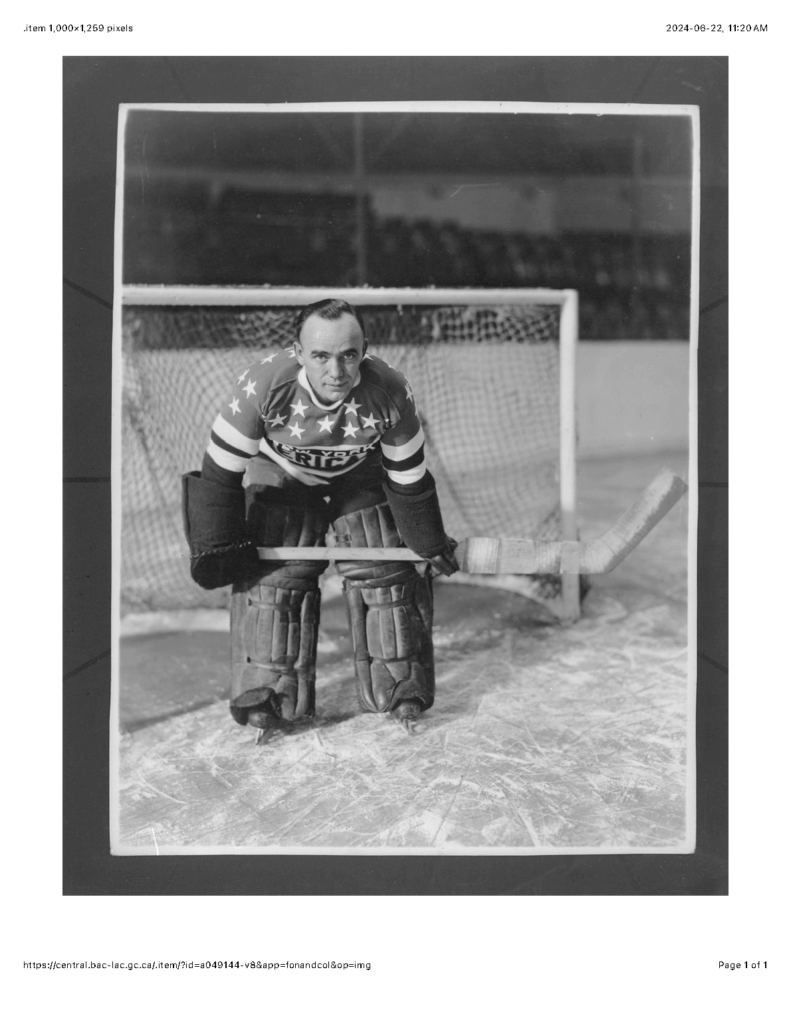
The Canadiens had arrived in New York City a single point ahead of the last place New York Americans in the Canadian Division standings. Three weeks before they had arrived in New York as the Division’s first place team, undefeated in 8. They had lost 3 of 5 since, including their last two in a row. The Americans had won 6, and only lost once, in their last 9 games.
The game had a turning-point feel to it, with the Canadiens and Americans seemingly headed in opposite directions. Howie Morenz seemed jaded as well – having neither scored a goal, nor assisted on a goal, in the Canadiens’ two most recent losses. He had fallen 5 points off the pace in the scoring race, and was now third behind Ebbie Goodfellow of the Falcons, and Bun Cook of the Rangers. It was an opportune time for him to make a statement about whether he and his team would show leadership, or continue to chase.
The Canadiens fell behind early on a defensive lapse while both teams were short-handed. Morenz led an entertaining response, prompting loud roars of appreciation from the crowd:
. . . his speed and skating delighted the audience. He tricked and fooled the Americans’ forward and defense lines almost at will, he penetrated within the net area frequently, but he missed all his shots at the net: The Montreal Daily Star, January 9, 1931, p.30, c.1
Then Worters swung at the puck with his stick on the Pit Lepine shot, fanning on it completely so that the teams went to their dressing rooms for the first intermission tied at one.
Fans might have been tempted to see the scoring plays in the first period as a validation of Eddie Gerard’s observation about mistakes, and goals, but Gerard’s perspective didn’t provide much room for the idea that even without mistakes, players could gain advantages by greater skating speed, by more mellifluous stickhandling, and quicker shots. Sometimes players were simply able to be better than their opponents.
That was the kind of challenge Howie Morenz posed for the Americans. As he roamed the Madison Square Garden ice through the second period, searching for each opportunity to score, the press and the fans had a front row chance to appreciate how his play contributed more than goals to the game:
. . . the flying Frenchmen had slightly the better of all the play, except in the last few minutes of the game. Led by the great Howie Morenz, keyman of the attack and a tower of defensive strength as well, they were a constant threat to the American defenders while they held the American attack well in check. Morenz’s stick work in mid-ice played an important part in breaking up New York attacks before they could get started: The Globe, January 9, 1931, p.9, c.1
Howie Morenz wasn’t playing a game that waited for mistakes. He preferred the challenge of a true athletic contest, a game where players on both teams were attempting to play their best, and to force mistakes by their opponents. That kind of game gave the Canadiens an advantage, as their offensive pace was on its way to producing nearly 30 shots on the Americans’ goal:
The forward thrust of Morenz, Gagnon and Joliat tore the Americans’ line to pieces, penetrating within a few feet of Worters every few minutes, their over zeal however in trying to score was the reason for their failing to tally more often: The Montreal Daily Star, January 9, 1931, p.30, c.1
As the Canadiens’ offensive efforts went unrewarded, Morenz’s failures were noticed more readily because he was repeatedly at the front of the attack. As surely as hopes and expectations rushed forward with him, disappointment and frustration also hung on his shoulders whenever he failed to score:
Fans are beginning to expect a little too much of Morenz. Just as Babe Ruth was always expected to knock out at least one home run a game, there is the demand that Morenz should put on his speedy act and whip through for at least one goal a contest. It is possible that he may get as much as a goal per game taken in the aggregate but it is certain that his getting more than the average attention from any defence and there are times when he will be held scoreless and even tied up. That is inevitable. . . . Baz O’Meara in The Montreal Daily Star, December 15, 1930, p.27, c.5
Roy Worters appeared to be redoubtable, standing in the Canadiens’ way to keep the score tied. In this sixth season of his twelve year career, Worters was enjoying his busiest, and most effective, campaign as a professional hockey goaltender. His 6 shutouts in his first 17 games that season approximated one of the best ratios of his career – and was best in the League to that point in the season. He was already boasting a scrawny goals-against average of 1.42. The Canadiens and George Hainsworth were allowing about a goal a game more. Worters was at his own athletic peak, facing one of his greatest adversaries.
That was the situation as Georges Mantha crossed the Americans’ blueline with the puck, but had no place to go forward, and no teammate open for a pass. He flung a rising shot in the direction of the Americans’ goal. Worters saw it all the way. Like a shortstop snagging a rising but lazy line drive, he reached out with his mitt and snagged the puck easily. Although every eye in the Garden was now on Worters, what happened next was to become a mystery for some. This is how the moment was recorded from different perspectives:
Worters handled it easily and then much to the amazement of the house tossed the puck nonchalantly over his shoulder. It landed squarely in the mesh . . .: The Gazette, January 9, 1931, p.18, c.1
Apres avoir attrape avec sa main un lancer de Georges Mantha, Worters leva nonchalantment le bras par desous son epaule pour envoyer la rondelle en arriere de son filet mais malheureusement pour lui, il la laisse tomber dans ses buts au grand etonnement de toute l’assistance.: La presse, 9 janvier 1931, p.22, c.1
With most of the players waiting for the bell, G.Mantha skated down and flipped one from long range at Worters, who caught the flying disc. He lost his balance, however, and apparently became flurried for in trying to toss the rubber aside aimed it right into his own net.: The Toronto Daily Star, January 9, 1931, p.12, c.1
Worters caught it over his solar plexus. He flopped to his knees and sprawled on his stomach as he threw the puck backwards to clear. It landed in the net.: The Toronto Daily Star, January 9, 1931, p.10, c.4 – 5
The writers scrambled over each other to describe Worters’ blunder as a gift: The Montreal Daily Star, January 9, 1931, p.30, c.1 – 2; La presse, 9 janvier 1931, p.22, c.1; a “freak” goal: “Freak Tally Gives Canadiens 2- 1 Win Over American Six”, The Gazette, January 9, 1931, p.18, c.1. The Gazette’s report on the game also used the phrase “freak goal”; and a Ripley’s “believe it or not” moment: The Gazette, January 9, 1931, p.18, c.1.
There were suppositions about Worters’ attitude:
The period lasted just long enough to give Worters time to commit the terrible blunder and put Canadiens in the lead: The Montreal Daily Star, January 9, 1931, p.33, c.6
Goaler Roy Worters stopped it and fell. Evidently misjudging his position as he tried to fling the puck into the far corner of the rink out of danger, Worters made a perfect throw into his own net . . . :The Globe, January 9, 1931, p.9, c.1
Some attempted to excuse the momentary fumble as being due to Worters being tired, or dizzy, or dazed:
When he arose, on his knees, he was evidently dazed, and in attempting to toss the puck over the net, put it high into his own net: The Montreal Daily Star, January 9, 1931, p.30, c.1 – p.33, c.6
George Sullivan, writing in the late 1960s, recalled it as an act of self-humiliation brought on by the puck sticking in the webbing of Worters’ glove: Sullivan, George, Face-off: A Guide to Modern Ice Hockey, D. Van Nostrand Company, Inc. (New York:1968), p.167.
The search for a satisfying explanation even went supernatural to the hockey gods::
. . . it was a tie game and would have ended thus. But the gods that rule hockeydom ruled otherwise and went so far as to make Worters score for his opposites: New York Daily News, January 9 1931, p.58, c.3
It creates a sense that the media people of the day were grasping at reasons for the gaffe which might serve to avoid the need to talk about whether Worters had thrown not only the puck, but the whole game.
Even if Morenz himself could have chosen to understand Worters’ mistake as foreseeable:
Worters est beaucoup plus impetueux et plus nerveux et, je ne sais si vous l’avez remarque, mais il a un talent special pour faire paraitre tout arrete fort difficile: La patrie, 26 mars 1928, p.9, c.1
Worters’ unforced error would be remembered for decades, and tarnish his athletic reputation forever.