
The Funny Guys: Howie Morenz and Jean Pusie
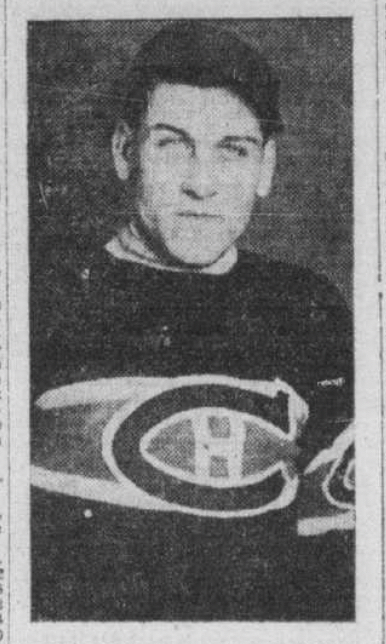
Modest, self-referential, humour was the way hockey players then, and now, often talk about their skills.
That was already part of the professional hockey culture of 1931. Even if a player actually believed he was the greatest, as Morenz did, the only appropriate and accepted way to say so was through a kind of oblique, and preferably light-hearted, jest. He might give a nod to the speed and power of his skating by reminiscing about cutting up a goal judge’s galoshes as he circled behind the nets: “Howie Really Cut Those Corners” by Milt Dunnell, in Roche, Bill; The Hockey Book, McClelland & Stewart Limited (Toronto:1953), pp.120 – 122.
Dean Robinson’s version of the story in Howie Morenz: Hockey’s First Superstar, Boston Mills Press (Erin, Ontario: 1982), at pp.39 – 41 attributies the sharp skating to Morenz-teammate Larry Berger, who then (after reimbursing the goal judge for the galoshes) had the gumption to demand them as a trophy!.
If urged to talk about his prodigious scoring talent, Morenz might explain a three goal performance by reference to a pre-game afternoon of beer and limburger cheese with onion sandwiches:
It was simple. Everytime I got within 10 feet of that goalie he would turn his head away and I’d just wack that puck into the net: “Howie Morenz” in Beddoes,Richard, and Fischler, Stan, and Gitler, Ira; Hockey: The Story of the World’s Fastest Sport, Macmillan Publishing Co. Inc. (New York:1973), at p.180.
This story is also recounted in Robinson, Dean; Howie Morenz: Hockey’s First Superstar, Boston Mills Press (Erin, Ontario: 1982), at pp.85 – 86; and in Fischler, Stan; Those were the Days, Dodd, Mead & Company (New York:1976), at p.85. Yet another expanded menu version of this story appears in Gzowski, Peter, The Game of Our Lives, McClelland & Stewart (Toronto:1981), at p.125
Howie appears to have consciously crafted these stories that might burnish his reputation so that they would create a fond chuckle – but do it without denigrating anybody else. Indeed, in none of the versions of the story about his goal-scoring prowess is the name of a goaltender ever mentioned.
He also consciously used humour between periods to keep the team relaxed:
Morenz . . . likes to kid his team mates, and extracts a lot of fun out of light badinage with Cecil Hart. Between periods he can be found figuring up some prank to play on the more sedate members of the team. :The Montreal Daily Star, December 27, 1930, p.15, c.4 – 5
The other real-life characters mentioned in this chapter all connect well with a consideration of how hockey humour is reflection of their attitudes towards the game.
Roger Jenkins, who provided the zinger to Pusie’s face that they were both NHL bench jockeys, enjoyed the limelight that came from delivering a good story with a snappy punch-line. He soon collected the nickname of “Broadway.”
Jenkins’ relationship with Pusie that began in that diner had a final twist. Jenkins was eventually traded from the Hawks to the Canadiens as part of the Howie Morenz deal in 1934. The Canadiens then sold Jenkins to Boston for cash, Walt Buswell, and Jean Pusie, on July 13, 1935. Quite a heightened value for Jenkins compared with Pusie.
The kindly humour associated with hockey was apparent in the anonymity granted to Pusie’s work for the Canadiens against the Falcons. For example, the defensive lapses that resulted in Falcon goals were described this way:
Lewis secured a loose puck inside the blue line and turned it past Hainsworth before anybody could block him: Detroit Free Press, January 7, 1931, p.15, c.7
Lewis flashed round showing barrels of speed and his strange skating style but effective ice covering lulled Canadiens’ defence into a state of false security. The latter didn’t cover up with their old effectiveness . . . .:The Montreal Daily Star, January 7, 1931, p.23, c.6
Unlike the newspaper reporters, the Canadiens’ anxious young tryout could only see his own miscues as mistakes that he could not afford to make. One might compare the tribulations suffered by Brian “Spinner” Spencer to those of Jean Pusie: O’Malley, Martin; Gross Misconduct: The Life of Spinner Spencer, Penguin Books (Toronto:1988), p.230.
That the newspapers were going out of their way to be gentle is shown by the fact that there was no anonymity granted to George Hainsworth’s stumbles in goal that same night. Hainsworth had proved himself to be an elite goaltender and a Stanley Cup winning goaltender, but sometimes the game made him look foolish. Even Buster Keaton would have enjoyed the Hainsworth display for its physical humour: Keaton, Buster; My Wonderful World of Slapstick, George Allen & Unwin (London:1967), at pp.149 – 150.
Like Howie Morenz, Stephen Leacock would have easily shared a laugh at Hainsworth’s stumbles against the Falcons. As discussed in Moritz, Albert and Theresa; Leacock: A Biography, Stoddart Publishing (Toronto:1985), at p.255, and in Leacock, Stephen; The Garden of Folly, Dodd, Mead and Company (New York:1924), at pp.ix – x, Leacock made his fortune exposing social situations that rendered humans of all ranks, stations, or positions, helpless against the chance jests of misfortune. Leacock’s deeper point was that the travails of his subjects represented the common afflictions of all mankind. That is why the “victims” in his stories were invariably treated gently, and kindly, and without malice or ridicule.
Jean Pusie first attempted to grasp the humour aspect of hockey culture by executing practical jokes, or engaging in physical-based humour. Both were already well-established in hockey culture by 1931. From before Howie Morenz’s time, see: Roche, Bill; The Hockey Book, McClelland and Stewart Limited (Toronto:1953), at pp.80, 139 – 143, 200 – 204; McFarlane, Brian; Clancy, McGraw-Hill Company of Canada (Toronto:1968), at p.85. In modern times, not much has changed: Mahovlich, Ted; The Big M: The Frank Mahovlich Story, Sports Publishing Inc. (Toronto:1999), at p.138; Malarchuk, Clint, with Robson, Dan; The Crazy Game, HarperCollins Publishers Ltd. (Toronto:2014), at pp.46, 70, 74 – 75; and Lowe, Kevin, with Fischler, Stan and Shirley; Champions: The Making of the Edmonton Oilers, Fawcett Crest (Toronto:1988), at pp.124 – 125, 134 – 137
Teammates remembered Pusie for bringing a monkey into the dressing room once, and another time for putting mice in his teammates’ beds on a train: Fischler, Stan; Those were the Days, Dodd, Mead & Company (New York:1976), at p.152; Fischler, Stan and Fischler, Shirley, Heroes and History: Voices from the NHL’s Past, McGraw-Hill Ryerson Ltd. (Toronto:1993), at p.65.
The physical-based humour was more difficult for Pusie to navigate. Some assessments of Pusie’s skills were kind:
Jean Pusie had the misfortune to appear in an era when . . . the individual calibre of hockey players in the league was at an all-time peak. Jim Coleman in The Ottawa Citizen, March 13, 1969, p.22, c.1 – 2
Others were blunt and dismissive:
In defensive blocking, although packing plenty of size, he wasn’t a good body-checker or blocker.
The only trouble was he could not play hockey. . . . He didn’t know where the puck was going or where he was going, . . . The Boston Globe, March 22, 1971, p.17, c.1 – 2
On the Forum’s big ice surface, Pusie too often appeared incapable, uninvolved, and irrelevant:
No player ever made more spectacular rushes without the puck. Compared to him, Pat Egan was a Howie Morenz. The Boston Globe, March 22, 1971, p.17, c.1 – 2
La presse was simply dismissive:
Ce brillant athlete . . . compensait par sa turbulence et ses excentricites ce qui lui manquait en habilite et en finesse athtletique.: La presse, le 23 avril 1956, p.34, c.8.
This epitaph was translated in full for the Canadian Press report on his death as well: “The colorful young giant . . . was generally conceded to make up in tempestuousness and eccentricities what he lacked in athletic fitness ability”: e.g., The Ottawa Citizen, April 23, 1956, p.14, c.6 – 7; and The Ottawa Journal, April 23, 1956, p.22, c.3 – 4
Bill Roche argued that Pusie was actually a good, solid skater, who could really strut on the blades. His difficulty was that he could only stickhandle if he kept his eyes down on the puck, and could only shoot successfully if the other players on the ice left him alone – which never happened at NHL speed. Pusie’s habit of skating with his head down consistently left him “reefed, rocked and rolled before he got anywhere on a rush.”: “Pusie, Hockey’s Clown Prince”, in Roche, Bill; The Hockey Book, McClelland & Stewart Limited (Toronto:1953), at p.172. See also: “The Funniest Guy” in Beddoes,Richard, and Fischler, Stan, and Gitler, Ira; Hockey: The Story of the World’s Fastest Sport, Macmillan Publishing Co. Inc. (New York:1973), at p.289.
Leo Dandurand’s own epitaph for Pusie would be polite but damning:
Bon patineur, possedent un tres bon lancer, Pusie etait le joueur designe pour effectuer un lancer de punition, et nous l’utilisons a cet effet dans les rares occasions ou il etait accorde par l’arbitre: La presse, le 24 avril 1956, “Ici et La dans le Sport”, p.46, c.4.
What Dandurand didn’t say was that in 1931 no one could build an actual NHL career by taking penalty shots.
What created real problems for Pusie was that he measured success by the intensity of the personal adulation he could extort from others. His misplaced hubris about the true level of his own hockey skills led him to a kind of resentment against those who lost patience with his exaggerated sense of self-importance. Pusie was drawn to cheap shots pointing out or exploiting the vulnerability of others, or making fun at the expense of others or of the game itself. Too soon and too often those became the only strategies by which he could gain cheers and applause: e.g., “The Funniest Guy” in Beddoes, Richard, and Fischler, Stan, and Gitler, Ira; Hockey: The Story of the World’s Fastest Sport, Macmillan Publishing Co. Inc. (New York:1973), at p.290; Roche, Bill, “Pusie, Hockey’s Clown Prince”, in Roche, Bill; The Hockey Book, McClelland & Stewart Limited (Toronto:1953), at p.172, 177
While his play sometimes had a kind of box-office appeal, his on-ice antics soon became tiresome for teammates. A pattern developed. Teammates became impatient. Pusie began to treat those teammates, and then goaltenders, with condescending disrespect. Sometimes he would wander off in the middle of a game for refreshments. Sometimes his behaviour required him to be forcibly removed from the ice and locked in his team’s dressing room. Other times he had to be restrained from continuing on-ice fights in his opponents’ dressing room. He became derisive of officials, poked fun at them, taunted them and used them as props for his gags. Then he began to physically attack them.
As he disintegrated, even the hockey fans who bought tickets to see the great Pusie began to tire of him. Pusie became physically antagonistic to them too, inviting them to fight. Sometimes he even chased them out of the arenas where he played.
As his behaviour became more erratic, he deteriorated from “Jean (The Great) Pusie,” to “Jumping Jean,” then “the excitable Frenchman,” the “mad Frenchman,” and finally “Hockey’s Clown Prince.”
Stories of him descended from misadventure, such as being injured by a flying puck while sitting on the bench, to being seemingly punch drunk and tearing his own hair out during hockey games. Reporters described him as having a “kooky” sense of humour, or just being a “buffoon.”
Those kind of descriptors proved too superficial. The truth about Pusie eventually revealed itself as much darker. As his hopes for a real professional hockey career waned, he lurched through efforts to become a boxer, a wrestler, a semi-professional baseball player, and a lacrosse player. Though these pursuits provided him with some intermittent and temporary notoriety, including charity cameo appearances with the Canadiens’ alumni, none of them fed his emotional need for flattery on an ongoing basis. His need for attention overcame the rest of his life.
His practical joking with the public veered into actual abuse. He once dressed up a scarecrow and, with liberal douses of ketchup, left it on a public road in his community of Chambly Basin to be struck by vehicles. He was entertained by the temporary distress that the prank gave to drivers.
Shortly after his last appearance at the NHL level, Pusie was charged with a group of 4 other men for having forcibly undressed a 10 year old child and then chased the naked youth down the main street in his home community of Chambly.
A decade later Pusie was taken to court for pointing a revolver at his “sweetheart” as he threatened her. By then he had been in so many jails across North America that he felt qualified to defiantly, and disdainfully, compare them. He had made himself into a dangerous and anti-social reprobate. His desire for adulation had become pathological.
And so it was interesting when I read La presse’s diagnosis of failure against the Falcons:
Tous les joueurs en general ont pratices un jeu completement individual et se sont montre tres egoistes.: La presse, 7 janvier 1931, p.20, c.1. See also: Detroit Free Press, January 7, 1931, p.15, c.7
A couple of final notes on where Pusie sourced the material for some of his on-ice shenanigan acts. There had been the Morenz miss that resulted in Howie’s stick-hammering:
Howie Morenz went right in and when Dolson beat him he almost split his stick hammering it on the ice in disgust: The Montreal Daily Star, January 7, 1931, p.22, c.2
Morenz a ete simplement furieux de ne pouvoir reussir a scorer. Il a meme montre son depit en jetant son baton sur la glace en signe de decouragement apres un sensationnel arret de Dolson sur un coup tire avec une force terrible: La presse, 7 janvier 1931, p.20, c.3
Morenz’s temporary and fleeting outburst became an enduring, internal, lifetime attitude for Pusie.
Just past the mid-point of the third period, a pass or bounce of the puck suddenly sprung three Falcons on an undefended breakaway against Hainsworth: Detroit Free Press, January 7, 1931, p.16, c.3. See also: The Gazette, January 7, 1931, p.14, c.1.
Pusie would create his own on-ice gag of how a defenceman could surrender in that kind of situation: Roche, Bill, “Pusie, Hockey’s Clown Prince”, in Roche, Bill; The Hockey Book, McClelland & Stewart Limited (Toronto:1953), at pp.181 – 182; “The Funniest Guy” in Beddoes, Richard, and Fischler, Stan, and Gitler, Ira; Hockey: The Story of the World’s Fastest Sport, Macmillan Publishing Co. Inc. (New York:1973), at p.292.
Leacockian humour is supposed to gently prick the balloon of hubris, remind us our common foibles, and teach us to recognize that the game of hockey with a stage made of slippery ice is probably the best for teaching its athletes humility rather than hubris.