
The Music of the Game
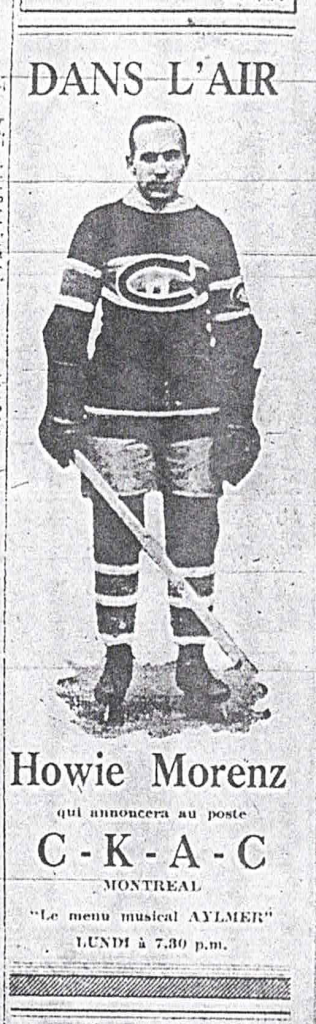
Late in the season, Morenz would be recruited to host “Le menu musicale AYLMER†on Radio station CKAC. The Aylmer Canning and Evaporating Company was formed in 1881, and over the course of the next decades became the well-known canner of vegetables and various soups. This advertisement is from La presse, 14 mars1931, p.50
The idea of music infused Howie Morenz’s game. It was exposed in how he played, and how he made the audiences at his games feel.
Morenz’s triumphs on the ice inspired his audiences, just as Quebecois poet Bernard Pozier recognized how Rocket Richard’s triumphs inspired Michel Normandin’s exclamation:
Les poetes chanteront ce but!
(Pozier, Bernard; Les poetes chanteront ce but, Ecrits des forges (Trois Rivieres, Quebec: 1991, 2004), at p.44
Normandin’s broadcasting career began in 1935. For a dozen years he was the broadcast voice of the Canadiens. He died on November 12, 1963
At the Ottawa game on December 11, 1930,  Morenz’s performance had entranced the reporters for both the English and French press in similar fashion:
It was thought a couple of seasons back that Morenz was at his peak, but he wasn’t. Never before has the Canadien flyer shown the form he displayed here last night. When going at top speed he made first class hockey players look ordinary . . . (Ottawa Citizen, December 12, 1930, p.13, c.5)
Howie Morenz, le heros de tant de memorables rencontres, l’incomparable centre du Canadien, a encore ete l’etoile de la partie d’hier soir et sa performance toute admirable ne sera pas oublie de sitot. (La presse, 12 decembre 1930, p.12, c.1)
Encore une fois le grand, celebre et unique Howie Morenz – le “Flash†de Stratford, l’elegant patineur, le heros d’aventures mutiples sur la glace, a sauve la situation au moment le plus critique de la joute de jeudi soir a l’Auditorium, comptant après trois minutes de la séance supplementaire le point qui assurait au Canadien une victoire de 5 a 4 sur l’Ottawa. (Le Droit, 12 decembre 1930, p.9, c.1 – 2)
Ceux qui furent temoins de l’exploit ne l’oublieront certes pas de sitot. On entend souvent parler des faits et gestes etonnants de Morenz, mais notre population n’avait jamais eu l’occasion d’en etre temoin de maniere a pouvoir se convaincre elle-meme de ses propres yeux, du merite de l’aeropatineur. (Le Droit, 12 decembre 1930, p.9, c.1 – 2)
There were differing views about Howie Morenz’s ability to translate his love of music to his efforts to produce music from his ukelele or his voice. Dean Robinson says that he “mastered†the ukelele (Robinson, Dean; Howie Morenz: Hockey’s First Superstar, The Boston Mills Press (Erin, Ontario:1982), at p.18). Others were less charitable (Beddoes, Fischler, and Gitler; Hockey: The Story of the World’s Fastest Sport, MacMillan Publishing Co. Inc. (New York: 1973), at p.179). Many were in-between, evaluating Howie’s skill with the ukelele as on par with Eddie Shore’s efforts to coax music from his tenor saxophone (Fischler, Stan; Those were the Days, Dodd, Mead & Company (New York:1976), at pp.55 – 56).
There is a different perspective to take in relation to Howie Morenz’s musical sense. That can be drawn from Dave Bidini’s observations about the relationship between understanding how to play music and understanding how to play hockey. The most apt reference which explains this idea that I have found in Bidini’s work comes from his book, The Tropic of Hockey.
In the kind of ineffable moment of dominant performance that Morenz experienced that night in Ottawa, the hockey player may not remember the specifics of each move and adjustment of the play. Instead he only recognizes that he has become inseparable from the pattern or organization of what is happening physically in the moment:
. . . as if seeming it from a distance. It’s no wonder; my mind seemed to levitate above my body, as if it were a boat riding the crest of a wave. To the person in the stands, the high pitch of the game, the din of voices rising to meet the climax of the moment, may have dominated the scene, but on the ice I felt like an action-film hero who hears only the sound of blood pounding in his ears. Solitude. A chi of energy and light. I was also alone before the goaltender, a four-inch hole peeking through his battered armour as it if were an eye winking at me. I had skated into a place so calm that I’d lost myself, propelled by physical music. (Bidini, Dave; Tropic of Hockey, McClelland & Stewart (Toronto:2000), at pp.86 – 87)
Once more, the floating image from Don Gutteridge’s Bus Ride (Tablo Publishing (2019), at pp.18 – 19, and 143) return to the mind.
The Quarter-pole of the Regular Season
The Canadiens had finished the first quarter of their regular season with an exclamation. They were the best team in the league, averaging more than 3 goals a game while allowing less than two and a half. They had the most wins, but Chicago was the best team defensively.
Canadian Section
P W L D GF GA Pts
Canadiens                11       8         3         0         36      26      16
Toronto                     10       5         3         2         21       11     12
Maroons                    10       5         5         0         17        22     10
Americans                12       3         5         4         14       17     10
Ottawa                      12       4         7         1         19       25      9
American Section
P W L D GF GA Pts
Chicago                     10       7         2         1         24       11       15
Boston                       11       6         4         1         25       21       13
Detroit                       10       4         4         2         20       18       10
Rangers                     11       4         5         2         26       27      10
Philadelphia             11       1         9         1         16       39       3
The League’s statistics as of the next Tuesday (December 16, 1930) listed Howie Morenz as the League’s top scorer. Morenz had been credited with participating in a full third of the Canadiens’ goals.
Take another moment to also consider his penalty minute totals to go along with those scoring points. Those penalty totals were proof that both Morenz and Joliat had been playing with a lot of attitude in responding to the efforts of opposing teams to way lay them.
The top 5 scorers in the Canadian Section were as follows:
                                   G        A       Pts      PiM
Morenz, Canadiens 12 3 15 27
Joliat, Canadiens       5       5         10       28
Bailey, Toronto          5       4         9        18
Conacher, Toronto    7       1         8        24
Jackson, Toronto 2 6 8 22
The top 5 in the American Section were as follows:
G A Pts PiM
F.Cook, Rangers 5 7 12 18
Goodfellow, Detroit 6 5 11 18
W.Cook, Rangers      8         1          9        8
Boucher, Rangers     5         4          9        2
Oliver, Boston           5         4          9        6
The Detroit Falcons, just a little better than the Rangers, were pleasantly surprised by the production of Ebbie Goodfellow. The Falcon centreman was right on the heels of the Rangers’ Bun Cook, and just 4 points behind Morenz. What was ominous for the Rangers was that 19 of their 26 goals all came from one line.