
The Mitchell Meteor Playing in Foreign Territory: Toronto’s Arena Gardens
For some time I wondered about Howie Morenz’s relationship with the city of Toronto. Toronto was the closest NHL city to his hometown. The St Pats had supposedly been interested in him in 1923. It had seemed like the natural place for him to play. He was always recognized in the Queen City as a quality player, as a dangerous and formidable opponent.
Was his relationship with Toronto difficult because he was thought to have spurned that early, half-season offer from the St Pat’s in the spring of 1923? Or did the city resent the fact that he hadn’t held out for a Toronto offer when the Canadiens had arrived on his father’s doorstep? That might have been how Toronto hockey fans felt.
I’ve come to think that it was the experience of playing in Toronto as a member of the Canadiens that changed him. For the Canadiens in the Morenz years, traveling west from Montreal to Toronto was as much like traveling to a foreign country as crossing the border to the States, perhaps moreso.
Marty Burke’s family ran a butcher business in the city. George Hainsworth and Bert McCaffrey had grown up in southwestern Ontario as well. But each time these four men returned to play hockey in Toronto, the fans at the Arena insistently treated them as less than opponents – as if they were defectors.
The Toronto Daily Star columnist Charlie Querrie, once the owner of Toronto’s own Arenas, and St Pat’s, hockey teams, promoted the Saturday night game at the Gardens between the Canadiens and the Leafs by disparaging the first place, Cup champion Canadiens (The Toronto Daily Star, January 2, 1931, p.11, c.4 – 5):
. . . outside of the more than wonderful Morenz and the little Joliat the Canadiens have nothing of a startling nature. . .
Small words for the defending Stanley Cup Champions. And that grudging acknowledgment of Morenz’s play through the first half of the League’s schedule was followed quickly by Querrie’s snide remark that the Canadiens’ management were “here and there men, none of them hockey experts . . . ” – insinuating that the Canadiens’ 1930 Cup triumph and their early season run to first place had been undeserved.
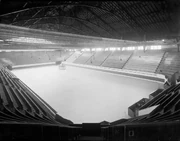
The Arena Gardens, sometimes referred to as the Victoria Arena Gardens, stood on Mutual Street, in the block between Dundas and Shuter. There had been a previous arena on the site known as the Caledonian Rink. Reputed to have been the largest building of its type when the Arena Gardens was built in 1912, it only became known as the Mutual Street Arena after Conn Smythe moved his hockey team into Maple Leaf Gardens in November, 1931: Young, Scott, 100 Years of Dropping the Puck: A History of the OHA, McClelland & Stewart Inc. (Toronto:1989), at p.55
In Hockey Night in Canada: The Maple Leafs’ Story, (The Ryerson Press (Toronto:1956), at p.59) Foster Hewitt described the Arena as having been the first artificial ice rink in Ontario.
Inside, the Arena had an official capacity of about 8,000, with reserved seating boxes, room for standees accommodated primarily in tiers at the north end, and a tolerance for squeezing more and more fans, closer and closer together, in bleacher seats. Chicken wire was used to keep the people in standing room from moving down into the seats. There was no heat. When the Arena opened in 1912, the lack of a local team meant that the opening hockey match featured an exhibition between Montreal’s Canadiens and Wanderers.
But enough about the Arena. What about those fans? As the paying customers pushed themselves in, the building inevitably took on an infested, claustrophobic feel. Young Toronto novelist Morley Callaghan, the same age as Morenz, observed how the clamour and commotion of a professional hockey crowd at the Arena in the mid 1920s would send “the skin on his back tingling.”: Callaghan, Morley; Strange Fugitive, Charles Scribner’s Sons (New York:1928), p.163. By squeezing all of the fan fervour into that limited space, the architecture magnified the support that local teams could feel, and the suffocation that could oppress visitors.
The bricks and mortar of the Arena also breathed the stale air of the city’s self-esteem about its civic hockey heritage. By January 1931, the Arena possessed a hockey tradition that was more venerated and hallowed than that of the NHL itself. The building had hosted city, regional, Allan Cup, and Memorial Cup competitions. Howie Morenz had first played here in March 1920 during an OHA semi-final as a midget, before his Memorial Cup appearances. George Hainsworth, Marty Burke, Bert McCaffrey, Charlie Conacher, Harvey Jackson, Joe Primeau, Hap Day, and Ace Bailey had all played here as well – as boys and young men – before turning professional. The building had been the home of Stanley Cup teams, and served as an Olympic team training facility for Canada’s women’s track team: Hotchkiss, Ron; The Matchless Six: The Story of Canada’s First Women’s Olympic Team, Tundra Books (Toronto:2006), at pp.44 – 45
Just by shoving themselves through the doors, local fans could gain a share of that communal vanity, the home ice narcissism, about the worth of their local hockey. Tonight Leo Dandurand was sitting and talking hockey with former fellow owner Charlie Querrie as the referees skated out on to the ice to begin play. Young Foster Hewitt was also there – having established himself by the boards of the Arena since his first hockey radio play by play broadcast there in 1923, but now broadcasting from the rafters: Hewitt, Foster; Foster Hewitt: His Own Story, The Ryerson Press (Toronto:1967), at p.35. Harold Ballard, future owner of the Leafs, took his first steps in hockey management here. Conn Smythe was there too, looking around and seeing that the only room left to move in the building was on the ice surface itself. He was already scheming about how to squeeze more money from program sales, and already considering his options for a new place for the Leafs to play.
That aura created by the “house” populating the audience space at the Arena was palpable, and always virulent. Morenz understood that a Toronto game in a full Arena could be controlled as much by the fans as the referees or even the players. The fans and their noise were involved in every moment of the play, and at every stoppage. This was the arena where a fan used to wind up a siren for Reg Noble whenever, as a St Pat, he stole the puck from an opponent.
While the Noble siren seemed acceptably atmospheric, the unravelling of fan behaviour could also be terrifying. This was Toronto’s main home advantage. Fans arrived full to the brim with a desire to create the right outcome, even in a professional game. It was challenging for the players, who had to negotiate a game in three full dimensions: both up and down the ice, as well as what was descending from above and on each side. Howie Morenz knew that sometimes those fans would overflow.
As Howie Morenz had anticipated, the proximity of the Arena’s capacity crowd to the players on the ice had condensed the fans’ antipathy to a more threatening level of intensity. Everything overflowed when Nick Wasnie chased a puck lobbed high towards the Toronto goal, and slapped at the puck as Lorne Chabot attempted to corral it in his arms like an outfielder as he dropped to his knees. The Globe, Toronto, January 5, 1931, p.8, c.1, explained what happened next:
It looked as if Wasnie had hit Chabot across the head with his stick. Charlie Conacher was close behind and he sailed into Wasnie, the two landing in the corner locked in each others arms. A melee threatened, . . . .
When play resumed, the level of violence elevated. Marty Burke upended Andy Blair, Conacher returned to the ice to chase down Pit Lepine and tumbled him to the ice. Red Horner hit Sylvio Mantha, causing Mantha to slam against the ice. Lou Marsh described Mantha’s arrival on the ice as “like a manhole cover dropped off a roof”: The Toronto Daily Star, January 5, 1931, p.8, c.1. Referee Odie Cleghorn called it a trip, but Toronto partisans thought that it had been a fair check, an attitude Horner fed by arguing the call.
The crowd’s animosity against the Canadiens overflowed at that point, suddenly defiant and howling and unruly:
. . . la foule se montra malveillante et un chaud partisan lanca meme une chaise sur la glace qui alla frapper Cleghorn: Le petit journal, 4 janvier 1031, p.19, c.2, mais passa a deux pouces de la tete de Cleghorn
. . . a fanette, equally – and as hysterically – enthusiastic about Cleghorn’s artistry with the bell and thumb, tore the oyster berries off her neck and presented them to Mr Cleghorn – also without leaving her seat: The Toronto Daily Star, January 5, 1931, p.8, c.1
The Montreal Daily Star, January 5, 1931, p.21, c.1, described the main event:
An exuberant spectator incensed when Odie Cleghorn gave Horner a penalty for tripping S. Mantha, sent a chair hurtling on the ice from a box seat. It sailed out over the heads of spectators and Canadien players, and hit the ice in the vicinity of Harvey Jackson who gave it a further push and Odie Cleghorn just missed being struck.
The Toronto Daily Star, January 5, 1931, p.8, c.1 saw it the same way:
The chair landed right beside Pete Lepine, and the Canadien centre ice man leaped as if he had been shot. It slithered over to Harvey Jackson and Busher did not delay it.
In fact, he helped it on its way. It crashed into Cleghorn’s heels and almost spilled him, much to the crowd’s great joy.
The Globe, Toronto, January 5, 1931, p.8, c.1 minimized the incident by reporting that the fan simply “slid a chair out onto the ice.”
The police may have again become involved. The Globe, Toronto, January 5, 1931, p.8, c.1 reported that the chair thrower was ejected from the Arena by the police. That was contradicted by all other media outlets: e.g., The Toronto Daily Star, January 5, 1931, p.8, c.1; The Montreal Daily Star, January 5, 1931, p.21, c.1. Odie Cleghorn disposed of the pieces of the shattered chair, and play resumed.
The Arena’s tolerance for this kind of fan misbehaviour spilling out onto the ice had existed for years, and had become a permission of sorts – except when the Leafs were the targets. When the same thing happened in Detroit, Conn Smythe himself waded into the stands to fight with the chair heaver: Fischler, Stan; The Rivalry: Canadiens vs. Leafs, McGraw-Hill Ryerson Limited (Toronto:1971), at p.89
Although it was reported that the chair heaver had been escorted out of the Arena by the second intermission, he was observed back inside the Arena enjoying the third period of play. And when the Canadiens were finally ready to leave the Arena, the chair-thrower stood by the door, ready to wish all of the Canadiens a good evening – cocky with the impunity of Leaf success.
None of the Toronto papers identified the chair-heaver by name, including Lou Marsh and W. A. Hewitt: The Globe, Toronto, January 5, 1931, p.8, c.1; The Toronto Daily Star, January 5, 1931, p.8, c.4; The Toronto Daily Star, January 5, 1931, p.8, c.7 – 8. Nor did the Montreal Herald, January 5, 1931, p.8, c.6, quoting the Toronto Mail and Empire. Lou Marsh certainly knew who he was, but ultimately the only newspaper to publicly report his identity was The Montreal Daily Star, in its January 5, 1931, edition at p.21, c.1 and 2, as Jerry Sullivan, “a prominent broker, contractor, and big shot” who was temporarily escorted to the Arena office.