The Morenz Homes in Montreal
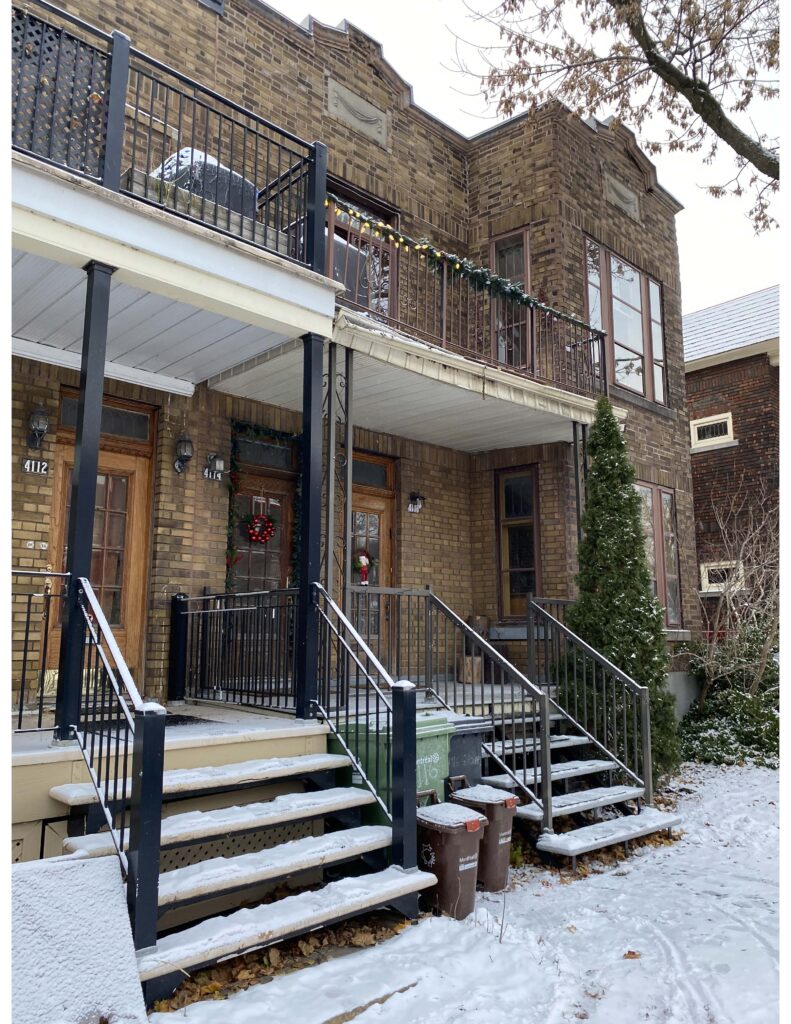
The Morenz home at 4114 Girouard Avenue in Montreal’s Notre Dame de Grace (NDG) neighbourhood (Lovell’s Montreal Directory, 1930) was the grandest and most stable of the homes he provided for his family in the city. Despite his fame, and his income, the Morenz family never made it to Westmount.
They left Girouard in 1932, moving north to 4420 Coolbrook in the city’s Snowdon area. It was a block closer to the northwest corner of Westmount, but still west of Decarie. They were in Snowdon until 1934, when he and Mary decided to move back to The Plateau, renting then at 5423 Jeanne Mance.
The moves continued in 1935, after he had already begun playing with Chicago. The family went to 2676 Soissons Avenue in Outremont for a couple of years, putting the whole mountain between them and Westmount. The family was still on Soissons when he came back from New York to play for the Canadiens in the fall of 1936 (The Gazette, March 9, 1937, p.1, c.1), making him a next door neighbour to fellow NHLer Marty Barry (The Stratford Beacon-Herald, March 13, 1937, p.10, c.3). After he died, Mary moved back to an apartment in The Plateau, at 5283 Park Avenue.
When Morenz played for the Canadiens, it was important that he had a year round place in the city. It was also important where he chose to live. Even at the height of his career he chose to live in the more egalitarian, cosmopolitan and accessible neighbourhoods like NDG and The Plateau, where at the time most of the other residents were also renters, like him. The neighbourhood has always been a neighbourhood of those in transition: https://en.wikipedia.org/wiki/Le_Plateau-Mont-Royal
Howie Morenz understood that those neighbours were his most faithful fans. They also came from places like Congregation Street in Point St Charles to the west, where a little English pup named Lorne Worsley was 18 months old in 1930 and invisible in the railway workers’ district below Westmount (Worsley, Lorne “Gump,†with Moriarty, Tim; They Call Me Gump, Dodd, Mead & Company, New York (New York:1975), at p.2). His fans also lived in the Bordeaux area to the east, on avenuses such as rue Boulogne, where Maurice Richard was already 9 years old, not yet known as a hockey player, and too poor to afford the 50 cents that would have given him entry into the Forum for a Canadiens game (Carrier, Roch (translated Fischman, Sheila); Our Life with the Rocket: The Maurice Richard Story, Penguin Canada (Toronto:2001), at pp.35 – 36).
Howie Morenz was never entirely settled domestically in Montreal, with his changing marital status, changing family status, and the financial and geographic roller-coaster of his professional career. While there may have been an initial aspiration for the space and parks and social cachet of a Westmount address, he was ultimately not a Westmount kind of person, nor a Westmount kind of player. Even if he could have afforded it.
He chose to live in the types of neighbourhoods that were much closer to the scale of his own life. He was a professional hockey player, but he had also been a machinist apprentice working in the railway shops in Stratford. Neighbourhoods of waged, working people were also where his own teammates, like the Mantha brothers, had grown up, and still lived. He lived among those who recognized that hockey was important.